Table of Contents
There is a particular kind of confession that keeps showing up in writing subreddits lately, and it always starts with an apology. This week on r/writingadvice someone admitted they had leaned on AI so hard for the past few years — stories, schoolwork, papers — that their own writing had gone flat. They used to love writing atmospheric, emotional prose with little poetic moments. Now, sitting down to write without the tool, everything came out “dry, overly simple, and at a fifth-grade level.” Functional, but with no life in it. And the question underneath the post was the one a lot of people are quietly asking: how do I actually get that back?
⚡ TL;DR – Key Takeaways
- •The dryness is atrophy, not damage. Reddit’s most upvoted framing: your voice is a muscle that went slack, not a skill you permanently lost — and it comes back faster than you expect.
- •Copywork is the exercise almost everyone in the thread landed on: literally hand-copy a paragraph you love, word for word, so you feel the choices a writer made that are invisible at reading speed.
- •Do daily observation reps — four or five sentences describing one real thing, no plot, no pressure. The fix for “forced” description is rejecting your first three images and keeping the fourth.
- •Write badly on purpose. The output has to exist before it can be good, and imperfection is the thing a machine can’t counterfeit for you.
- •The long game isn’t abandoning AI — it’s flipping how you use it: stop asking it to generate and start asking it to interrogate what you already wrote.
The Confession Behind the Thread
What makes the original post land is how specific the loss is. This isn’t a beginner asking how to start. It’s someone who already knew what good felt like, watched it slip, and can name exactly what went missing: the figurative language, the sentence rhythm, the ability to find a description that isn’t the first generic one that comes to mind. They even pre-empted the useless replies — please don’t just say “read more” or “just write.”
r/writingadvice
How do I relearn creative writing after relying on AI too much?
“I used to love creative writing — atmospheric, emotional, beautiful descriptions, little poetic moments. Now when I try to write on my own, everything feels dry, overly simple, fifth-grade level. It’s functional, but it has no life. I want to rebuild those skills without using AI. Does anyone have advice on how to actually practice this?”
View on Reddit →The thread filled up fast, and what surprised me is how little of the advice was vague. Almost nobody said “read more” and left it there. The good answers all pointed at concrete, slightly boring reps — the writing equivalent of scales. I answered the thread myself (founder disclosure up front: I build Automateed, an AI ebook creator, so I spend my whole week around the exact tension of AI helping versus AI hollowing out the writer), and here is the long version of what I told them.
Automateed founder · r/writingadvice
“The dryness isn’t your real voice, it’s an atrophied muscle. It comes back faster than you’d expect if you stop reaching for the tool that did the reaching for you. Two exercises rebuild the noticing muscle. Copywork: pick a paragraph from a writer whose prose you love and type it out by hand, slowly — you start feeling why they broke the sentence there, why that verb and not a plainer one. Observation reps: once a day, write four or five sentences describing one real thing in front of you with no plot and no pressure. ‘Forced’ descriptions come from grabbing the first image; the fix is to reject your first three and keep the fourth. And don’t just read a lot — reread the same short thing and ask what it’s doing.”
View on Reddit →What Reddit Actually Told Them to Do
Pull the useful advice out of the thread and it collapses into four exercises, roughly in the order people reached for them. None of them is “buy a course.” All of them are things you can start tonight with a pen and one book.
1. Copywork — hand-copy a paragraph, word for word
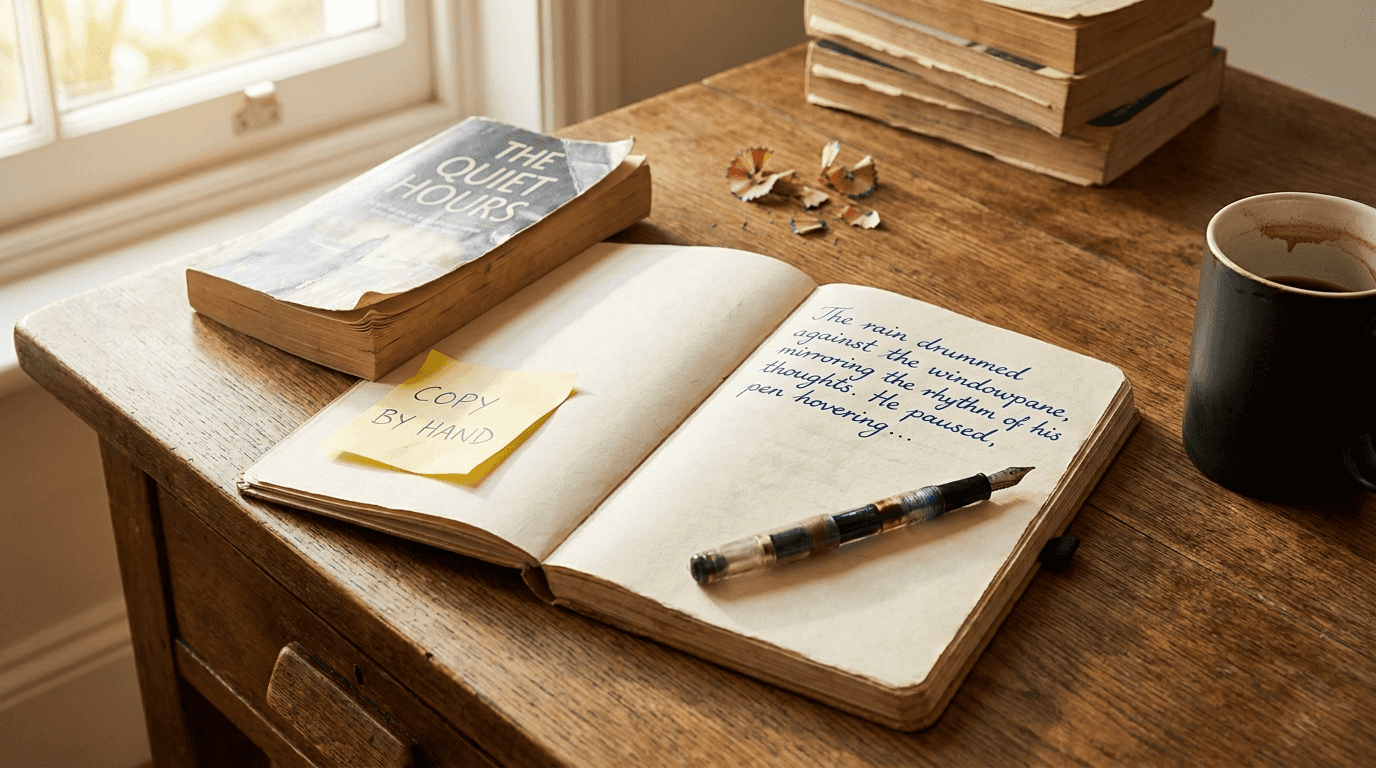
This was the runaway favorite. Multiple writers, independently, landed on the same exercise: take a passage from a writer you admire and physically copy it out, ideally by hand, definitely not paraphrased. One commenter put it well — do it by hand so you “pay attention to how it’s done,” even grabbing highlighters to mark where the writer switches POV or shifts style. What’s striking is how many people admitted they’d misread this advice for years. As one writer confessed, they’d always taken “copy it” metaphorically and never realized you were supposed to transcribe the actual sentences.
The reason it works is mechanical. When you read, your eye skims. When your hand has to form every word, you feel the decisions: the short punchy sentence dropped right after a long winding one, “clenched” chosen over “closed,” a paragraph that ends on an image instead of explaining it. That texture is invisible at reading speed and obvious at copying speed. An English teacher in the thread described the progression she uses with students: copy first, then find the essence and style, then write your own thing in that mode. Copywork is scales; the composition comes after. If you want a runway of structured prompts to graduate into, our roundup of creative writing exercises pairs naturally with a copywork habit.
2. Observation reps — describe one real thing a day
The second exercise targets the specific thing the OP mourned: descriptions that feel dry and generic. The fix people kept describing is a daily observation rep — four or five sentences about one real thing in front of you. The light in a room. A stranger’s hands. No plot, no stakes, no pressure for it to be beautiful. The whole point is to force your eye to slow down and reach past the first, laziest image.
Here’s the mechanic that makes it click: a “forced” description almost always comes from grabbing image number one. The exercise is to reject your first three descriptions and keep the fourth. “A tired woman” is nothing. “A woman who keeps checking her phone but never opens it” is a whole character. Specificity is where atmosphere actually lives, and it’s the first muscle AI lets go slack, because a model will happily hand you the generic version forever.
3. Reread the same short thing and ask what it’s doing
“Read more” was the advice the OP explicitly dreaded, and the thread quietly fixed it. The upgrade isn’t reading more, it’s reading the same short piece again and interrogating it. Find a good book — not necessarily your favorite, just one you genuinely like — and pull it apart. Understand the choices. What did the author care about most in this passage? What did you miss the first time, and why? A short story you can reread five times in a week teaches more than five novels you skim once.
4. Write badly, on purpose, every day
The gentlest and maybe most important note in the thread: your writing muscle needs walks, not marathons. Write even if it sucks. It doesn’t need to be good, it needs to exist — you can delete it later. One commenter framed imperfection as the entire point: being flawed is the thing a machine can’t do for you, and it’s exactly how you develop a style that sounds like you. Another writer relearning after a long AI-heavy stretch swore by journaling — ugly, unedited, thoughts straight onto the page — plus a deliberate daily detox from screens so the brain has room to think for itself again.
The Deeper Reframe: Stop Generating, Start Interrogating
The exercises above rebuild the craft. But there’s a second thread on r/WritingWithAI that nails why the skill atrophied in the first place, and it’s worth sitting with. A writer described going through a phase where AI actively made them worse for three months before it made them better.
r/WritingWithAI
AI made me a worse writer for 3 months before it made me a better one
“Months one to three it was generating scenes, hitting word counts, feeling productive — then reading it back and cringing. Everything sounded the same and the voice I’d spent years developing was gone. By month four I stopped generating and started asking questions about what I’d already written: why isn’t this scene working, what does this character actually want. The writing got harder but the output got 10x better, and the voice came back. The tool didn’t change. How I used it did.”
View on Reddit →The whole comment section converged on one line: it got better the moment they treated AI like an editor instead of an author. “WritingWithAI” — somewhere in the workflow but not in the output — beats “WritingByAI” every time. That distinction is the crux of the relearning problem. Generation outsources the exact muscles the OP wants back: deciding what happens, finding the words, sitting in the discomfort of a blank line. Interrogation does the opposite — it makes you defend your choices, which sharpens them. If you’ve felt the model-quality slide people keep complaining about, our piece on what to do when ChatGPT’s writing got worse covers the same “it’s the workflow, not the model” lesson from a different angle.
A 4-Week Plan to Get Your Voice Back
Here’s how I’d sequence all of this if I were starting from the OP’s exact spot — skills hazy, motivation intact, wanting a concrete routine rather than a vibe.
- Week 1 — Pure input, zero output pressure. Copywork, ten minutes a day, by hand. Pick one writer whose prose you love and transcribe a paragraph. Don’t analyze hard yet; just notice whatever surprises you. A commenter suggested the opening of Bleak House as a copywork target — anything dense and deliberate works.
- Week 2 — Add the noticing rep. Keep copywork. Add one daily observation: five sentences about a real thing, first three images rejected. Start rereading one short story and jotting a single note on what each paragraph is doing.
- Week 3 — Ugly original drafts. Now you write. A fixed 15–20 minutes a day, no editing, no judging until you have a first draft of something. It will feel janky. That’s the muscle firing again, not evidence you’ve lost it.
- Week 4 — Reintroduce AI as an interrogator only. Write the scene yourself. Then ask the model to poke holes: where does this drag, what does this character want that I’m not showing, which sentence is doing the least work? Never let it hand you the replacement line. You fix it.
Notice the tool comes back last, and only in a role that can’t re-atrophy the muscle. That ordering is the whole trick. If you eventually want to turn the rebuilt habit into a finished manuscript, the same discipline scales — our guides on improving your writing skills and running a proper self-editing checklist are the natural next rungs once the daily reps stop feeling forced.
Where AI Still Fits (Without Eating Your Brain)
Full disclosure again: I run an AI writing company, so weigh this accordingly. But I’d be lying if I pretended the honest answer is “never touch it.” The OP’s problem wasn’t AI existing; it was AI doing the part of the job that was the job. Prose is a thinking activity, and if you outsource the thinking, the thinking gets weak. That’s not mystical — it’s the same reason GPS erodes your sense of direction.
So the rule I’d give anyone rebuilding: let AI touch everything around the sentences and nothing inside them. Brainstorming structure, pressure-testing a plot hole, checking continuity across a long project, formatting the final file — fine, that’s scaffolding. The actual choosing of words, the noticing, the voice — that stays yours, because it’s the only part readers can tell you didn’t outsource. It’s the same principle behind keeping a long book coherent: in our walkthrough on keeping an AI-generated book consistent, the fix is always the human holding the source of truth while the tool handles the mechanical labor. A good AI ebook generator should remove busywork, not the part where you actually write.
Mistakes That Keep You Stuck
- Waiting to feel “ready.” The voice returns through reps, not through reading one more article about reps. Copy a paragraph today.
- Reading passively. Volume without dissection just entertains you. Reread one short thing and ask what it’s doing.
- Judging first drafts. Deleting a bad sentence before it exists is how you write nothing. Let it be ugly, fix it later.
- Copying the style instead of the words. Paraphrasing a passage skips the entire benefit. Transcribe it literally, then diverge.
- Bringing AI back as a generator. The moment it writes lines for you again, the muscle goes slack again. Interrogator only.
FAQ
Does relying on AI actually make you a worse writer?
It atrophies specific skills rather than damaging them. When AI does the word-choosing and idea-finding, those muscles weaken from disuse — which is why prose comes out dry and generic when you go solo. The encouraging part, repeated all over the thread, is that it’s atrophy, not brain damage. The skill returns with deliberate practice, usually faster than people expect.
What is copywork and why does everyone recommend it?
Copywork is transcribing a passage you admire word for word, ideally by hand. It works because forming every word manually forces you to feel the author’s micro-decisions — sentence rhythm, verb choice, where a paragraph lands — that your eye skips at reading speed. It’s how many writers trained before it was ever called a hack.
How long does it take to rebuild your writing voice?
There’s no fixed timeline, but Reddit writers who’ve done it describe weeks, not years. A daily rhythm of copywork, one observation rep, and short ugly drafts tends to show life in your sentences within two to four weeks. The dryness lifts before the fluency fully returns, so early progress is a rhythm change more than a quality jump.
Should I quit AI completely to get better?
You don’t have to quit — you have to change its job. The failure mode is letting AI generate your prose. Rebuilding works when AI is used only to interrogate what you already wrote (“why isn’t this scene working?”) rather than to produce it. A short, clean break during the rebuild helps, but the durable answer is a permanent role change, not permanent abstinence.
What’s the single best exercise to start with tonight?
Copywork. Pick one paragraph from a writer you love, copy it out slowly by hand, and notice whatever surprises you. It requires no plan, no talent, and no tools beyond a pen, and it’s the exercise the most experienced people in the thread reached for first.