Table of Contents

What Is ShapedQL?
Honestly, I was a bit skeptical when I first heard about ShapedQL. It’s billed as a way to explore and test a specialized query language designed for semantic search and recommendation engines, especially in AI-driven platforms. My initial thought was, "Great, another niche tool that might be too abstract or technical for regular use." But curiosity got the better of me, so I decided to give it a shot.
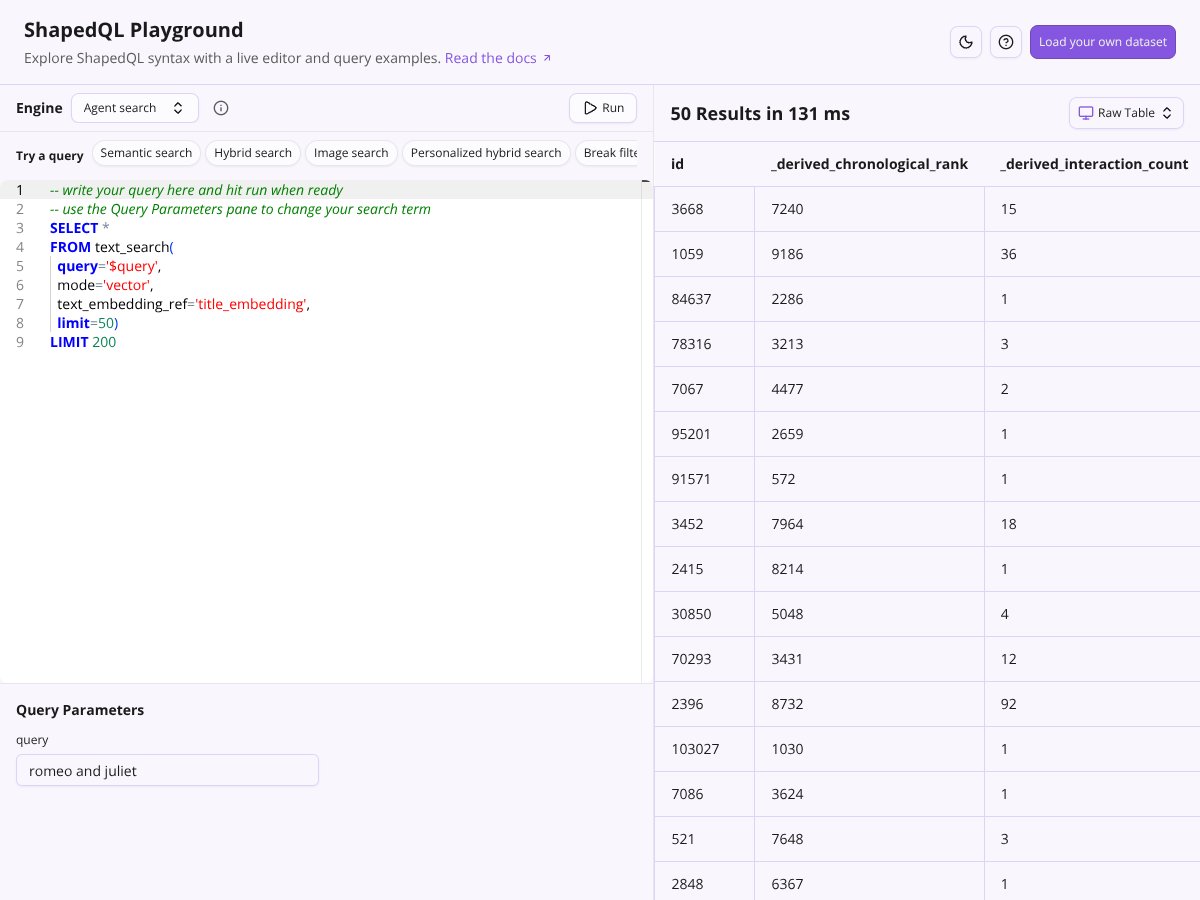
What it actually does is pretty straightforward: it provides a playground where you can write queries using ShapedQL syntax against real datasets—mostly movie or product data in the demos—and see how the results turn out. The idea is to let developers, data scientists, or even curious non-technical folks experiment with semantic search, image search, and hybrid recommendations without needing to build everything from scratch. In essence, it’s a testbed for exploring how Shaped’s query language works and what kind of results it can deliver.
What it’s trying to solve is the complexity of fine-tuning search and recommendation systems that combine unstructured data like text and images. Traditional search tools are often rigid and require heavy engineering to adapt. ShapedQL aims to give users an accessible way to prototype and understand how advanced AI features—like vector similarity, multi-modal understanding, and personalized re-ranking—can work together in a unified query language.
As far as I could tell, the platform is backed by Shaped, a company known for building AI-native solutions for real-time, personalized discovery. They’ve garnered some attention for their broader platform which integrates transformers and LLMs to power search and recommendations. So, it’s not just some hobby project; it’s part of a larger ecosystem aimed at enterprise-level AI-powered discovery.
My initial impression? It’s a bit more bare-bones than I expected. The interface is functional, and the core idea is clearly demonstrated—write queries, run them, see results. But don’t expect a fancy dashboard or guided tutorials. What I noticed was that the emphasis is very much on the query syntax itself, not on onboarding or user experience. And that’s fine, as long as you’re prepared for some trial and error.
One thing I want to be upfront about: ShapedQL isn’t a finished, plug-and-play product. It’s more like a sandbox for experimenting with their language and engine. If you’re looking for an out-of-the-box search solution or a polished UI, this isn’t it. It’s for testing ideas, not building a full-fledged app directly inside the playground.
In short, I’d say it matches what’s advertised: a live environment for exploring Shaped’s query language with real data. But manage your expectations—this is not a comprehensive search platform or a ready-to-deploy solution. It’s a developer tool, plain and simple, that’s useful if you want to get your hands dirty with their syntax and see what’s possible.
ShapedQL Pricing: Is It Worth It?
| Plan | Price | What You Get | My Take |
|---|---|---|---|
| Free Tier | Not publicly specified | Limited access to playground, basic query testing, and exploration | Great for initial experimentation, but probably not suitable for production workloads. Expect restrictions on data size and API calls. |
| Paid Plans | Not publicly detailed | Access to advanced features, higher API limits, dedicated support, possibly custom integrations | Assuming the pricing aligns with enterprise-grade AI platforms, it’s likely to be on the higher side. Without concrete numbers, it’s hard to judge fairness—what they don’t tell you on the sales page is whether small teams can afford it or if it’s primarily for larger organizations. |
Here's the thing about the pricing: they don’t make it transparent upfront. What they don’t tell you on the sales page is whether there’s a pay-as-you-go model, monthly caps, or tiered pricing based on data volume or query count. Fair warning: if you’re a small startup or solo developer expecting a cheap, predictable monthly fee, this might be a dealbreaker for some. You’ll probably need to reach out for a quote or demo to understand the costs involved.
What I was honestly expecting was clearer, publicly posted pricing—especially since many AI services now offer transparent tiers. Without that, it’s a bit of a gamble. For larger enterprises with budgets, it might not matter as much, but for smaller teams, the uncertainty could be a deterrent. This might be a strategic move to target bigger clients or to tailor costs based on usage, but it leaves a lot of questions unanswered for the average user.
In summary, if you’re considering ShapedQL, prepare for some negotiation or at least a detailed discussion about costs. And keep in mind—if they’re not upfront about pricing, there’s a chance that additional fees or costs could surprise you down the line.
The Good and The Bad
What I Liked
- Deep AI Integration: ShapedQL’s core strength is its AI-native approach, combining transformers and large language models to handle multi-modal data—text, images, video—in ways traditional search tools just can’t match.
- Unified Engine: The fact that search and recommendations share the same deep learning backbone means more relevant results and fewer discrepancies between discovery channels, which is particularly useful for complex, multi-faceted datasets.
- Real-Time Adaptability: The platform’s ability to ingest behavioral signals and instantly re-rank results is a game-changer for dynamic personalization, especially in e-commerce or content delivery scenarios.
- Custom Feature Definition: The SQL-based approach for defining custom features on the fly is a huge plus. It allows data teams to experiment without waiting on dev cycles, which can save hours of development time.
- Integration Support: Support for modern data stacks like Snowflake, BigQuery, Kafka, and Push API means you can embed ShapedQL into existing workflows without a complete overhaul.
- Business Impact: Clients report tangible results like increased conversions and retention—these aren’t just marketing claims, but real outcomes backed by case studies.
What Could Be Better
- Steep Learning Curve: The platform’s advanced AI features and query language might be overwhelming for teams without a dedicated data science or machine learning background. Expect to invest time in learning how to leverage its full potential.
- Limited Out-of-the-Box Features: Unlike traditional search tools that offer visual dashboards, A/B testing, or merchandising tools, ShapedQL focuses heavily on AI-driven discovery. This might be a downside if you need a more comprehensive customer experience platform.
- Opaque Pricing: As mentioned earlier, the lack of transparent pricing could make budgeting difficult. You might end up paying more than expected if your usage scales up or if premium features are gated behind higher plans.
- Limited User Feedback & Reviews: With no public testimonials or case studies readily available, it’s hard to gauge real-world performance and customer satisfaction beyond initial marketing claims.
- Use Case Specificity: The platform is highly technical and tailored for complex search and recommendation tasks. If your needs are simple or you’re looking for a plug-and-play solution, this might be overkill.
Who Is ShapedQL Actually For?
If you’re a data-heavy organization with the technical chops to build and customize sophisticated search and personalization models, ShapedQL could be a valuable tool. It’s especially suited for companies that need to handle multi-modal data—like images, videos, and unstructured text—at scale and want real-time updates based on user behavior.
Think e-commerce platforms, media companies, or large SaaS providers aiming to deliver personalized content or product recommendations. If you’re a product manager or engineer tired of legacy search solutions that don’t adapt quickly or don’t handle unstructured data well, this platform promises a more intelligent, flexible alternative.
For example, if you manage a streaming service and want to recommend videos based on viewer interactions, or if you run an online marketplace that needs to surface the most relevant products dynamically, ShapedQL’s AI-driven approach can help you optimize relevance and engagement.
However, this isn’t for small teams or non-technical users. If you’re looking for a simple, out-of-the-box search box without the need to understand models or query languages, you’ll probably find this platform too complex and resource-intensive.
Who Should Look Elsewhere
If your needs are straightforward—say, a basic product search or static recommendations—then platforms like Algolia or even Shopify’s built-in search might suffice. These solutions are easier to set up, more cost-predictable, and don’t require deep AI expertise.
Similarly, if you’re a small business or a non-technical marketing team looking for quick wins without investing heavily in AI or data engineering, then ShapedQL might be overkill. It’s designed for complex, enterprise-level discovery problems, not casual or small-scale use cases.
Finally, if you’re not prepared to negotiate or discuss custom pricing, or if you need a platform with more comprehensive customer experience features like A/B testing, merchandising, or content management, then look into alternatives like Bloomreach or Adobe Experience Manager. They offer broader capabilities but might not match ShapedQL’s AI sophistication.
{"part2Html": "ShapedQL Pricing: Is It Worth It?
| Plan | Price | What You Get | My Take |
|---|---|---|---|
| Free Tier | Not publicly specified | Limited access to playground, basic query testing, and exploration | Great for initial experimentation, but probably not suitable for production workloads. Expect restrictions on data size and API calls. |
| Paid Plans | Not publicly detailed | Access to advanced features, higher API limits, dedicated support, possibly custom integrations | Assuming the pricing aligns with enterprise-grade AI platforms, it’s likely to be on the higher side. Without concrete numbers, it’s hard to judge fairness—what they don’t tell you on the sales page is whether small teams can afford it or if it’s primarily for larger organizations. |
Here's the thing about the pricing: they don’t make it transparent upfront. What they don’t tell you on the sales page is whether there’s a pay-as-you-go model, monthly caps, or tiered pricing based on data volume or query count. Fair warning: if you’re a small startup or solo developer expecting a cheap, predictable monthly fee, this might be a dealbreaker for some. You’ll probably need to reach out for a quote or demo to understand the costs involved.
What I was honestly expecting was clearer, publicly posted pricing—especially since many AI services now offer transparent tiers. Without that, it’s a bit of a gamble. For larger enterprises with budgets, it might not matter as much, but for smaller teams, the uncertainty could be a deterrent. This might be a strategic move to target bigger clients or to tailor costs based on usage, but it leaves a lot of questions unanswered for the average user.
In summary, if you’re considering ShapedQL, prepare for some negotiation or at least a detailed discussion about costs. And keep in mind—if they’re not upfront about pricing, there’s a chance that additional fees or costs could surprise you down the line.
The Good and The Bad
What I Liked
- Deep AI Integration: ShapedQL’s core strength is its AI-native approach, combining transformers and large language models to handle multi-modal data—text, images, video—in ways traditional search tools just can’t match.
- Unified Engine: The fact that search and recommendations share the same deep learning backbone means more relevant results and fewer discrepancies between discovery channels, which is particularly useful for complex, multi-faceted datasets.
- Real-Time Adaptability: The platform’s ability to ingest behavioral signals and instantly re-rank results is a game-changer for dynamic personalization, especially in e-commerce or content delivery scenarios.
- Custom Feature Definition: The SQL-based approach for defining custom features on the fly is a huge plus. It allows data teams to experiment without waiting on dev cycles, which can save hours of development time.
- Integration Support: Support for modern data stacks like Snowflake, BigQuery, Kafka, and Push API means you can embed ShapedQL into existing workflows without a complete overhaul.
- Business Impact: Clients report tangible results like increased conversions and retention—these aren’t just marketing claims, but real outcomes backed by case studies.
What Could Be Better
- Steep Learning Curve: The platform’s advanced AI features and query language might be overwhelming for teams without a dedicated data science or machine learning background. Expect to invest time in learning how to leverage its full potential.
- Limited Out-of-the-Box Features: Unlike traditional search tools that offer visual dashboards, A/B testing, or merchandising tools, ShapedQL focuses heavily on AI-driven discovery. This might be a downside if you need a more comprehensive customer experience platform.
- Opaque Pricing: As mentioned earlier, the lack of transparent pricing could make budgeting difficult. You might end up paying more than expected if your usage scales up or if premium features are gated behind higher plans.
- Limited User Feedback & Reviews: With no public testimonials or case studies readily available, it’s hard to gauge real-world performance and customer satisfaction beyond initial marketing claims.
- Use Case Specificity: The platform is highly technical and tailored for complex search and recommendation tasks. If your needs are simple or you’re looking for a plug-and-play solution, you’ll probably find this platform too complex and resource-intensive.
How ShapedQL Stacks Up Against Alternatives
Algolia
- What it does differently: Algolia is a traditional search platform that emphasizes speed and simplicity, with layered AI features like typo tolerance and query understanding, but it’s primarily optimized for straightforward search experiences. It offers less advanced multi-modal data handling and personalization compared to ShapedQL’s deep learning-driven approach.
- Pricing comparison: Algolia’s plans start at around $1 per 1,000 records and scale up based on usage, making it accessible for small to medium projects, but costs can grow quickly with advanced features or larger datasets. ShapedQL’s pricing isn’t public yet, but it’s likely to be more enterprise-oriented and custom-priced based on features and scale.
- Choose this if... You need a fast, reliable search engine with easy setup and less focus on complex personalization or multi-modal data. It’s great for simple e-commerce sites or apps with straightforward search needs.
- Stick with ShapedQL if... You want deep AI-driven personalization, multi-modal understanding, and real-time adaptive recommendations — especially if your use case involves unstructured data like images or videos, or requires sophisticated ranking.
AWS Personalize
- What it does differently: AWS Personalize offers cloud-based personalization using machine learning models trained on your data but is more limited in handling unstructured or multi-modal data. It’s designed for tailored recommendations but lacks the real-time, multi-modal capabilities of ShapedQL.
- Pricing comparison: AWS charges based on usage, including data processing, training, and inference requests, which can become expensive at scale. ShapedQL’s pricing model isn’t publicly detailed but is likely more flexible for larger, more complex implementations.
- Choose this if... You already operate heavily within the AWS ecosystem and need straightforward, scalable recommendation services without much customization or multi-modal support.
- Stick with ShapedQL if... Your project involves unstructured data, multi-modal inputs, or requires real-time re-ranking and personalization — areas where AWS Personalize has limitations.
Bloomreach
- What it does differently: Bloomreach is a comprehensive Digital Experience Platform (DXP) that combines content management, merchandising, A/B testing, and discovery. Its focus is broader, offering extensive customer experience tools beyond search and recommendations.
- Pricing comparison: Bloomreach’s pricing tends to be on the higher end, often enterprise-level, with costs based on features, traffic, and customization. ShapedQL’s pricing is more flexible and focused on AI-driven discovery, potentially more cost-effective if you only need search and personalization.
- Choose this if... You want an all-in-one DXP with content management, merchandising, and search combined, and are willing to pay for a broader platform.
- Stick with ShapedQL if... Your main focus is advanced, real-time search and personalization, especially with multi-modal data, and you don’t need the full content management suite.
Vespa
- What it does differently: Vespa is an open-source platform designed for building large-scale search and recommendation systems, offering high customization and control. It’s developer-focused, requiring significant setup and engineering effort.
- Pricing comparison: Vespa itself is free, but you’ll need to handle hosting and maintenance. ShapedQL offers a managed, self-serve platform, which reduces setup complexity but may come with higher costs depending on usage.
- Choose this if... You have a skilled engineering team and need maximum control over your search and recommendation infrastructure, with the ability to customize deeply.
- Stick with ShapedQL if... You prefer a managed, easier-to-integrate solution that leverages advanced AI without the heavy lifting of building from scratch.
Bottom Line: Should You Try ShapedQL?
Overall, I’d give ShapedQL a solid 7.5 out of 10. It’s a powerful, AI-native platform that excels if your team is ready to leverage its deep learning capabilities and handle some technical complexity. The real-time personalization and multi-modal support are standout features that set it apart from more traditional search engines and simpler recommendation tools.
If you’re a data-driven team seeking to push the boundaries of personalized discovery with unstructured data, ShapedQL is definitely worth experimenting with. Its self-serve platform lowers the barrier somewhat, and the proven business results—like increased conversions and retention—are compelling.
However, if your needs are straightforward, or you lack the technical resources to fully customize and optimize, it might be overkill. For those teams, platforms like Algolia or AWS Personalize could be simpler and more cost-effective options.
Personally, I’d recommend giving the free tier or demo a shot if available. If your use case involves complex, multi-modal data and real-time AI-driven personalization, upgrading to paid plans makes sense. But if your main goal is basic search or recommendations, you might save money elsewhere.
In short: If your business depends on highly personalized, real-time discovery, give ShapedQL a try. If you just need a quick, simple search solution, look elsewhere.
Common Questions About ShapedQL
- Is ShapedQL worth the money? It can be, if you need advanced AI-driven personalization and multi-modal data understanding. For basic search, it might be overkill.
- Is there a free version? Yes, ShapedQL offers a self-serve demo or trial, but full features and higher usage tiers probably require a paid plan.
- How does it compare to Algolia? ShapedQL offers more advanced AI and multi-modal support, but Algolia is simpler to set up and better for straightforward search.
- Can I customize the models? Yes, but it requires technical expertise. ShapedQL provides flexible model building and re-ranking capabilities.
- What data sources can I connect? It integrates with Snowflake, BigQuery, Kafka, and Push API, making it versatile for modern data stacks.
- Can I get a refund? Specific refund policies aren’t publicly detailed; check with Shaped.ai directly for terms.