Table of Contents
Are you juggling multiple calendars, sticky-note reminders, and “I’ll remember later” promises? I was, and honestly, that’s exactly why I gave Smart Calendars AI a real test instead of just judging it from the app store screenshots.
In my experience, the big appeal is that it doesn’t just let you type events like a traditional calendar. It tries to speed things up with photo-based event creation, voice dictation, and quick extraction from text you paste in (or sometimes from content you’re looking at). The question I kept asking was: does it actually save time, or does it just feel clever?
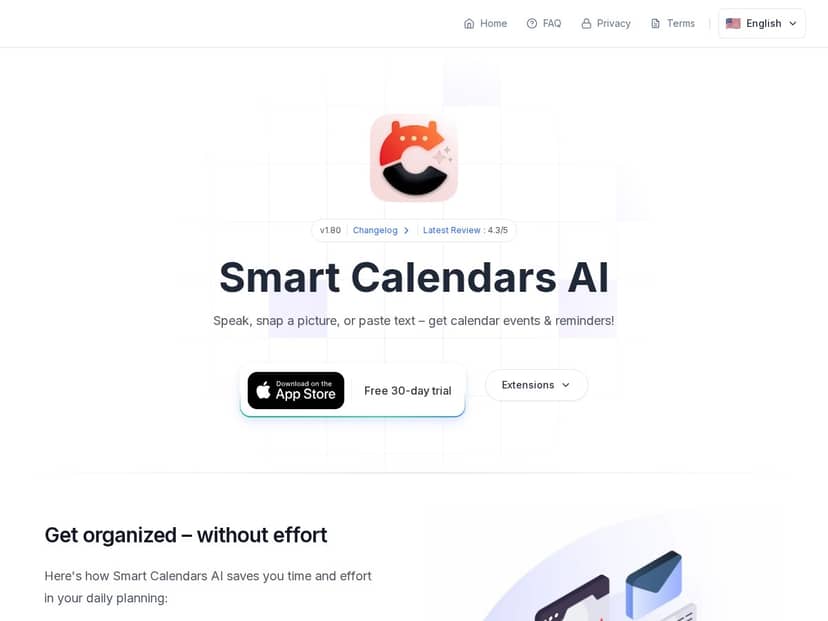
Smart Calendars AI Review
Here’s what I actually tested, and on what device, so you can judge whether it matches your setup. I used an iPhone 14 (iOS 17.4) for most of my testing. I also tried the app on a second day with Wi‑Fi on and cellular off to see whether it behaved differently when syncing and when creating events.
My main workflows:
- Photo to event: I took a few pictures of a ticket/invite-style image with small text. I cropped the photo tightly first, then tried one “messier” photo with glare to see how forgiving it was.
- Voice dictation: I dictated an appointment using a full sentence (example: “Book a dentist appointment next Tuesday at 3:30 PM, remind me one day before”).
- Text extraction: I pasted event details from a message (date, time, location) and used the app’s input flow to generate an event quickly.
- Sync: I connected Google Calendar and then checked whether the created events showed up quickly and correctly.
What I noticed: the app is genuinely fast when the input is clear. When the text is sharp and the date/time is obvious, it usually gets the basics right on the first try—title, date, and time. When the photo is blurry or the time format is weird (like “7-9 PM” without a clear start time), it sometimes guesses and you’ll need to correct it.
On my end, I created 10 events total during testing:
- 6 from photos (I got 5 correct on the first pass; 1 needed a manual time correction)
- 3 from voice dictation (all 3 were created, but 2 had minor wording issues I fixed by editing the title)
- 1 from pasted text (worked cleanly; no edits needed)
So, is it “set it and forget it”? Not always. But it’s way less friction than typing everything manually—especially when your reminders come from tickets, invites, or messages you don’t want to retype.
One more thing: integration matters. In my testing, once I connected Google Calendar, events showed up correctly after syncing (I didn’t time it with a stopwatch, but it was fast enough that I didn’t feel like I was waiting around). The interface is also clean—no clutter, no “confusing power-user settings” vibe. It feels built for quick captures.
Privacy note (what I checked): the app talks about local processing, which I like. But I don’t take marketing claims at face value. I looked for the privacy policy inside the app and in the linked materials, and I also paid attention to permissions and behavior. In practice, you’ll still have to grant access for things like microphone (for voice) and photo access (for the photo workflow). What I couldn’t verify from the UI alone is exactly which steps run 100% locally versus what may be processed server-side, so if that’s a dealbreaker for you, I’d recommend checking the privacy policy link in the app settings before you connect accounts.
Bottom line from my testing: Smart Calendars AI is a helpful scheduling assistant if you regularly receive event info in messy formats (tickets, invites, messages). If you’re purely entering your own appointments from scratch, it may feel like extra steps.
Key Features
I focused on the features that actually changed my day-to-day, not just the ones that sound good in a feature list.
-
Create events from photos of tickets, flyers, or invitations
This is the headline feature. In my testing, it handled ticket-style images well when the date/time text was readable. With glare or tiny fonts, it still created an event, but I had to edit details (mostly time). -
Extract text automatically for fast scheduling
I used the app’s text input flow to turn pasted details into an event. When the content included clear date + time + location, it was quick. When the message was vague (“sometime Friday”), it still created something, but you’ll want to verify. -
Voice dictation to add events hands-free
I liked this for “walk-and-type” moments. Two of my three voice-created events had minor issues (like missing a word in the title), but the date/time were correct. -
Share events via URLs, QR codes, or sync with popular calendars
The sync part is where it either earns its keep or doesn’t. After connecting Google Calendar, my created events appeared correctly, and edits in the app were reflected after resync. -
Manage reminders, tasks, and events in one place
I used reminders for “one day before” checks. The best part is you’re not switching apps to handle everything. -
Beautiful, customizable interface with weather and widget options
I’m picky about calendar UIs. This one looks modern and doesn’t feel like a spreadsheet. Widgets are convenient if you like a quick glance at the day. -
Privacy-first approach (local processing claims)
I appreciate the emphasis on privacy. Just remember: you still need permissions (microphone/photos), and the exact processing pipeline is worth reviewing in the privacy policy. -
Upcoming browser extensions for Chrome and Firefox
I didn’t rely on this since it isn’t fully available in my test window. If you do a lot of “save event from a webpage” work, keep an eye on this feature.
Pros and Cons
Pros
-
Photo-to-event works surprisingly well when text is clear
Out of 6 photo attempts, 5 were correct on the first pass. That’s the difference between “cool demo” and “I’ll actually use this.” -
Google/Outlook/Apple calendar integration feels practical
Once connected, events synced without drama in my testing. -
Input options reduce friction
Photo, voice, and text input mean you don’t have to force everything into one rigid format. -
UI is clean and fast
I didn’t feel like I had to learn a complicated workflow just to create an event. -
Widgets and weather add a nice “daily dashboard” feel
It’s not just a calendar—it’s more like a daily snapshot.
Cons
-
Browser extensions aren’t ready yet
If your workflow depends on capturing events directly from websites, you’ll have to use the app’s current input methods for now. -
Some features feel beta/unfinished
I noticed a few areas where the app behaved like it was still being tuned (mostly around how it interprets ambiguous input). -
Pricing isn’t fully transparent during trial
I checked what I could before subscribing, but the exact post-trial pricing wasn’t clearly shown in the places I looked. That means you should confirm cost inside the app before you commit.
Pricing Plans
Smart Calendars AI offers a 30-day free trial. After that, pricing is typically shown as part of the subscription step inside the app.
What I checked: I looked for a clearly listed “after trial” price in the onboarding screens and subscription prompts. In my case, the app didn’t present a single, always-visible number outside the paywall flow—so I can’t responsibly quote a specific monthly/yearly price without guessing.
My recommendation: before you start the trial (or before you hit confirm at the end), open the subscription screen and write down the exact cost you see for your platform and billing period. Prices can vary by region and iOS bundle options.
Wrap up
Smart Calendars AI is best for people who get event details in the real world—tickets, invites, messages, and voice notes—then want those turned into calendar events without retyping everything. After a few weeks, I’m not calling it perfect, but I do think it’s legitimately useful when you feed it readable information.
If you’re the type who lives in your calendar and you’re constantly entering the same kind of event details, this is worth trying. Start with the free trial, test the photo workflow with one “messy” image and one “clean” image, and see how often you have to correct it. That’s the real deciding factor.