Table of Contents
Low content books are books with little or no written text — journals, planners, notebooks, logbooks, coloring books, and puzzle books whose value comes from the pages a reader fills in, not the words an author writes. They're one of the simplest, lowest-cost ways to start self-publishing on Amazon Kindle Direct Publishing (KDP), which is exactly why so many people ask what a low content book is and how to make one. This guide covers the definition, the main types of low content books, how to create and design them, how to sell them on KDP in 2026, and what you can realistically earn.
⚡ TL;DR – Key Takeaways
- •A low content book contains minimal text — journals, planners, notebooks, logbooks, coloring and puzzle books. The buyer supplies the content by using it.
- •Low content books are cheap to create (no long manuscript) and sell through Amazon KDP print-on-demand, so you carry no inventory.
- •In 2026, niche specificity wins. A "weekly planner for shift nurses" beats a generic lined journal and commands a higher price.
- •A low content book priced at $6.99 nets you a few dollars per copy after print costs, so the model scales with catalog size.
- •Interior layout and cover quality are the difference between a low content book that sells and one that never gets found.
What Are Low Content Books?
Low content books are publications that contain minimal to no written content. Instead of chapters and paragraphs, a low content book offers blank or lined pages, prompts, grids, or images for the reader to complete. A traditional book delivers the author's words; a low content book delivers structure and space, and the reader supplies the rest.
That flips the usual value equation. The worth of a journal or planner isn't in what's printed — it's in how well the layout serves the person using it. A well-designed gratitude journal with the right prompts and a clean interior can outsell a generic notebook many times over, even though it took barely more effort to produce.
Low content vs. medium content books
There's a close cousin worth naming: the medium content book, which adds some repeated or instructional text — a few pages of how-to guidance in front of an activity workbook, for example. The line between low content and medium content is blurry, and Amazon KDP treats them similarly, so don't overthink the label. What matters is that both are low-effort to produce compared with writing a full-length book.
Types of Low Content Books
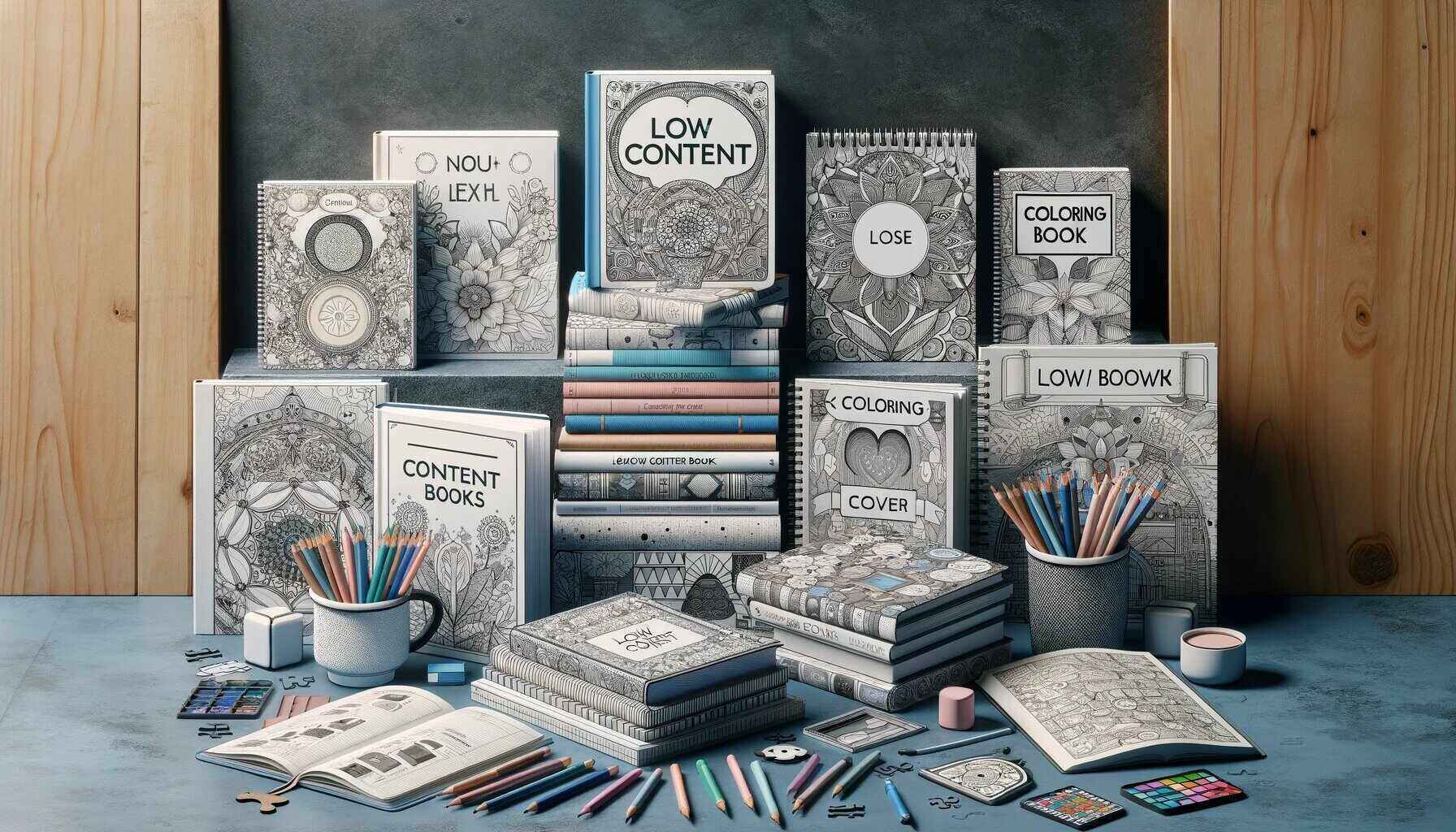
Low content books come in several forms, each serving a different hobby or need. From simple hardcover keepsakes to recipe books, the world of low content books is broad. Here are the most common and profitable types on the market:
Journals
Lined or blank pages for writing thoughts, reflections, or daily notes, often with prompts or quotes. Gratitude journals, prayer journals, mindfulness journals, and travel journals are perennial sellers, and there are dozens of other types of journals to serve. If you want ideas for structuring prompts, our guide to creative journaling techniques is a useful starting point.
Planners
Calendars, to-do lists, and scheduling spreads for organizing time. Niche planners — for teachers, real estate agents, fitness goals, or meal planning — sell far better than generic ones because they solve a specific person's specific problem.
Notebooks and logbooks
Simple ruled or dotted notebooks, plus specialized record-keepers: a beekeeping log, a mileage tracker, a sobriety tracker, a blood-pressure log. Memory books and sketchbooks fall in the same family. The narrower the use case, the less competition your low content book faces.
Coloring books
Designs and illustrations waiting to be colored, popular with both adults and children. Adult coloring took off as a stress-relief and art-therapy trend and remains a substantial market — one industry estimate from Dataintelo valued the global adult coloring book market at about $1.8 billion in 2025, projected to reach $3.2 billion by 2034 (roughly 6.6% annual growth). Estimates across research firms vary widely, but every one points to a market still worth entering. Mandala designs alone accounted for an estimated 34% of that revenue in 2025. If drawing isn't your strength, an AI coloring book generator can produce printable pages for you.
Puzzle and activity books
Sudoku, word search, crosswords, and mazes. These do especially well in large-print editions aimed at seniors and in themed kids' editions.
How to Create a Low Content Book Step by Step
The creation process for a low content book is refreshingly simple compared with writing a full book. Here's the workflow.
Step 1: Pick a specific niche
This is the single most important decision in 2026. Generic lined notebooks face brutal competition; a low content book aimed at a clearly defined buyer does not. Validate demand before you design — check Amazon Best Seller Rank, review counts, and pricing on similar low content books. A dedicated Amazon KDP niche research tool speeds this up dramatically.
Step 2: Choose a trim size and page count
Your low content book is a print-ready PDF sized to a KDP trim size — 6"×9" and 8.5"×11" are the most common. Page counts usually run from 100 to 120 pages. Keep the count reasonable: more pages raise the print cost and shrink your royalty.
Step 3: Design the interior
Build the interior in Canva, Adobe InDesign, Affinity Publisher, or a dedicated low content book tool, or generate a structured interior with AI and refine it. Keep margins and bleed within KDP's specs so nothing gets cut off, and make every page pull its weight for the person using the book.
Step 4: Nail the cover
The cover is your entire marketing budget on a low content book — it's the only thing a browsing shopper sees. Match the design to the promise, keep the title readable at thumbnail size, and don't skimp here. Our guide on how to design book covers covers the fundamentals.
Step 5: Upload and publish on KDP
Create a KDP paperback listing, upload your interior PDF and cover, set your price, and fill in metadata (KDP assigns a free ISBN if you want one, or you can use your own). Once it passes review, your low content book is live and printed on demand for every order.
How to Sell Low Content Books on Amazon KDP
Most low content books sell through print-on-demand, meaning Amazon prints each copy only when someone orders it. You hold no inventory and pay no upfront printing cost — KDP deducts the print cost from each sale, and its expanded distribution option can push your low content book out to bookstores and libraries.
How the money works
Amazon KDP pays up to a 70% royalty on ebooks priced between $2.99 and $9.99, per PublishDrive's 2026 royalty breakdown; paperbacks — which is what most low content books are — use a 60% royalty minus the per-book printing cost. So a $6.99 paperback journal might net you a few dollars per copy after printing. No single low content book makes you rich — the model works by building a catalog of well-targeted titles, each earning steadily. For the full payout mechanics, see how Amazon KDP pays you.
Get your low content book discovered
Discoverability on KDP is mostly about keywords and categories. Fill all seven keyword slots with phrases a real buyer would type, choose the most relevant (and least crowded) categories, and write a benefit-led description. A small Amazon Ads budget can help a promising low content book gain its first reviews.
Sell beyond Amazon
You're not limited to KDP. Etsy is strong for printable and digital versions of planners and coloring pages — see how to sell books on Etsy — and you can also earn money on KDP without writing a word of prose. For the full publishing walkthrough, our Amazon KDP publishing guide covers every step.
Most Profitable Low Content Book Niches in 2026
If you want your low content book to sell, the niche matters more than the format. On Amazon Kindle Direct Publishing, the low content books that earn consistently in 2026 tend to be narrow and specific. A few proven directions for a profitable low content book:
- Professional planners. Daily planners for nurses, teachers, real estate agents, or freelancers command $9.99–$14.99 and face less competition than a generic planner.
- Habit and wellness journals. Fitness journals, gratitude journals, sobriety trackers, and meal-planning notebooks pair a clear promise with repeat buyers.
- Large-print puzzle and activity books. Word search, sudoku, and crossword activity books for seniors sell steadily on KDP year-round.
- Seasonal and themed coloring books. Holiday, animal, and mandala adult coloring books ride predictable demand spikes.
- Hobby logbooks. Beekeeping logs, fishing logs, reading journals, and memory books for grandparents serve passionate micro-audiences.
The pattern is the same across every winning low content book: one clearly defined buyer, a design that matches the promise, and a title and cover that make the value obvious at a glance. Nail that, and even a simple notebook or sketchbook can outsell a beautifully drawn book aimed at nobody in particular.
Are Low Content Books Still Worth It in 2026?
Yes — but the easy-money volume game of a few years ago is over. Publishing a hundred generic notebooks and hoping the numbers add up no longer works, because Amazon has raised quality scrutiny and buyers have more choice. What works now is fewer, better, more specific low-content books. The people who still publish low content books profitably treat it as a real book publishing business, not a lottery, and design each low-content book for one clear buyer. Invest real effort in niche research and interior design for each title, and low content publishing remains one of the most accessible on-ramps to a self-publishing income. Done well, creating low content books can become a genuine source of passive income, which is why so many self-publishers and small low content publishers keep at it. The winning low content categories reward patience: you publish a low-content book, learn what sells, and repeat. I built part of Automateed around exactly this idea: remove the tedious production work so creators can focus on picking the right niche and making the book genuinely good.
FAQ
What exactly counts as a low content book?
Any book made mostly of blank, lined, or template pages that the buyer fills in — journals, planners, notebooks, logbooks, coloring books, and puzzle books. The defining trait of a low content book is minimal printed text; the value is in the structure and the space.
How much money can you make with low content books?
Per book, not much — a KDP paperback at the 60% royalty tier nets a few dollars per copy after print costs, based on PublishDrive's 2026 figures. The model scales with catalog size and niche quality: a handful of well-targeted low content books earning steadily adds up, while generic titles often earn nothing.
Do I need to be a designer or writer to make a low content book?
Neither, really. A low content book needs almost no writing, and tools like Canva or AI interior and cover generators handle the design. What you do need is good judgment about which niche to serve and attention to interior and cover quality.
Where do I sell low content books?
Amazon KDP via print-on-demand is the largest marketplace for low content books, but Etsy works well for printable and digital versions, and you can sell PDFs directly from your own site too.
Are low content books saturated in 2026?
Generic categories like plain lined journals are saturated. Specific, well-designed low content books are not. The winning strategy in 2026 is to go narrow — solve one clearly defined buyer's problem better than the generic competition.
Can you make passive income publishing low content books?
Potentially. A catalog of well-designed low content books can earn steadily with little ongoing work, which is the appeal for self-publishers. But it is not truly passive — the upfront niche research and interior design for each low-content book is real work, and the creation process rewards consistency over shortcuts.