Table of Contents
Every few weeks the same complaint surfaces on r/WritingWithAI: the AI used to nail my characters' voices, and now everyone sounds the same. This week a writer put it bluntly. Their dialogue used to come back in-character, each person recognizable, and after a round of model changes the same prompts produced flat, interchangeable lines. They can't afford a premium model, they're down to a free Gemini subscription that expires this month, and they wanted to know what to actually do. It's worth answering properly, because the real fix has almost nothing to do with which model you're paying for.
⚡ TL;DR – Key Takeaways
- •AI doesn't "remember" a character's voice — it pattern-matches off whatever text is closest in the prompt, so voice drifts the moment your reference falls out of the window.
- •The fix is a short voice card per character (how they talk, their tics, what they'd never say, two real sample lines) that you paste at the top and re-paste the instant the voice slides.
- •Pasting whole previous chapters back in makes voice worse, not better — the model copies the average tone of everything you fed it.
- •Brainstorm in small asks ("give me 10 one-line versions of this in her voice") instead of "write the scene," where generic tone creeps in.
- •None of this needs a paid model. It's a prompting-and-reference discipline, and it works on a free tier.
The Question Reddit Keeps Asking
The thread that prompted this article was posted in r/WritingWithAI. The writer described using AI to brainstorm and test dialogue that came back in-character, each voice distinct, and then hitting a wall: the same workflow suddenly produced lines that ignored the prompt and lost both the voice and the thread of what had already happened. Their constraint made it sharper than the usual complaint — they said plainly they can't pay for the premium models, so "just use a better model" isn't an answer available to them.
r/WritingWithAI
“I used AI to brainstorm and experiment with new dialogues which were in-character plus had their voices… now I'm really struggling as the AI not only can't maintain the voice but also context. What to do? I can't afford paid services — the only one I have is a Gemini subscription that'll expire this month.”
View on Reddit →Another writer in the thread pushed back in a useful way: the AI doesn't have to be good at writing, because that's your job — the trouble starts when you hand the whole task over and hope. That's half right, and it points straight at the real problem. If you want the model to hold a voice, you have to give it the voice, every time, in a form it can actually use. I answered the thread with the specifics, and this is the longer version of that answer.
Why AI Flattens Character Voice
The model isn't remembering your character — it's pattern-matching
A language model has no memory of your book or your cast. It has a context window: the text sitting in the current prompt. When it writes a line of dialogue, it isn't recalling "how Mara talks." It's predicting the next words based on whatever is nearest in that window. If the nearest text is a distinctive sample of Mara's voice, you get Mara. If the nearest text is three chapters of mixed narration and everyone else's dialogue, you get the average of all of it — which reads as smooth, competent, and characterless.
This is why voice is usually the first thing to go. Facts can survive in a summary. Voice is fragile because it lives in texture — rhythm, word choice, what a character refuses to say — and texture gets diluted the instant it's outnumbered by other text in the prompt.
A model change makes the drift obvious, not new
When a model gets updated, a lot of writers notice their old prompts stop producing the voices they used to. It feels like the model got worse at character. Sometimes tone genuinely shifts between versions — that's a real and separate frustration, and we wrote about what authors do when AI writing quality drops. But most of the "it lost my characters" reports are the same underlying fragility surfacing: a prompt that leaned on the model's defaults instead of on an explicit voice reference was always one update away from breaking. The durable fix isn't chasing the model that happens to default closest to your voice. It's not relying on defaults at all.
Why pasting old chapters back in makes it worse
The instinct, when the voice slips, is to paste in previous chapters so the model "remembers." This is the single move that backfires most reliably. Feed the model raw prose and it latches onto the overall style of that prose — the blended tone of narration plus every character who spoke. You get output that sounds consistent with the manuscript's average and is therefore less distinct per character, not more. You wanted to sharpen one voice and you handed the model a smoothie of all of them.
The Fix: Voice Cards the Model Can See Every Time
Here's the answer I gave in the thread, which works regardless of which model you're on:
r/WritingWithAI
“Build a short voice card for each character before you brainstorm. Four or five lines: how they talk, their verbal tics, what they'd never say, and two real sample lines in their voice. Paste it at the top and re-paste it the moment the voice starts sliding. Models don't remember a voice, they pattern-match off whatever text is closest in the window, so keeping the reference near the prompt does more than any setting.”
View on Reddit →What goes on a voice card
Keep it to four or five lines so it stays cheap to paste and easy to keep near the prompt:
- How they talk. Sentence length, formality, rhythm. Clipped and blunt, or winding and hedged?
- Verbal tics. A word they overuse, a way they deflect, whether they answer questions directly or sideways.
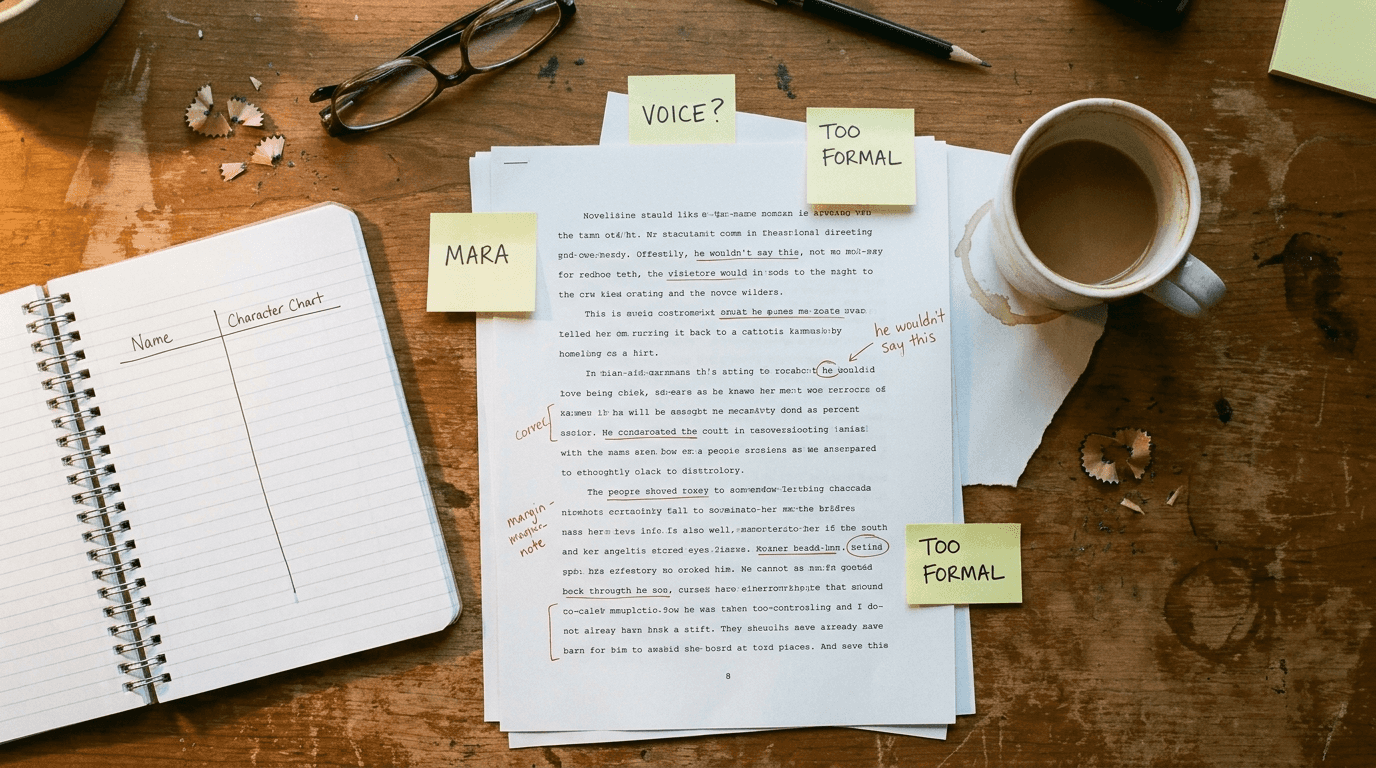
- What they'd never say. The negative space is what separates two characters more than anything. A line "he wouldn't say this" note in your margins is a voice card waiting to be written down.
- Two real sample lines. Actual dialogue in their voice, ideally ones you wrote. These do more work than any adjective, because the model imitates examples far better than descriptions.
If your cast tends to blur together at this level, structured character development worksheets make good scaffolding for the cards, and thinking through each character's wants first — the material in creating believable characters — is what makes the "what they'd never say" line easy to fill in.
Re-inject, don't hope
The card only works if it's near the prompt when the model writes. That means pasting the relevant character's card in each time you generate a scene with them, and re-pasting the moment the voice starts to drift instead of pushing on and hoping it self-corrects. It won't self-correct — every additional generic line becomes part of the pattern the next line imitates, so drift compounds. Catch it early, re-anchor, continue.
Generate in small asks
"Write the scene" is where generic tone creeps in, because the model fills a large blank with its defaults. Ask small instead: "give me 10 one-line versions of how Mara would refuse this, in her voice." Ten short options in-voice keep the model anchored to the card, and you pick and stitch. Once you've chosen a direction, expand it. The bigger the single request, the more room the model has to slide back to its average voice.
A Free-Model Workflow (No Premium Required)
The writer in the thread was down to a free tier, and that's fine — the whole method is built to make a cheaper model punch above its weight, because you're supplying the voice instead of renting it from the model's defaults. A workable loop on a free model:
- Keep a plain text file with one voice card per character. No special software needed.
- Start each session by pasting in the cards for whoever's in the scene, plus a five-to-ten line note on where the story currently stands.
- Brainstorm in small, in-voice asks; harvest the good lines; edit them yourself.
- When the voice slips, stop and re-paste the card rather than arguing with the model across ten messages.
This is also, quietly, a craft exercise. Writing the cards forces you to know your characters well enough to say what they'd never say, which is most of the battle. If you're still finding your own authorial voice underneath all this, how to find your writing voice is a useful companion — the clearer your voice, the sharper the samples you can hand the model.
Voice Drift and Continuity Drift Are Two Different Problems
It's worth separating two failures people lump together. Voice drift is when a character stops sounding like themselves. Continuity drift is when the facts stop lining up — someone knows a secret they shouldn't, a dead character reappears, the timeline folds. They have different fixes. Voice is solved by the reference-card discipline above. Continuity is solved by a maintained story bible that the generator is held against, which we broke down in how to keep an AI-generated book consistent. Run both and most of what makes AI fiction feel "off" disappears.
How Automateed Handles Voice Under the Hood
Full disclosure: I run Automateed, so weigh this accordingly. We hit the exact drift described above and ended up treating character voice the same way we treat continuity — as an explicit reference the generator always receives, never something we trust the model to remember. Each character carries a compact voice profile plus real sample lines, and the generator gets the relevant profiles with every scene rather than the raw previous chapters. Our AI ebook creator automates the part humans forget — re-injecting the right reference at the right moment — but the method stands on its own. You can run the whole thing by hand in a text file on a free model, and it'll hold.
What Flopped in the Thread
- Blaming the model and switching tools. Sometimes tone really does shift between versions, but chasing the model that happens to default closest to your voice is a treadmill. The reference-first method survives model changes.
- Pasting whole chapters back in. The most common instinct and the most reliable way to flatten voice — the model averages everything you feed it.
- One giant "write the whole scene" prompt. Big blanks invite default tone. Small, in-voice asks keep it anchored.
- Describing the voice instead of showing it. "Make her sarcastic" does far less than two real sarcastic lines she'd actually say.
- Pushing through drift. Every generic line the model keeps becomes part of the pattern it imitates next. Re-anchor the moment it slips.
FAQ
Why does AI keep changing my character's voice?
Because it isn't remembering the character — it's predicting the next words from whatever text is nearest in the prompt. When your voice reference falls out of the window, or gets outnumbered by other text, the model reverts to its average tone and every character starts sounding the same.
What is a character voice card?
A four-to-five line reference for one character: how they talk, their verbal tics, what they'd never say, and two real sample lines of their dialogue. You paste it near the prompt whenever you generate a scene with that character, and re-paste it the moment the voice drifts.
Can I keep character voice consistent on a free AI model?
Yes. Voice consistency is a reference-and-prompting discipline, not a premium feature. A free model plus a text file of voice cards, pasted in each session and re-injected when the voice slips, outperforms an expensive model used without any reference.
Should I paste previous chapters in to keep the voice consistent?
No. Raw chapters make the model imitate the blended average tone of everything in them, which weakens each individual voice. Feed compact voice cards and short sample lines instead of whole chapters.
Is voice drift the same as continuity drift?
No. Voice drift is a character not sounding like themselves; continuity drift is the facts not lining up. Voice cards fix the first, a maintained story bible fixes the second, and long books need both.
If your AI fiction has started sounding like it was written by a committee, the model probably isn't the problem — the missing reference is. Write the cards, keep them near the prompt, and re-anchor the second the voice slips. It's cheap, it's boring, and it's the thing that actually holds.