Table of Contents
Dreamflow is one of those tools that sounds great on paper: build a cross-platform app fast, with AI doing a lot of the heavy lifting. So I tested it with a pretty simple goal—get to a working, responsive Flutter app without writing everything from scratch. What I noticed right away was the workflow: you pick a template (or start blank), then design and iterate using a three-panel editor. The AI suggestions are there to help you refine screens and logic, not just spit out code and disappear. And yes, exporting the build was smooth enough that I didn’t feel stuck in “demo mode.”
Dreamflow Review: what it’s like to build with AI + Flutter
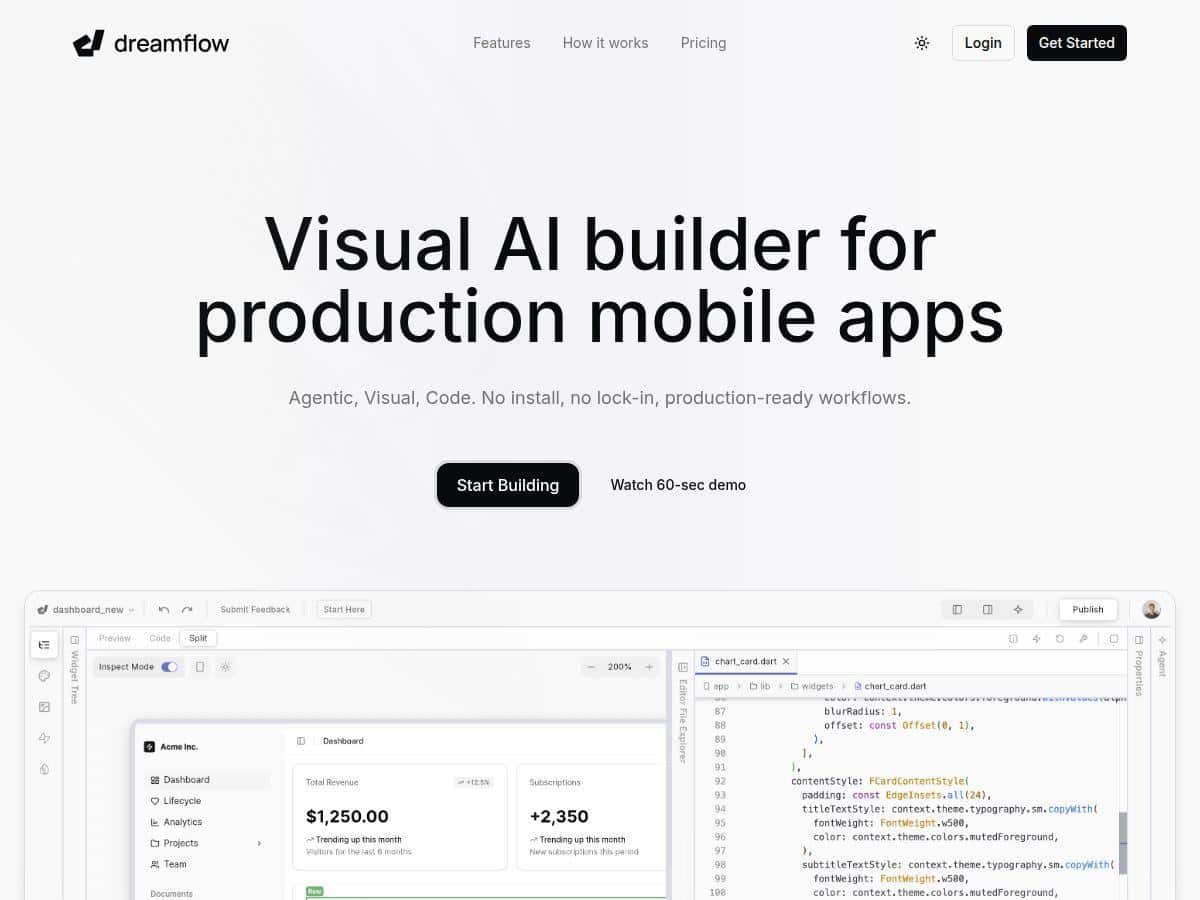
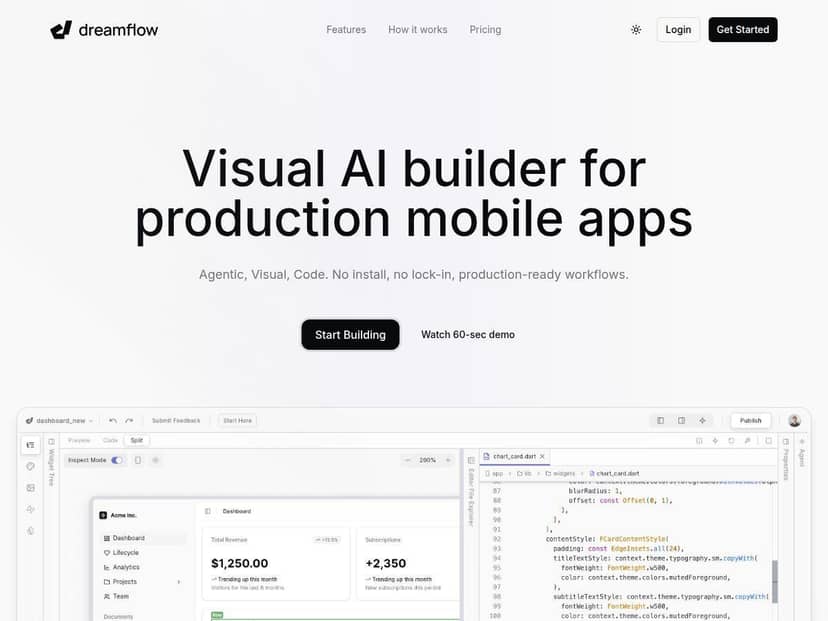
Here’s the honest version of my test. I didn’t start from scratch—I used a basic template because I wanted to see how quickly Dreamflow could get me to something real. After that, I iterated screen-by-screen. The editor layout is the big deal: you’re not bouncing between separate “prompt” and “code” tools. The three-panel view keeps the loop tight—prompt/intent on one side, visual design in another, and the code view so you can sanity-check what’s happening.
What I built: a small “task list” style app with a home screen, a simple add-item flow, and a responsive layout that doesn’t look broken when the screen gets wider. I tried to keep my prompts specific instead of vague. For example, I asked for a top app bar, a list view with cards, and an “Add” button that opens a form. That’s where I saw Dreamflow’s value: it tends to turn those instructions into concrete UI structure quickly.
Time-wise, I was able to get a first working version faster than I expected. I’m not claiming it’s instant—there are always a couple tweaks—but I didn’t spend hours wrestling with layout basics. The responsive bit was also noticeable. On smaller screens, the spacing felt reasonable without me manually adjusting every widget. On wider layouts, the UI stayed organized instead of collapsing into something cramped.
One thing I appreciated: the export step didn’t feel like a “trust me” moment. It was straightforward to get a Flutter project out, and from there I could customize further. That matters because even if the AI nails 80% of the UI, you’ll still want to adjust details—colors, spacing, navigation behavior, and any edge-case logic.
Limitations I ran into (and this is where reviews should be real): when I pushed for more complex flows—like adding validation rules and handling empty states cleanly—the generated version needed manual edits. It wasn’t broken, but it wasn’t “production-perfect” either. In my experience, the AI is great at scaffolding. It’s less consistent when you want very specific business rules or complicated state management without having to nudge it.
Key Features: the stuff I actually used
- Tri-surface editing (prompt + visual + code)
This is the workflow I kept coming back to. I could tweak the idea in the prompt panel, see UI changes immediately in the visual canvas, and then check the Flutter code for what actually got generated. That “check the code” part matters because it builds trust and saves time when you’re debugging. - AI suggestions that map to UI structure
In practice, the AI didn’t just offer generic tips—it suggested layout patterns that matched what I asked for. For example, when I requested a list of items with a clean card style, the output reflected that (list widget + item cards + consistent padding). It’s not magic, but it’s a solid starting point. - Responsive layouts for phones/tablets/desktops
I tested the same screen at different sizes and looked for two things: (1) whether text got clipped, and (2) whether spacing got weird when the width changed. The generated layout held up pretty well without me rewriting constraints from scratch. - Backend integrations (Firebase + Supabase)
I didn’t fully deploy a live backend in this test, but I did check how Dreamflow approaches integration. The key thing is that it’s designed for full-stack work, not just UI mockups. If you’re using Firebase or Supabase, you typically need to align auth rules and data schema with what the app expects (collections/tables, fields, and queries). That’s the part you’ll still need to think through—Dreamflow can help generate the scaffolding, but your data model still has to be correct.
What the generated Flutter output looked like (practical example)
When I asked for a “task list” UI, the code output generally followed standard Flutter widget patterns—scaffold + app bar + list rendering + a form trigger. I’m paraphrasing the structure here (since the exact code will vary by prompt/template), but the key point is that it produced real Flutter widgets, not placeholder text. In other words, it wasn’t just “here’s a design”—it was “here’s the actual widget tree you can edit.”
If you’re planning to use Dreamflow heavily, my advice is simple: after each AI generation, scroll the code view once and look for obvious issues like missing imports, inconsistent naming, or state hooks that don’t match your intended flow. That quick check saves you from debugging later.
How AI prompts translate into changes
Here’s what I noticed about prompt behavior. Vague prompts lead to vague structure. Specific prompts lead to specific UI. For example:
- Good prompt: “Create a home screen with an app bar titled ‘My Tasks’, show tasks in a card list, and add a floating action button that opens a modal form.”
- What I got: a screen layout with a list UI and a clear entry point for adding items.
- Then I refined it: “Add empty-state text when there are no tasks and validate that the title can’t be blank.”
- What happened: the UI updated, but I still had to adjust logic manually for validation and empty-state behavior to match my exact expectations.
Pros and Cons: the real-world tradeoffs
Pros
- Fast iteration: I could go from idea → UI → code quickly, without constantly switching tools.
- One workspace: visual editing and code checking together is a big time-saver (especially if you’re not purely UI-first).
- Responsive output: the layouts didn’t collapse when I increased screen width, which is usually where generated UIs fall apart.
- Cross-platform direction: Dreamflow is built around Flutter, so exporting for multiple platforms is the natural path.
- Export-ready Flutter: the generated code is editable, which is exactly what you want if you’re going beyond the first draft.
Cons
- Free plan limits: you’ll hit credit limits fast if you’re iterating on multiple screens or regenerating often.
- More advanced work costs more: if you want deeper functionality, you’ll likely need a paid plan sooner than later.
- Complex logic still needs you: I found that UI scaffolding is strong, but detailed state handling and validation often require manual tweaks after generation.
- AI won’t replace product thinking: you still have to define the actual rules (data fields, auth behavior, edge cases). The AI can generate code, but it can’t guess your business logic perfectly.
Pricing Plans: which one makes sense
Dreamflow’s plans are pretty straightforward. Here’s how I’d think about them based on what I saw while testing:
- Free Plan: 10 credits, app generation, and web deployment at no cost. This is enough for a quick prototype, but if you’re trying to build more than one or two screens, you’ll probably feel the limits.
- Hobby Plan ($20/month): 100 credits plus support for web, iOS, and Android, and unlimited private projects. If you’re building a personal app or experimenting with real features, this is the first plan I’d consider.
- Pro Plan ($50/month): 260 credits, priority access to premium models, and unlimited private projects. This feels like the “serious tinkerer” tier—enough room for iterative changes without constantly running out of credits.
- Custom / Enterprise: dedicated support, onboarding, and options like private cloud. If you’re a team with defined workflows and security needs, that’s where it starts to make sense.
Wrap up
Dreamflow is genuinely useful if your goal is to move quickly from an app idea to a real Flutter codebase. The tri-panel workflow is the standout feature, and the responsive output is a pleasant surprise compared to a lot of “AI app builders” that only look good at one size. That said, don’t expect it to handle every complex edge case for you—especially around validation, state, and backend logic. You’ll still do some manual cleanup, and that’s normal.
If you want a tool for rapid prototyping and iterative UI building (and you’re okay reviewing/editing the generated Flutter), Dreamflow is worth trying. If you need fully custom, deeply complex logic from day one, you’ll likely want to plan for extra hands-on work or start with a simpler scope.