
Table of Contents
Reading 10,000 words takes 40 minutes at 250 words per minute, or 50 minutes at 200 words per minute. A research-based estimate is about 42 minutes for adult English silent nonfiction reading: 10,000 divided by the 238-word-per-minute average reported in Marc Brysbaert’s 2019 reading-rate research. These times cover reading itself; studying, editing or recording will need a fuller plan.
Reading aloud takes 66 minutes 40 seconds at 150 words per minute, or 55 minutes 33 seconds at 180. If you’re planning a speech or recording, use a spoken pace rather than your silent-reading speed. For a quick answer, pick your pace in the table below. For a book-club deadline, study session or recording slot, the worked examples show how to allow for the extra work.
For a more personal estimate, time yourself reading a representative passage and use that pace for the remaining words. If your task includes discussion notes, checking sources or taking a break, give those activities their own place in the schedule. You’ll find the arithmetic and examples below.
How long 10,000 words takes at different speeds
Divide 10,000 by your reading speed in words per minute to find your reading time in minutes. At 250 words per minute, 10,000 ÷ 250 = 40. The table applies this calculation to several speeds. The rows are planning examples, rather than ratings of reading ability.
| Pace | Time for 10,000 words | Calculation |
|---|---|---|
| 100 words/minute | 100 minutes | 10,000 ÷ 100 |
| 150 words/minute | 66 minutes 40 seconds | 10,000 ÷ 150 |
| 175 words/minute | 57 minutes 9 seconds | 10,000 ÷ 175 |
| 200 words/minute | 50 minutes | 10,000 ÷ 200 |
| 238 words/minute | 42 minutes 1 second | 10,000 ÷ 238 |
| 250 words/minute | 40 minutes | 10,000 ÷ 250 |
| 260 words/minute | 38 minutes 28 seconds | 10,000 ÷ 260 |
| 300 words/minute | 33 minutes 20 seconds | 10,000 ÷ 300 |
Times are rounded to the nearest second where needed so you can check the arithmetic. For your calendar, round up to a whole minute and add work beyond reading. A calculated time of 42 minutes 1 second is still an estimate for a real document.
You can work backward from a deadline, too. Reading 10,000 words in 30 minutes requires about 333 words per minute; finishing in an hour requires about 167. Compare that with your timed pace. At 200 words per minute, a 30-minute appointment accommodates 6,000 comparable words, leaving the rest for another session.
What reading research tells you about timing
Adult English readers averaged 238 words per minute for silent nonfiction reading and 260 for fiction in Brysbaert’s 2019 meta-analysis of reading rate. The analysis covered 190 studies with 18,573 participants. Its oral-reading analysis included 77 studies and 5,965 participants, with an average of 183 words per minute. These figures also appear in the author’s university research record.
At those rates, 10,000 words would take approximately 42 minutes for nonfiction, 38 minutes for fiction and 55 minutes aloud. These are calculations from reported averages, rather than separately observed completion times for every 10,000-word text.
The study found differences among individuals, populations and languages, so its adult English averages are starting points rather than targets for everyone. See the study’s scope and findings for more detail.
Your purpose matters as well. Imagine a report asking you to compare its findings with a chart on another page. Reading that sentence counts toward your reading time; making the comparison needs its own allowance. Similarly, enjoying a story and preparing editorial comments on it have different finishing points. Decide what “finished” means before choosing a reading speed.
Measure your pace with a representative sample
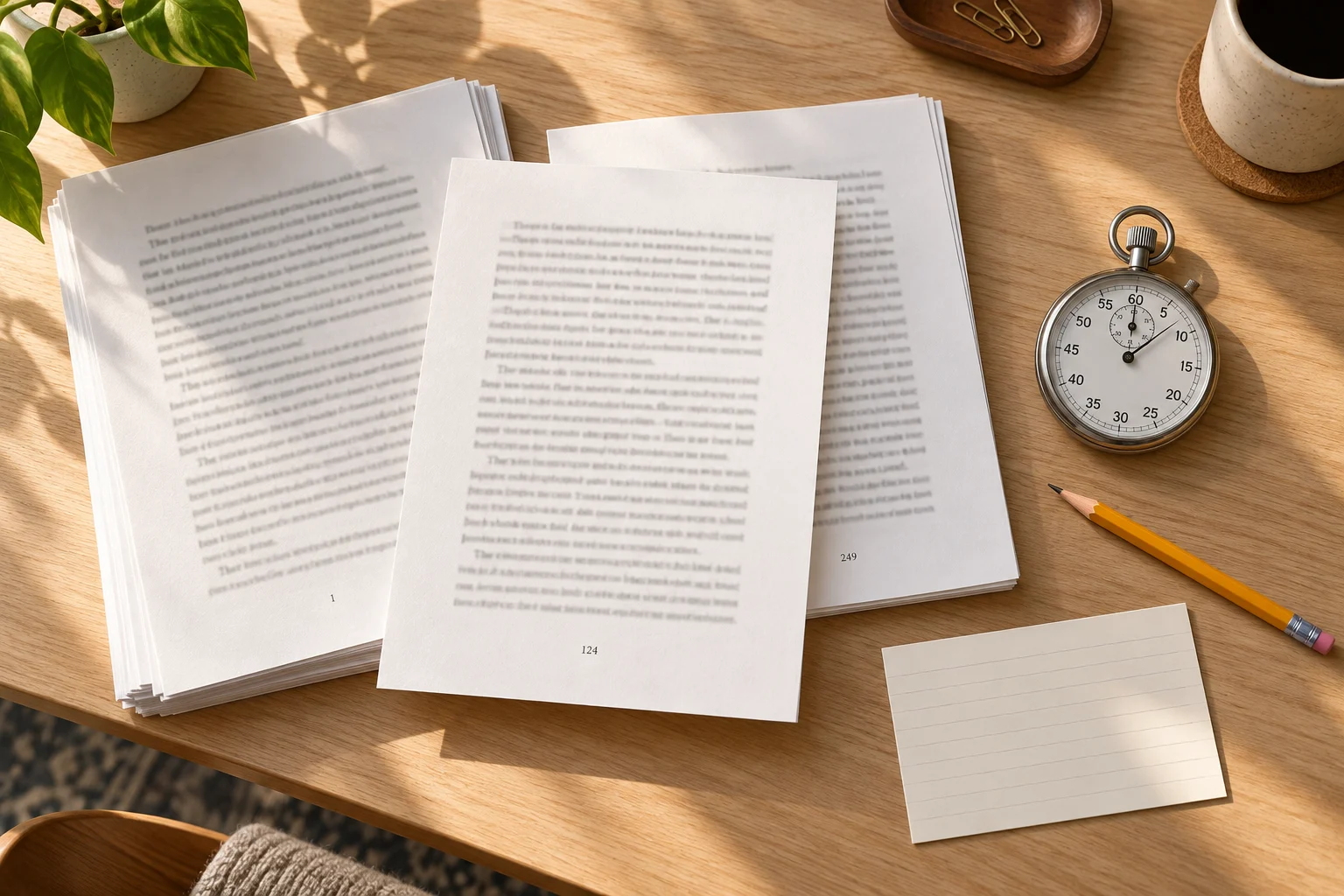
Time yourself reading about 1,000 representative words, then divide the word count by the elapsed minutes. Choose a passage from the body rather than automatically using the opening. Match the material to the reading ahead: dialogue in a dialogue-heavy story, or explanatory prose with relevant references in a report.
- Match your reading conditions. Use the device or printed copy you plan to read, with the same purpose you’ll bring to the full text.
- Decide what to time. For a continuous-reading estimate, record unrelated interruptions separately. Include ordinary rereading if that’s part of how you understand the material.
- Read for the understanding you need. Afterward, close the text and summarize its main point. This is a practical check, not a formal comprehension test.
- Calculate the full reading time. Divide the sample word count by elapsed minutes, then divide the full word count by that rate.
Suppose you read 1,000 words in 4 minutes 30 seconds. Convert that time to decimal minutes: 4 + (30 ÷ 60) = 4.5. Your pace is 1,000 ÷ 4.5, or about 222 words per minute. The full text is ten times the sample length, giving a projected reading time of 45 minutes for 10,000 comparable words.
Enter 4.5, rather than 4.30, in your calculator. A decimal value of 4.30 means 4 minutes plus 0.30 of a minute: 4 minutes 18 seconds. Converting the seconds first prevents this input error from changing your estimate.
Now suppose a second sample of 800 words takes 4 minutes, or 200 words per minute. Combine the samples by dividing the total 1,800 words by the total 8.5 minutes. That gives about 212 words per minute and a projected time of about 47 minutes for 10,000 words—or 48 minutes rounded up for your calendar. Use the original totals rather than averaging the two rounded speeds.
If your samples give very different results, look at the passages you chose. A straightforward introduction and a dense analytical section may deserve separate estimates. Calculate each section’s time and add them together, preserving that useful difference.
Make room for the whole task in your calendar
Add reading, follow-up work and breaks as separate parts of your appointment. That makes the schedule easier to adjust. If checking a chart runs over, you can revise that allowance without assuming you misjudged your reading speed.
Here are three ways the same word count can fit into your day. The extra time allowances are examples you can adjust to your task.
| Task | Reading assumption | Other planned work | Illustrative total |
|---|---|---|---|
| 1. Read a story before a book-club conversation | 40 minutes at 250 words/minute | 10 minutes to record three discussion points | 50 minutes |
| 2. Read a report and write a short response | 50 minutes at 200 words/minute | 20 minutes checking charts, 20 minutes drafting, a 10-minute break | 100 minutes |
| 3. Read a chapter over two evenings | 50 minutes at 200 words/minute | Split reading into two 25-minute sessions; reserve recap time separately | 50 minutes of reading, plus your chosen recap allowance |
Your three book-club notes might cover a character’s turning point, a disputed choice and a question about the ending. For the report, choose the charts you need to check before you begin. Whether the example’s 20-minute allowance is enough depends on those charts.
When dividing a chapter between evenings, use the word budget to find a natural stopping point. At 200 words per minute, 25 minutes allows for 5,000 words by calculation. If a section ends at 4,600 words, stop there instead of halfway through the next argument. Leave a brief note about where you stopped and the question you’ll pick up next, allowing time for it beyond the reading itself.
Plan separately for studying, source checks and editing
Estimate these tasks around what you need to produce. They involve more than reading continuously at a slower pace. When studying, replace “finish the chapter” with “explain the author’s three claims and identify the evidence supporting each.” Then allow time for reading, revisiting definitions and putting that explanation together.
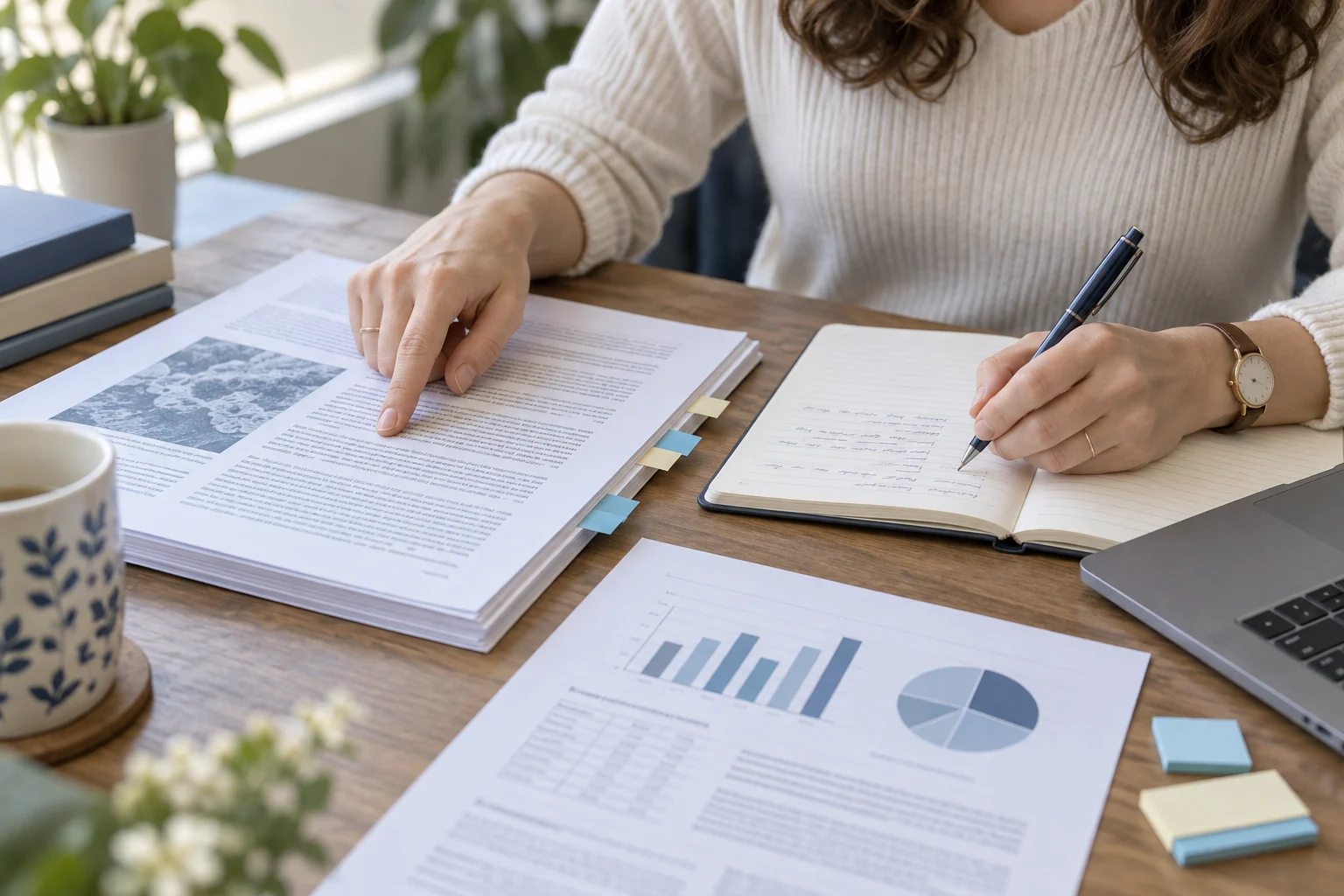
A report can work well in three passes. First, read the argument and mark claims that need checking. Next, examine the supporting sources and note what each establishes or leaves uncertain. Finally, draft your response. Unless a missing definition prevents further reading, you can leave links for the checking pass instead of opening each immediately.
Set a finishing point for your research: perhaps a list of checked claims and questions still needing answers. Otherwise, following references can take far longer than reading the report. Give any remaining essential checks a separate appointment rather than trying to squeeze them into the original reading slot.
When estimating editing time, include the actual work in your sample: comments, sentence revisions or structural recommendations. If editing 1,000 words takes 15 minutes, ten comparable sections suggest 150 minutes of editing. This is an illustrative projection, not an industry benchmark. If your sample already included all the reading you need, don’t add another full reading allowance.
Different levels of editing deserve separate estimates. A clean chapter needing punctuation corrections and one whose argument needs reordering require suitable samples of their own, even when their word counts match.
Reading 10,000 words aloud or recording a script
A 10,000-word script takes 66 minutes 40 seconds at 150 words per minute, or 55 minutes 33 seconds at 180 words per minute. These are example delivery speeds for calculation; your narrator and performance choices determine the actual pace.
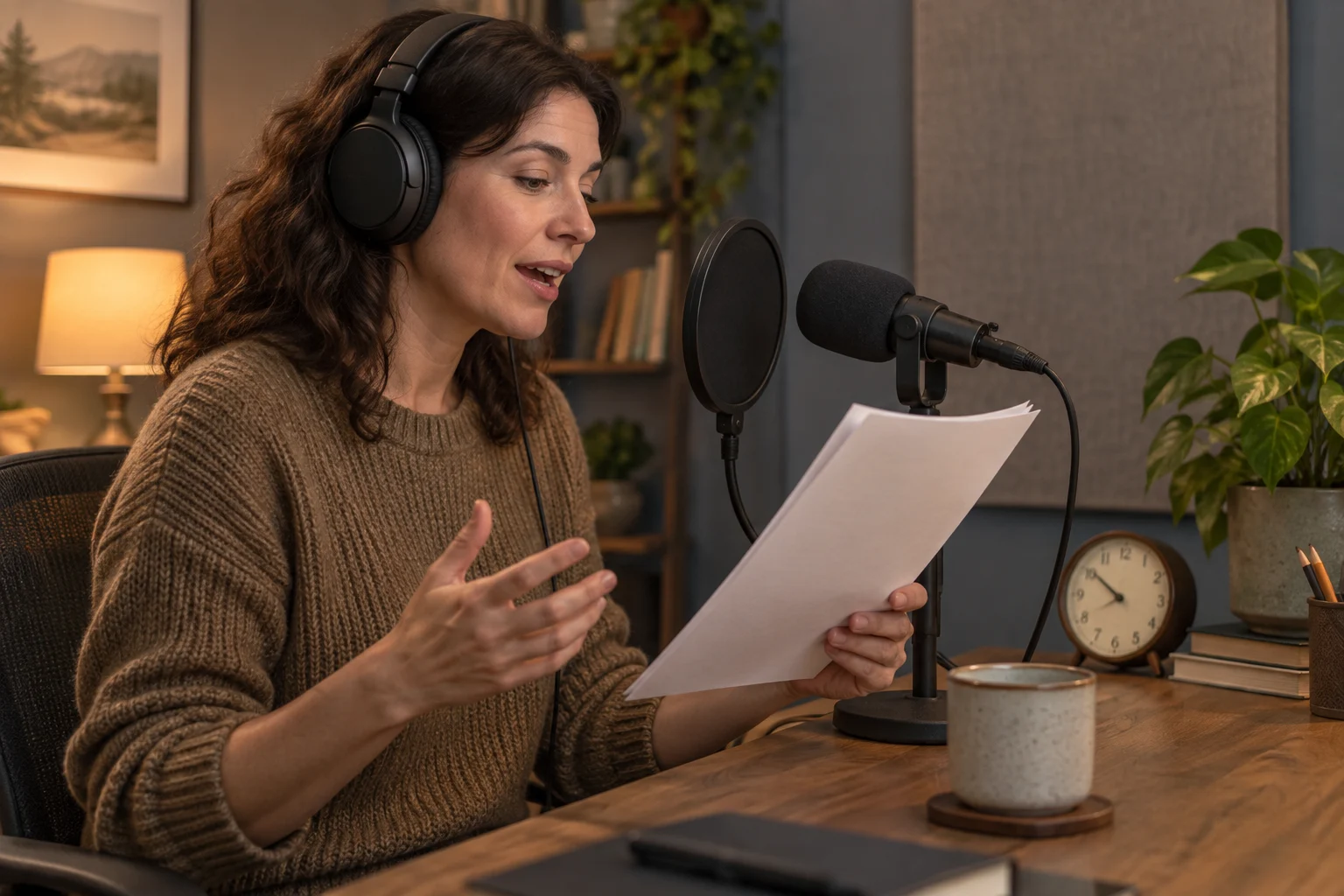
Rehearse a representative passage with your intended expression and pauses. Choose a similar proportion of dialogue, unfamiliar names and audience-facing explanations to the full script. If you’re making a recording, record the sample and listen back before using its pace to estimate the whole piece.
Dramatic pauses included in the sample are already reflected in its words-per-minute rate, so don’t add them again. Allow separate time for anything the sample leaves out, such as an audience discussion or a long transition between sections.
The rehearsal can help you decide whether the script fits. At 150 words per minute, a 60-minute slot holds 9,000 spoken words before additional activities. A 10,000-word script therefore needs a longer slot or a cut of about 1,000 words at that pace. Rehearse the revised script, since cuts may change the delivery.
Finished audio duration is only one part of production time. ACX’s audiobook production guidance separates preparation, recording, editing and quality control, mastering, and delivery. Schedule retakes and listening checks outside the clean performance estimate. For project budgeting, the audiobook production cost guide explains how finished hours differ from the work needed to produce them.
Use the calculator with a pace that fits your reading
With any basic calculator, divide your word count by your measured words per minute, then round up for scheduling. For 10,000 words, a pace of 200 words per minute gives 50 minutes; a pace of 250 gives 40 minutes.
| What to calculate | Calculator entry | Worked result |
|---|---|---|
| Reading minutes | Word count ÷ words per minute | 10,000 ÷ 200 = 50 minutes |
| Your sample pace | Sample words ÷ sample minutes | 1,000 ÷ 4.5 ≈ 222 words/minute |
| Words that fit your available time | Available reading minutes × words per minute | 25 × 200 = 5,000 words |
| Total appointment length | Reading + other work + breaks | 50 + 40 + 10 = 100 minutes |
If you haven’t timed a sample, start with the nonfiction average of 238 words per minute from the adult English reading-rate study. Replace it when you have an estimate better suited to your document and purpose. Use a positive reading speed; dividing by zero won’t give you a reading time.
To convert decimal minutes into minutes and seconds, multiply the fractional part by 60. For example, 66.6667 minutes is approximately 66 minutes 40 seconds, not 66 minutes 67 seconds. Keep unrounded values through intermediate calculations and round only the final result.
The worksheet also works for a remaining section or revised draft. Enter only the words you intend to read, excluding material you’ll skip. If you only know the page count, consult the 100-page book word-count guide before using a page-based estimate. Finally, add the notes, checks and breaks your task needs, without counting activities already included in your timed sample twice.
Reading-time calculator
Adjust the word count and your observed reading speed. The result is an estimate, not a performance target.