LIFETIME DEAL — LIMITED TIME
Get Lifetime AccessLimited-time — price increases soon ⏳
AI Tools

Innhold.ai Review – Your Academic Writing Companion

Updated: April 20, 2026
4 min read
#Ai tool#writing

Table of Contents

If you’ve ever stared at a blank page thinking, “Okay… where do I even start?”, you’re definitely not alone. Academic writing is a different beast. You’re not just trying to sound smart—you’re trying to prove things, cite properly, and keep your sources organized. That’s exactly what I wanted to test with Innhold.ai.

Innhold.Ai

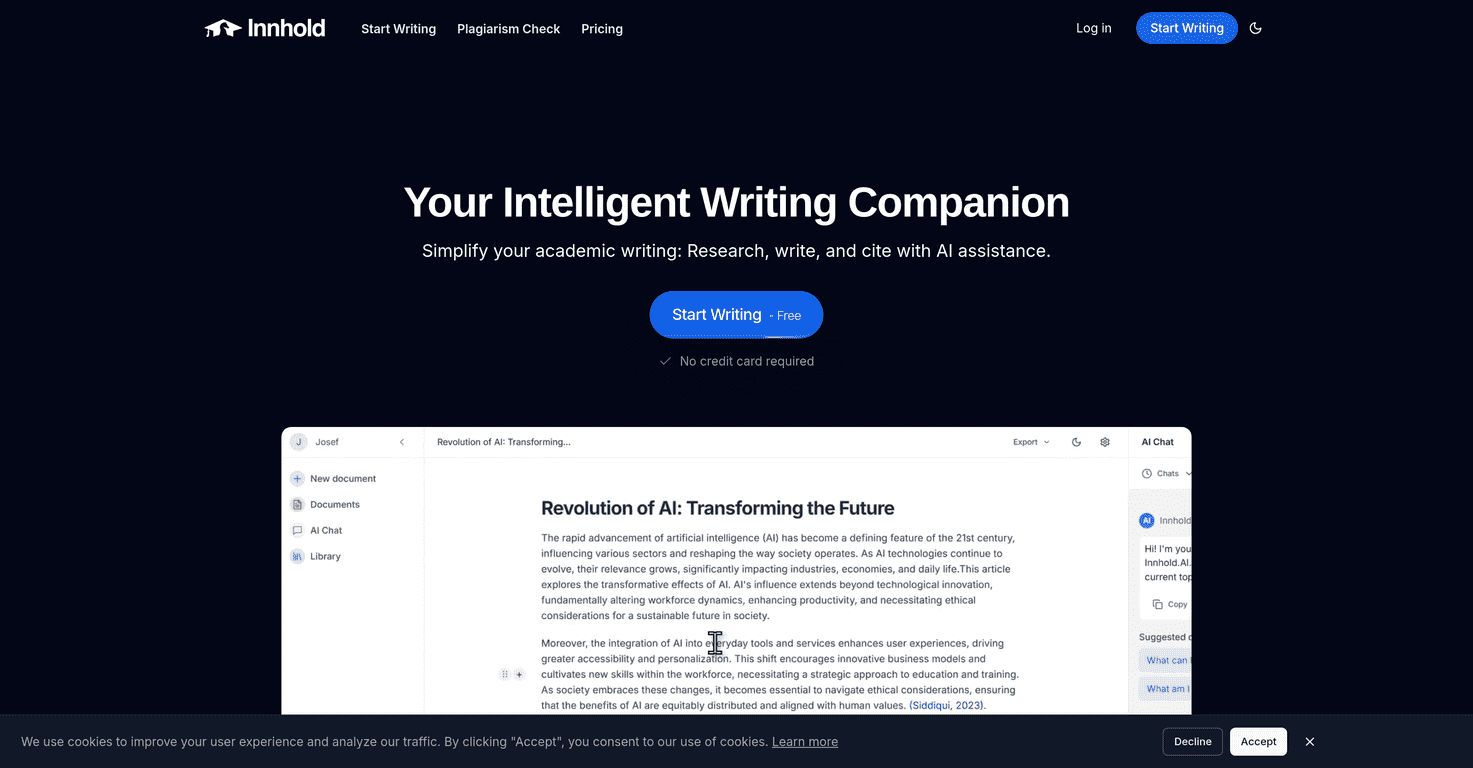
Innhold.ai positions itself as an academic writing companion—helping with research, drafting, and citation work. It’s also still relatively new, so some areas feel a bit like “beta vibes.” I found it helpful for getting moving faster, but I also noticed you can’t just paste everything in and magically trust the output. You still have to do the academic legwork.

Table of Contents

Innhold.ai Review: Does It Actually Help With Academic Writing?

Here’s the real question I kept asking while testing it: can it reduce the busywork without creating sloppy scholarship?

Innhold.ai is built for academic writers, with an emphasis on research support, writing assistance, and citation management. It’s meant to help you move from “I have a topic” to “I have a draft with references” faster. And in my experience, that’s where it shines—especially when you’re stuck in the early stages: outlining, finding angles, and turning notes into coherent paragraphs.

That said, academic writing isn’t just about generating text. You still need to check claims, verify sources, and make sure your citations match the style you’re required to use (APA, MLA, Chicago, etc.). The tool can help you organize the process, but it won’t replace your judgment.

Key Features I Looked For (And What They’re Good At)

  1. AI-powered research assistance
    This is the part I tried first. I used it to help brainstorm relevant themes and narrow a broad topic into something more manageable. What I noticed: it’s better at suggesting directions and structuring questions than it is at acting like a perfect replacement for reading papers yourself.
  2. Writing support tailored for academic purposes
    When I fed it rough notes, it helped me turn them into more academic-sounding wording. The tone was generally appropriate for scholarly writing, but I still had to revise for clarity and to make sure the argument actually matched my sources.
  3. Citation management to streamline referencing
    This is where I had the most “okay, this could save time” moments. Instead of hunting for formatting rules every time, I could focus on building the reference trail. Still, I recommend double-checking citations against the original sources—especially for page numbers and exact wording.

Pros and Cons (My Honest Take)

Pros

  • Gets you unstuck faster. If you’re spending hours just trying to start, it helps you move toward an outline and a working draft.
  • Helps reduce the “blank page” problem. I liked that it supports drafting in a more academic direction instead of generic content.
  • Citation workflow feels smoother. Even when I still verified details manually, the process was less chaotic than usual.

Cons

  • Not a lot of detail on specific functionality. When I was looking for exact options (what citation styles are supported, how references are exported, etc.), I found the information pretty limited.
  • You need to know what you’re doing. If you don’t already understand academic writing basics (thesis statements, evidence, citation accuracy), you’ll likely end up spending time correcting problems anyway.
  • AI output still needs verification. I don’t mean “sometimes it’s wrong”—I mean that’s always the case with AI. You should treat it like a drafting assistant, not an authority.

Pricing Plans: What I Could Find (And What You Should Check)

Right now, I couldn’t find clear information about pricing plans. That’s a bummer, because pricing is usually the first thing I want to confirm before I commit to testing a tool seriously.

My advice: check the official site for the latest updates and see whether they offer a free trial, a monthly plan, or anything student-friendly. If you’re using it for a specific assignment, you don’t want to get stuck paying for features you can’t fully evaluate.

Wrap up

Overall, I think Innhold.ai can be a useful companion for academic writing—especially for speeding up research direction, drafting, and citation organization. Just don’t expect it to handle everything end-to-end. In my experience, the best results come when you use it to get structure and momentum, then you verify sources and tighten the argument yourself.

If you’re the type who already cares about citation accuracy and academic rigor, it’s worth trying. If you want a fully automated “submit-ready” paper, you’ll probably be disappointed.

Stefan

Stefan

Stefan is the founder of Automateed. A content creator at heart, swimming through SAAS waters, and trying to make new AI apps available to fellow entrepreneurs.

Related Posts

Figure 1

Strategic PPC Management in the Age of Automation: Integrating AI-Driven Optimisation with Human Expertise to Maximise Return on Ad Spend

Title: Human Intelligence and AI Working in Tandem for Smarter PPCDescription: A digital illustration of a human head in side profile,

Stefan
AWS adds OpenAI agents—indies should care now

AWS adds OpenAI agents—indies should care now

AWS is rolling out OpenAI model and agent services on AWS. Indie authors using AI workflows for writing, marketing, and production need to reassess tooling.

Jordan Reese
experts publishers featured image

Experts Publishers: Best SEO Strategies & Industry Trends 2026

Discover the top experts publishers in 2026, their best practices, industry trends, and how to leverage expert services for successful book publishing and SEO.

Stefan

Create Your AI Book in 10 Minutes