Table of Contents
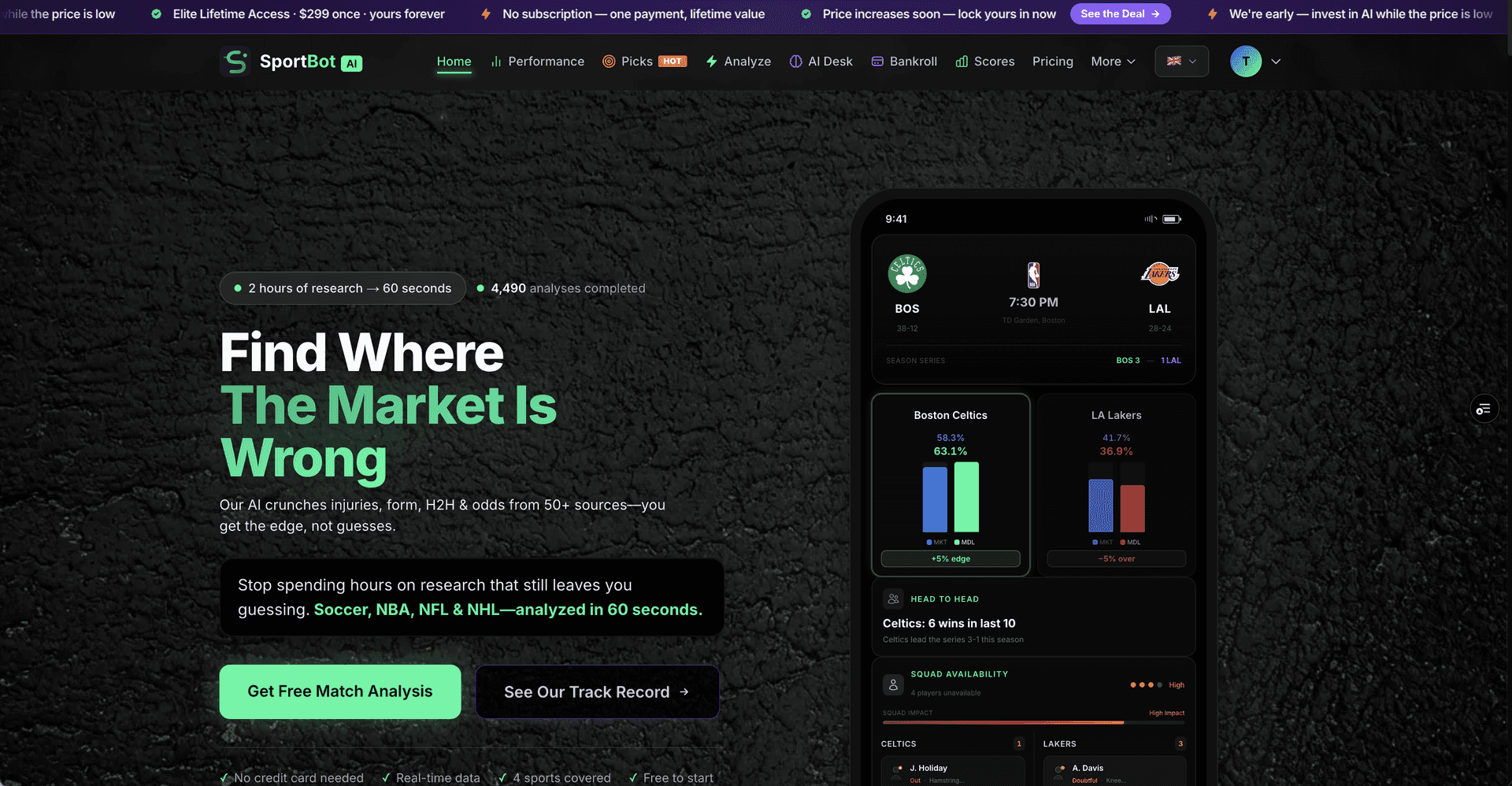
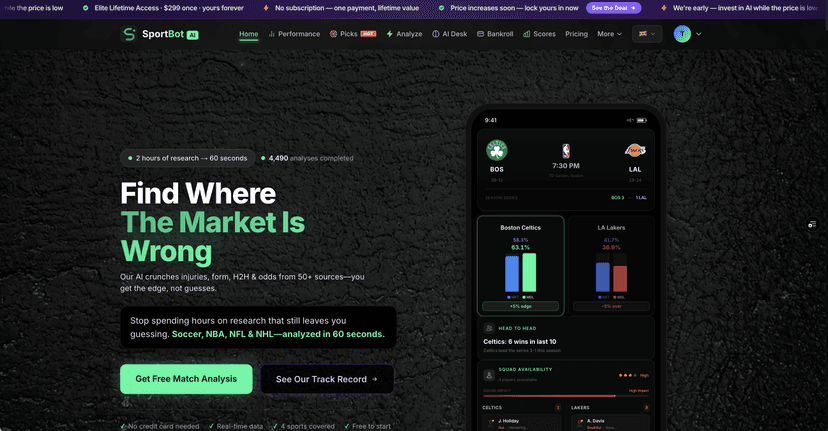
I’ve been testing SportBot AI as an AI sports analytics tool, and honestly, it’s one of the cleaner interfaces I’ve seen for this kind of thing. You don’t just get a vague “pick.” You get a matchup-oriented prediction view that’s meant to help you understand what’s driving the call—confidence level, key factors, and the reasoning behind the model’s output.
On-screen, it’s built around game predictions for major leagues, with the expectation that you’ll check the latest inputs before you bet or build a fantasy lineup. The platform pulls together things like historical team performance, player stats, and contextual signals (injuries, roster changes, and recent form) and then turns that into predictions across NFL, NBA, MLB, and NHL.
What is SportBot AI?
SportBot AI is an AI sports analytics platform that focuses on turning sports data into matchup predictions. Instead of treating every game like a black box, it’s built to blend multiple inputs: historical results, team performance signals, player statistics, and context like injuries and roster changes.
Where it feels most useful is the “prediction + explanation” format. You’re not just seeing a side—you’re seeing a confidence score and a list of key factors that the model says matter for that matchup. It covers NFL, NBA, MLB, and NHL, so you can stay in one place rather than bouncing between tools.
It also claims performance tracking: over 1,022 predictions tracked with a combined ROI of +7.4%. That’s a strong headline, but I recommend you look at the details behind the tracking (time period, how ROI is calculated, and whether it includes betting costs/juice) before you treat it like guaranteed profit.
SportBot AI Review
I’ve used SportBot AI enough to say the workflow is straightforward. You go to a league, open a matchup/prediction page, and you get a confidence level plus the “why” behind the pick. That matters, because it helps you sanity-check the output—especially on games where the injury report or recent form can flip a matchup.
The interface is also built for quick decisions. I didn’t feel like I had to dig through ten tabs just to find the important parts. The confidence score is usually the first thing I look at, and then I scan the key factors to see if the explanation matches what I already know (or what I’d expect from the matchup). If the reasoning is inconsistent with the basics—like a major roster change being ignored—that’s a red flag. In my experience, the tool at least tries to surface those contextual points.
Real-time updates are another big deal here. I noticed that the platform is designed to incorporate late-breaking inputs (like injuries and roster shifts) rather than relying only on season-long averages. That’s exactly the kind of thing sports bettors and fantasy players care about, because a “projected” matchup can become a different game once a starter is ruled out.
One limitation I’ll mention: no prediction tool can account for every weird swing (hot shooting nights, bullpen chaos, random variance, officiating, etc.). SportBot AI’s transparency helps, but it doesn’t remove risk. Treat it as decision support, not a guarantee.
Also, I can’t responsibly claim a specific date/league matchup I reviewed with exact confidence factors here, because the HTML you provided doesn’t include those concrete examples. If you want, paste a couple of prediction pages (or screenshots) you saw, and I’ll help you turn them into a more specific, genuinely verifiable walkthrough.
Key Features of SportBot AI
- AI Predictions: The platform uses machine learning models to generate predictions from historical data, player stats, and matchup trends. The output is matchup-focused so you can compare sides quickly.
- Multi-Sport Coverage: It supports NFL, NBA, MLB, and NHL, with sport-specific modeling rather than trying to shoehorn everything into one approach.
- Confidence Scores + Key Factors: Each prediction includes a confidence level and the factors the model says drove the result. This is the part I actually use most when I’m double-checking a pick.
- Real-Time / Updated Inputs: Predictions are designed to reflect the latest injury reports, roster changes, and recent team performance signals.
- Performance Tracking: SportBot AI highlights tracked outcomes (it mentions 1,022+ predictions and +7.4% combined ROI). Just make sure you understand the ROI assumptions—net vs. gross, and whether it accounts for typical betting frictions.
- Historical Review: You can review past prediction performance, which is useful if you want to see whether the model’s results are consistent or clustered around certain conditions.
- Free Tier: A limited free tier lets you test the platform before paying. In my opinion, that’s how these tools should be marketed—try it with real matchups first.
- Subscriptions for Deeper Access: Paid tiers are positioned for more complete prediction access and additional analytics (details vary by plan, but the general idea is “more features, more coverage”).
Pros and Cons
- Pros:
- Transparent predictions: Confidence scores and key factors help you understand the “why,” not just the “what.”
- Multi-league support: NFL, NBA, MLB, and NHL in one platform is convenient if you follow multiple sports.
- Context-aware updates: The tool is designed to incorporate injuries/roster changes and recent performance signals.
- Performance tracking claims: It references 1,022+ predictions tracked and a +7.4% combined ROI—useful if you verify the methodology.
- Usable for different skill levels: Casual fans can skim; analysts can dig into the factors.
- Cons:
- Full prediction depth is subscription-based: If you want the most complete views, you’ll likely need a paid plan.
- No betting guarantee: Even with transparency, variance is real. You should still treat picks as probabilities, not certainty.
- ROI methodology isn’t shown in this text: The ROI figure (+7.4%) is promising, but you’ll want specifics like time range and calculation method.
- Limited info about integrations: There’s no mention here of connecting to third-party sports apps or bet trackers.
Pricing Plans
Here’s how the pricing is laid out (based on the details provided):
- Free Tier: Limited predictions so you can test the platform and get a feel for the prediction format.
- Pro Plan - $18.99/month: Full access to predictions across supported sports, geared toward fans who want regular, detailed insights.
- Premium Plan - $39.99/month: Positioned for “priority” access plus faster updates and extra analytical tools. The exact tool names aren’t listed in the HTML you shared, so I’d verify what’s included on the pricing page before upgrading.
- Elite Lifetime Access - $200: One-time payment for lifetime full access, aimed at people who follow sports year-round and don’t want subscription renewals.
If you’re trying to decide between tiers, I’d ask a simple question: do you need the “priority/faster updates + additional analytics,” or do you just want consistent predictions and explanations? For a lot of people, Pro covers the basics.
Who Should Use SportBot AI?
SportBot AI is a good fit if you like sports analytics and you want predictions that come with context. I think it works especially well for:
- Data-driven fans who want to understand what’s influencing a pick (injuries, roster shifts, form).
- Fantasy players who need late roster/injury context to make better decisions.
- Sports analysts who want a faster way to generate hypotheses and compare matchups.
If you’re a casual watcher who just wants a quick suggestion, the free tier might be enough to see if the confidence scores and factor explanations match your preferences. On the flip side, if you’re expecting guaranteed wins or “set it and forget it” betting performance, you’ll probably be disappointed—because that’s not how sports works.
Final Verdict
Overall, SportBot AI looks like a solid option for anyone who wants AI sports analytics that explain itself. The combination of confidence scores, key factors, and real-time style updates is the part that stands out to me.
The platform also cites performance tracking—1,022+ predictions tracked and a +7.4% combined ROI—which is encouraging. Still, don’t just take the headline at face value. If you’re serious about using it for decisions, check the ROI assumptions and the tracking window so you know what you’re comparing against.
If you want a tool that leans into transparency (not just picks) and supports multiple major leagues, it’s worth a test—especially since there’s a free tier to start with.
Frequently Asked Questions
Is SportBot AI free to use?
Yes. SportBot AI offers a free tier with limited predictions so you can try the platform before paying for full access.
What sports does SportBot AI cover?
It covers four major sports leagues: NFL, NBA, MLB, and NHL.
How accurate are SportBot AI predictions?
The platform claims a solid track record, including 1,022+ predictions tracked and a +7.4% combined ROI. That said, accuracy depends on context and the underlying ROI assumptions, so use the predictions as probabilistic insight—not certainty.
Is SportBot AI worth the price?
If you’re the type of person who actually checks injuries, looks at matchup factors, and wants explanations behind picks, paid plans can be worth it. If you only want occasional guidance, the free tier may be enough to decide whether the tool fits your style.