Table of Contents
GRC (governance, risk management, and compliance) always sounds tidy on paper. In real life, though, it’s a messy mix of policies, evidence, questionnaires, internal audits, and “wait—where’s that document?” moments. That’s why I was interested in Trustero AI in the first place. The pitch is simple: use AI to help you map controls, pull in data, and answer compliance questions faster—without turning your team into full-time compliance librarians.
Trustero AI Review: What It Does (and What I’d Watch Out For)
When I look at tools like Trustero AI, I’m mostly asking one question: “Will this actually reduce the work, or just repackage it?” From what I’ve seen described (and what these kinds of platforms typically require), Trustero focuses on the parts of GRC that eat up time—collecting evidence, mapping controls to requirements, and answering the same security/compliance questions over and over.
One of the core capabilities is real-time data ingestion. The idea is that you can pull in information from different sources, then have the system analyze it and connect it back to policies and controls. That matters because most compliance efforts fail in the “evidence collection” stage, not in the “knowing what you should do” stage.
Trustero also emphasizes gap detection using inference techniques. In plain English: it tries to spot where your current documentation and controls don’t line up with what a framework or requirement expects. I like this approach because it’s more useful than generic “you should have a policy” suggestions. It’s closer to “you have pieces A and C, but B is missing or not mapped clearly.”
Beyond that, Trustero positions its AI for things like:
- Compliance roadmaps (so you’re not guessing what to fix first)
- Internal audit support (help finding what to test and where evidence should live)
- Remediation guidance (direction on what to change and how to document it)
- Security questionnaire automation (the part where teams usually spend days rewriting the same answers)
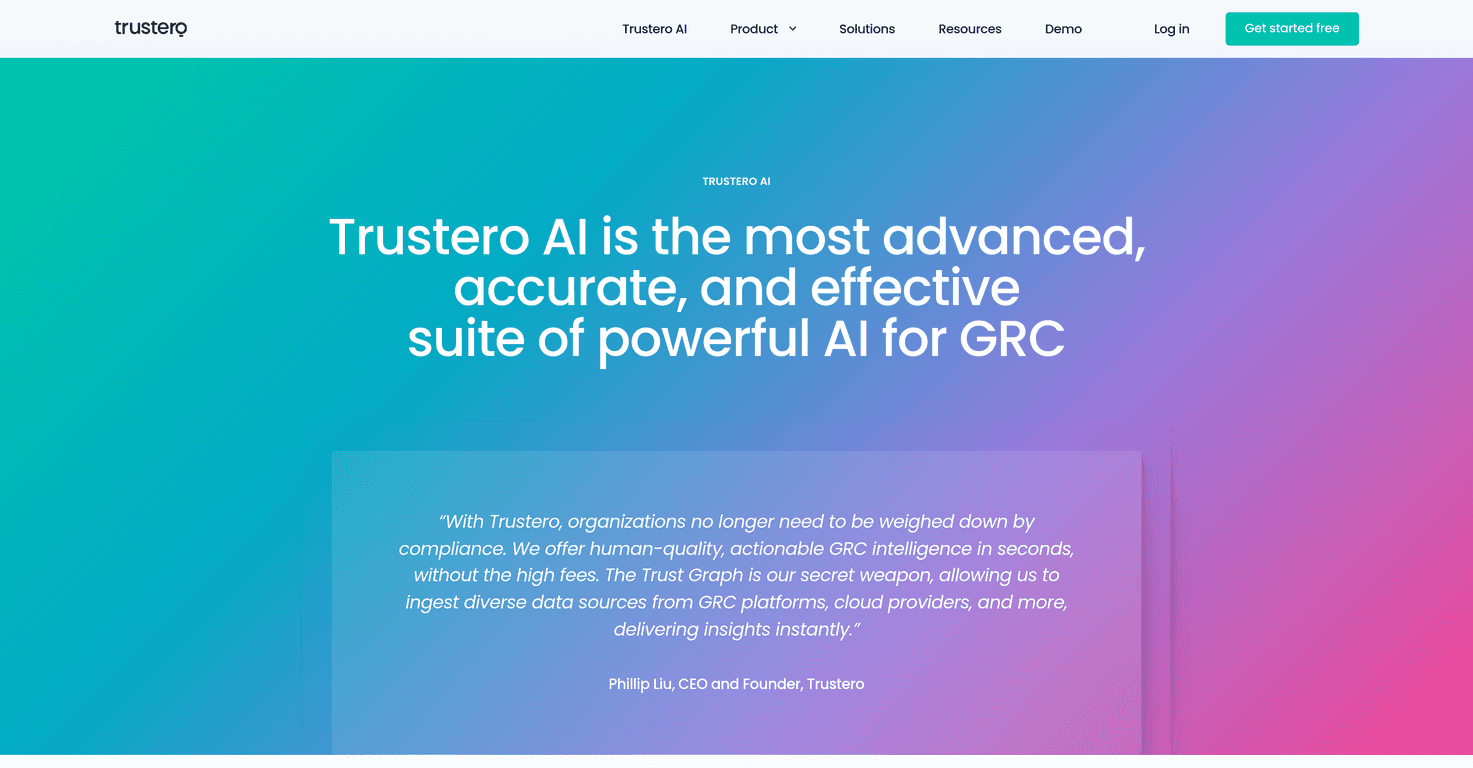
There’s also a feature called the Trust Graph for mapping and indexing data. I’m a fan of graph-style approaches for GRC because compliance isn’t just a spreadsheet—it’s relationships. Controls relate to policies. Policies relate to procedures. Procedures relate to evidence. If the tool can keep those connections straight, it’s genuinely helpful.
That said, I wouldn’t pretend it’s plug-and-play for everyone. Even with AI, you still need to give the system clean inputs. If your data sources are scattered, outdated, or inconsistent, the “smart” part can only work with what it’s fed. So yes, Trustero can simplify GRC—but you’ll still want a plan for setup and data quality.
Key Features (What You’ll Actually Use)
- Real-Time Data Ingestion: bring in information from your existing sources so the system can work from current material.
- Organizational Mapping: connect policies, controls, and related evidence so answers aren’t floating in isolation.
- Gap Detection: identify missing or weak coverage based on inference, not just keyword matching.
- Compliance Monitoring: help track what’s covered and what needs attention as requirements change.
- AI solutions for multiple GRC tasks: not just one use case—roadmaps, audits, and guidance are part of the pitch.
- Intelligence automation for compliance queries: aimed at reducing the grunt work of answering questionnaires.
Pros and Cons: My Take
Pros
- Strong answer quality (when configured well): the platform is marketed as having high accuracy and low hallucination rates. In my experience with AI tools, that usually comes down to good retrieval and solid setup—so it’s a positive sign if they’re doing that.
- Good on-ramp with the free tier: the first 1,000 answers are available at no cost. That’s enough to test real workflows instead of just clicking around.
- Designed to fit existing GRC programs: it’s not presented as a total replacement for everything. If you already have policies and controls in place, you’re more likely to see value quickly.
- Trust Graph helps with real-world mapping: if the relationships are handled well, it reduces the “where did that come from?” problem during audits and questionnaire responses.
Cons
- Setup can take time: the tool likely needs a robust initial setup for data ingestion. If your documentation is messy or hard to access, expect friction upfront.
- Full value depends on adoption: some functionality may require adapting to how Trustero structures things. If your team resists changing processes, you might not get the smooth experience they promise.
One more honest note: AI in compliance is only as good as the evidence it can reference. If the system can’t find the relevant docs, you’ll still be doing manual digging. The best outcome is when it points you to the right sources quickly—not when it tries to “guess” answers without backing.
Pricing Plans (Free Tier + Contact for Custom Pricing)
Trustero AI offers a free plan that includes the first 1,000 answers at no charge. After that, they encourage you to contact Trustero for customized pricing details based on your usage and needs. Demos are available if you want to see how it handles your actual data flow instead of relying on marketing screenshots.
If you’re evaluating tools like this, I’d recommend asking a couple practical questions during the demo: how they ingest your sources, what “mapping” looks like in your environment, and how they handle updates when policies change. Those details often determine whether the tool feels easy—or like extra work.
Wrap up
Overall, Trustero AI looks like a solid option if your biggest pain in GRC is time spent collecting evidence, mapping controls, and answering security/compliance questionnaires. The combination of data ingestion, gap detection, and AI-driven automation is exactly the direction GRC tools should be going. Just don’t expect it to magically fix messy inputs. Get the setup right, feed it useful documentation, and it can genuinely make compliance feel less chaotic.
Promote Trustero AI