
Table of Contents
US ebook publisher revenue reached an estimated $2.2 billion in 2025, up 3.2% from the previous year. The newer trade-publisher report shows a softer start to 2026, with ebook revenue down 3.0% in January–June. Together, these figures give authors a useful view of the market's size and recent direction, although the annual estimate and monthly reporting group cover different populations. publishers.org
Updated September 12, 2026. Below, you'll find the main sales figures, reader surveys and format changes, followed by practical examples of what they mean for an independent publisher. The tables keep each number's year, country and source close by so you can use the figures without losing their context.
A reader's favorite format, the number of people buying downloads and the money publishers receive each tell us something useful. They just answer different questions. We'll look at all three while keeping ebook figures separate from audio wherever the source allows.
2026 ebook market snapshot
Here are the main figures at a glance. Check the period and what each row measures before comparing two percentages:
| Market and period | Measure | Reported result | Important boundary |
|---|---|---|---|
| United States, 2025 | Estimated industry-wide publisher revenue | Ebooks: US$2.2 billion; up 3.2% | Publisher revenue, not retail spending. (publishers.org) |
| United States, January–June 2026 | Participating trade publishers’ revenue | Ebooks: US$516.1 million; down 3.0% year over year | Reported panel data, not the annual industry estimate. (publishers.org) |
| United Kingdom, 2025 | UK publishers’ consumer revenue, including exports | Digital: £558 million, up 7%; print: £2.1 billion, up 2% | Digital includes £255 million in digital audiobooks. (publishers.org.uk) |
| Canada, reading during 2025 | Readers’ stated format preference | Print: 58%; ebooks: 18%; audiobooks: 16% | Preferences are not revenue shares. (booknetcanada.ca) |
| European Union, 2025 versus 2024 | Recent internet users purchasing ebooks or audiobooks online in the preceding three months | 9.5% in 2025, versus 7.3% in 2024, using published rounded figures | Combined digital-book purchase incidence, not spending or reading frequency. (ec.europa.eu) |
Use the revenue rows to understand sales, and the survey rows to understand readers. For example, growing purchase participation may suggest more people are trying digital books, while revenue tells you how much publishers received. Don't average those growth rates together: one counts people and another counts money.
What these ebook statistics measure
This guide focuses on text-based digital books. Audiobooks get their own figures unless a source combines the two. Beside each statistic, you'll see the relevant country, period and unit so it's clear whether you're looking at revenue, purchases or reading preferences.
When you see a market-size number, check what's included. Does it cover subscriptions, library licenses or educational titles? Is it counting what customers spend or what publishers receive after deductions? Those details can explain why two reports give very different totals while both describing something real.
- Publisher revenue answers how much money a defined publishing sector generated in a particular format.
- Reader research answers what respondents said they read, bought, borrowed, or preferred within a stated period.
- Platform and format documentation answers what files publishers can supply and what access purchasers receive. It does not measure market demand.
Keep dollars and pounds separate unless you deliberately convert them using a recorded exchange rate. Likewise, keep a source's “digital” label when it includes more than ebooks. It takes only a small change in wording to turn a useful statistic into a claim the underlying report never made.
United States: ebooks grew in 2025, then softened in early 2026
The Association of American Publishers' 2025 StatShot Annual report places ebooks within US$33.4 billion of total publishing revenue, up 2.5%. Digital audio reached US$2.5 billion, up 5.3%; print represented 50.6% of industry revenue, while ebooks and digital audio together represented 14.2%. Industry Insights built the annual estimate from publisher submissions, Census information, historical StatShot data, Bowker, Circana, and other research, accounting for restatements and participation changes. (publishers.org)
The AAP report covering June 2026, published September 9, 2026, reports June ebook revenue of US$86.4 million, down 0.3%. First-half digital audio revenue was US$597.8 million, up 12.6%. AAP notes that participation changes and revised publisher submissions can alter comparisons. (publishers.org)
The annual estimate tells us about the size of the industry; the newer trade report gives a more recent view from participating publishers. You can't subtract one from the other to find second-half sales. Doubling the first-half figure would also assume the rest of the year behaves the same way, which the report doesn't establish.
For your own books, compare January–June with the same six months a year earlier. Then check releases, prices, units and refunds. A national decline gives you context, but it won't explain why one title earned less. Use the comparison figures within the same AAP release, since publishers can revise earlier submissions.
United Kingdom: digital grew, but print retained the larger share
The Publishers Association reported 2025 consumer publishing revenue of £2.6 billion, up 3%, including home and export business. Print supplied 79% of consumer revenue, while digital audiobooks grew 10%. These figures describe UK publishers’ activity, not exclusively purchases by UK residents. The public summary reports consumer digital revenue without a separate ebook-only line. (publishers.org.uk)
For a campaign aimed at British readers, remember that a UK publisher's overseas sales also contribute to this total. The publisher's home country and the buyer's location aren't the same thing. Look for territory-specific information when deciding where to advertise or which readers an edition is meant to reach.
The reported format totals also require careful arithmetic. Subtracting £255 million in audio from £558 million in digital leaves £303 million in other reported digital revenue. That is a calculation from rounded published values, not a separately published ebook estimate. Calling the remainder ebooks would require confirmation that no other components belong there. (publishers.org.uk)
Print and digital can each earn their place in a publishing plan. For an ebook edition, compare the extra conversion and distribution costs with the receipts it could bring in. You don't have to assume every digital buyer would otherwise buy the paperback. Some readers choose a format because it fits a different situation.

Who reads and buys digital books?
Canada
Use the Canadian survey to understand reading and acquisition, not to estimate an ebook revenue share. BookNet Canada's 2025 leisure and reading study asked 1,278 Canadians about 2025; 79% had read or listened to a book. Its format-preference percentages apply to readers, and public libraries supplied 21% of ebook acquisitions. (booknetcanada.ca)
An 18% preference for ebooks doesn't mean ebooks received 18% of spending. Someone who usually prefers paper might buy a download for immediate access. An ebook enthusiast might borrow most books from the library. Ask about preference, acquisition and spending separately if you want to understand the audience behind the percentage.
BookNet’s later ebook-use analysis for 2025 makes this overlap explicit: 94% of ebook readers also read print, and 74% listened to audiobooks. Among ebook readers specifically, 24% preferred ebooks, compared with 18% among all readers. (booknetcanada.ca)
If you're surveying your readers, ask which formats they used, which they prefer and where they got their most recent book. Those three answers are more useful together. They help distinguish someone likely to buy an ebook from someone who wants the same format through a library.
European Union
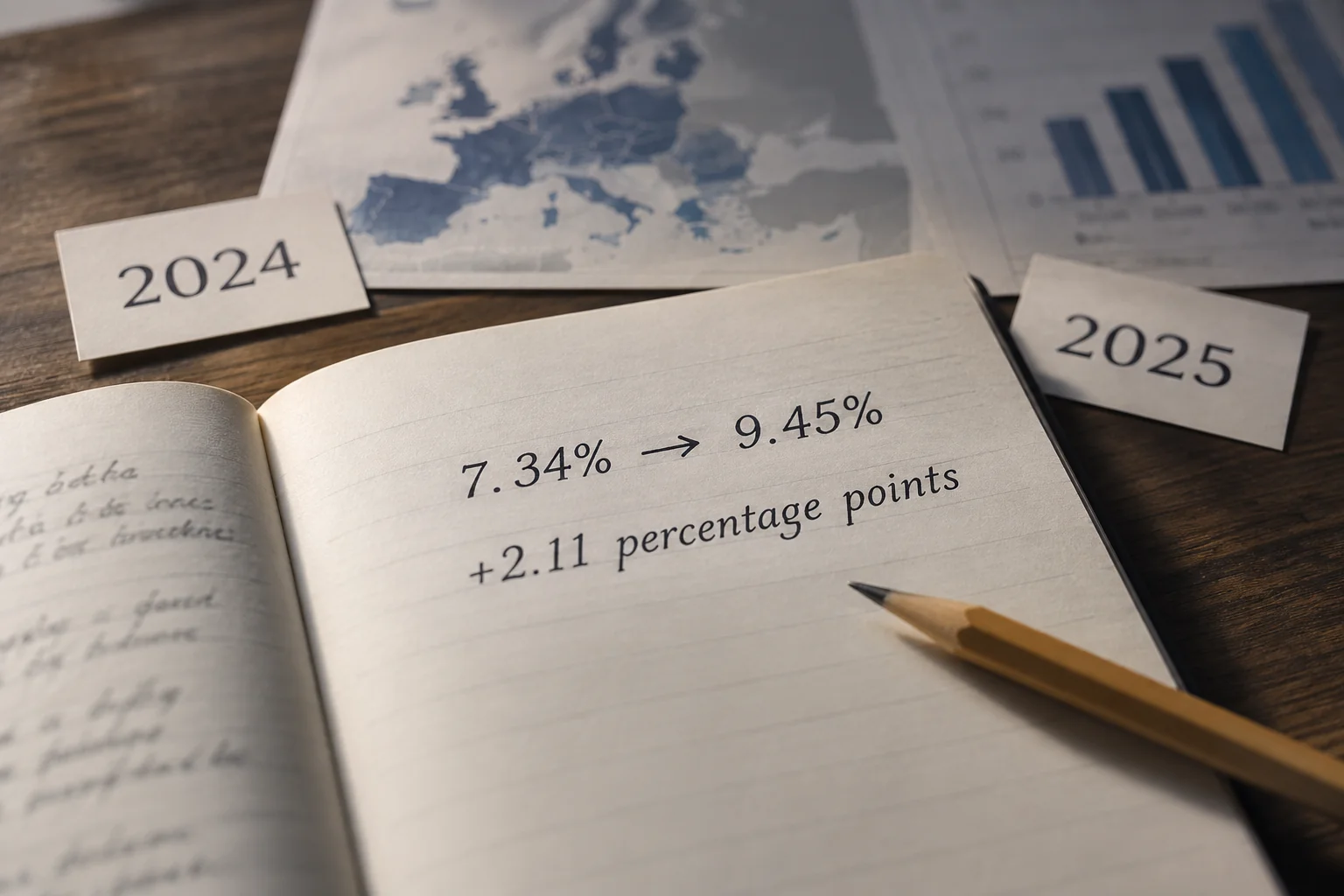
Use Eurostat to track the proportion of recent internet users buying digital books online. Its April 23, 2026 release reports a rise from 7.3% in 2024 to 9.5% in 2025, rounded to one decimal place. The purchase window is the three months preceding the survey, not the whole calendar year. (ec.europa.eu)
The accompanying digital-purchase series extract identifies the more precise values as 7.34% and 9.45%. The separate physical-publication series extract gives 15.83% for printed books, magazines, and newspapers in 2024, without a 2025 observation in that extract. The API responses checked on September 11, 2026 contain these exact values; Eurostat’s news release rounds the digital comparison to one decimal place. (ec.europa.eu)
Keep the physical-publication comparison in 2024, where that extract has a value, and describe the category fully. It includes magazines and newspapers as well as books. You also can't fill the missing 2025 observation with zero or copy the previous year's number forward; neither would represent a reported result.
Using the two-decimal values, participation rose by 2.11 percentage points: 9.45 − 7.34. Relative to the starting value, that's about 28.7% growth: 2.11 ÷ 7.34 × 100. Both describe the same change differently. Use the same inputs throughout, because calculating from the rounded press-release values gives a slightly different answer.
Neither calculation measures ebook revenue growth. The category combines ebooks and audiobooks, and purchase incidence does not reveal transaction count, average spend, completion, or borrowing. A person buying one qualifying download and a person buying ten both count as purchasers. Treat the result as a change in participation, not a change in total sales value. (ec.europa.eu)
Audiobook growth should not be counted as ebook growth
Keep audiobook revenue in its own format line, even when it appears beside ebooks in a digital-publishing report. The Audio Publishers Association's 2025 sales survey reports US$2.43 billion in 2025 audiobook sales revenue, up 9%, and more than 750,000 active titles reported by publishers. Toluna conducted the sales survey. (audiopub.org)
The separate consumer study, conducted by Edison Research at SSRS in February 2026, surveyed 1,706 adult spoken-word audio listeners. Its sample and listening questions belong to audience research, not the publisher-sales calculation. (audiopub.org)
Don't average APA's result with AAP's audio estimate or assume the gap is unreported sales. The organizations use different coverage and methods. Read each as its own measurement first. You would need matching definitions and populations before combining the figures into a new total.
For a proposed audio edition, build a separate budget using the guide to audiobook production cost, then compare expected audio receipts with audio-specific costs. Adding an ebook-only total to a separately measured audio total creates a combined digital category. Adding audio to a digital total that already contains audio double-counts it. Write out the components before doing either calculation.
Format changes that affect ebook production in 2026
Maintain a structured EPUB source and check each destination’s upload requirements before preparing a new edition. W3C published the current EPUB 3.3 Recommendation on January 13, 2026. EPUB packages structured web content into a distributable publication and supports reflowable and fixed-layout approaches. That makes it a production standard, not evidence of sales growth. (w3.org)
For a text-based ebook, include headings, navigation and image descriptions in your production checklist. For a designed page, check readability at the smallest intended display size too. File validation is useful, but still open the book and inspect reading order, links, tables and images. Passing a package check doesn't show how comfortably it reads.
Amazon stopped accepting fixed-layout MOBI uploads on March 18, 2025. Its current KDP guidance specifies EPUB or KPF for fixed-layout books and EPUB, KPF, or DOC/DOCX for reflowable books, with additional manga-specific options. Previously published books need no replacement merely because of this upload change. (kdp.amazon.com)
The distinction between a production file and reader delivery is covered in EPUB support on Kindle. Keep those two questions separate when commissioning conversion: what you submit is not necessarily the file or access route the customer uses.
Under Amazon’s DRM guidance, effective January 20, 2026, verified purchasers can obtain EPUB and PDF downloads for confirmed DRM-free titles through Manage Your Content and Devices. Royalty rates and payment structure do not change with that selection. Older DRM-free books published before December 9, 2025 require explicit confirmation; Kindle Unlimited borrowers do not receive these downloads. (kdp.amazon.com)
Review that choice title by title rather than treating it as a growth tactic. Amazon also states that applying DRM later does not remove files already downloaded. The documentation establishes access conditions; it does not establish that either DRM choice increases sales. (kdp.amazon.com)
A market dashboard for an independent publisher
Build your own dashboard around what each book earns and costs. Keep market statistics nearby for context. Where your reports allow, separate rows by title, format, retailer, territory, currency and month. You'll then be able to see whether a change comes from one book, one store or the whole catalog.
| Field | What to record | Mistake to avoid |
|---|---|---|
| Paid units and refunds | Paid transactions, returned units, and free claims separately | Counting every download as a sale |
| Gross and net revenue | Clearly labeled sales value, deductions, and publisher receipts | Comparing retail spending with money received |
| Subscription reading | Reported reading units and associated income in separate fields | Relabeling page reads as purchased copies |
| Format-specific costs | Conversion, production, distribution, and promotional expenses by format | Assuming the ebook budget also describes audio economics |
| Territory and currency | Original currency plus any documented conversion | Adding dollar and pound receipts directly |
| Availability and release status | Launch date, available months, and new-release or backlist classification | Comparing a partial-year launch with a full-year title |
Choose a consistent way to assign earnings to periods. You might use the sales month on the retailer's statement and keep the bank-receipt date in another column. That stops a late payment from looking like a sudden jump in demand and makes the numbers easier to compare from one month to the next.
Compare total receipts, receipts per title and receipts per month each title was available. Separate new releases from older books before deciding that the catalog is getting stronger. For a promotion, choose the evaluation period and included costs first, then check the result against the transaction reports rather than relying only on a dashboard screenshot.
What authors can learn from these trends
- Supported: participating U.S. trade publishers reported weaker ebook revenue in the first half of 2026. (publishers.org)
- Supported: reported audio growth exceeded the relevant U.S. ebook and UK consumer-digital growth rates. (publishers.org)
- Supported: print retained a majority share in the cited U.S. industry and UK consumer revenue summaries. (publishers.org)
- Not established: a worldwide ebook value, global reader count, or universal subscription share. These figures cover different geographies and measures.
- Not established: that digital publishing is automatically more sustainable than print. Such a comparison needs a defined lifecycle, device assumptions, reading volume, and energy mix—not a revenue trend.
For author-led publishing, consult the separate self-publishing statistics report. Before comparing or combining its numbers with association revenue, identify overlap and exclusions. “Self-published” describes a publishing route; “ebook” describes a format. Those categories are not mutually exclusive.
Example: more revenue doesn’t always mean stronger sales per book
A catalog can earn 50% more overall while earning 25% less per book. Imagine two books available throughout year one and four throughout year two. Receipts rise from $1,000 to $1,500, but the catalog doubles. The table below shows why both the total and the per-title figure are worth checking.
| Measure | First year | Second year |
|---|---|---|
| Titles available throughout the year | 2 | 4 |
| Net publisher receipts | US$1,000 | US$1,500 |
| Receipts per title | US$500 | US$375 |
| Available title-months | 24 | 48 |
| Receipts per title-month | US$41.67 | US$31.25 |
Total receipts grew by (1,500 − 1,000) ÷ 1,000 = 50%. Receipts per title fell from $500 to $375, a (375 − 500) ÷ 500 = −25% change. Those results don't contradict each other. You earned more money, but you also had more books available to earn it.
Now suppose the two new books launched in July rather than January. The original pair contributes 24 title-months and the new pair 12, making 36. Divide $1,500 by 36 and you get $41.67 per title-month, matching year one after rounding. Taking availability into account changes how the comparison looks.
That doesn't settle every question about demand. Genre, price, season and promotion still matter, and a new release may sell differently from an older book. Compare the original pair on their own, then compare the new titles over similar launch periods. Keep the transaction files so you can investigate refunds or unusual receipts when something needs explaining.

Sources and downloadable data
Download the source ledger (CSV) for the figures used in this guide. It keeps values, units, reporting periods, countries, source links and coverage notes together. Use it as a convenient starting point, then return to the original publication when you need more detail about how a number was measured.
Keep release dates separate from measurement periods. AAP’s June 2026 report was released on September 9, 2026; its annual 2025 estimate appeared on August 10, 2026. Neither release date changes the period measured. (publishers.org)
The Eurostat download supplies the two-decimal figures used above. If a year is blank, the extract has no observation for it. Leave it blank rather than turning missing information into zero or assuming the earlier year's figure still applies.
When updating a comparison, use the same source and coverage, including any revised earlier values. Flag changes in the reporting group instead of drawing an uninterrupted trend through them. Then bring the numbers back to your own books: a market report can suggest what to investigate, while your receipts, costs and reader response tell you how an edition is performing.