🐣 EASTER SALE — LIFETIME DEALS ARE LIVE • Pay Once, Create Forever
See Lifetime PlansLimited Time ⏰
AI Tools

HasMCP Review (2026): Honest Take After Testing

Stefan
10 min read
#Ai tool

Table of Contents

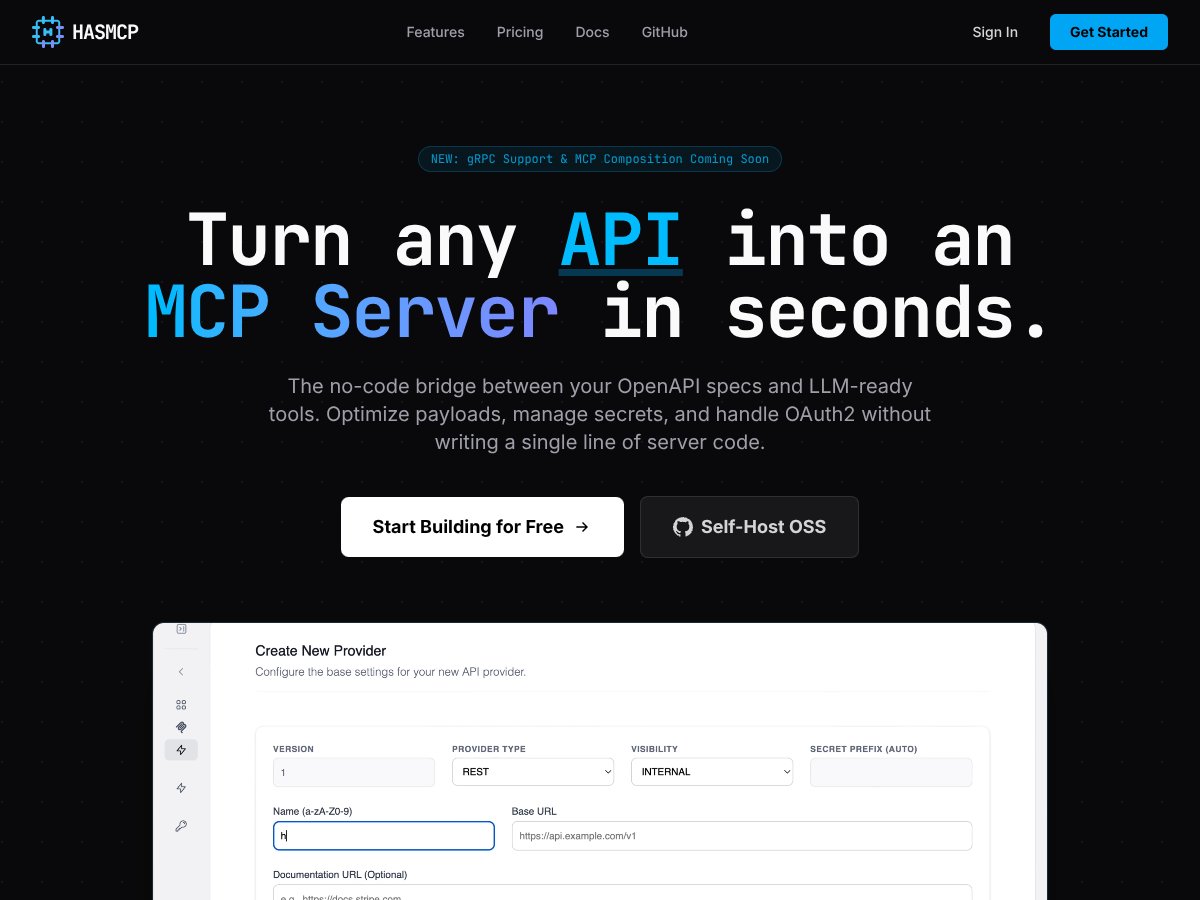
HasMCP screenshot

What Is HasMCP?

Honestly, when I first heard about HasMCP, I thought it was just another API wrapper or a no-code tool trying to make API integration easier. But as I dug into it, I realized it’s aiming to do something a bit more specific: it’s a no-code bridge that turns your OpenAPI specifications into a Model Context Protocol (MCP) server, which is basically a way for large language models (LLMs) to interact more reliably with APIs.

The problem it’s trying to solve is pretty clear — many LLM integrations struggle with understanding and securely calling APIs, especially when it comes to handling authentication, managing payload sizes, or adapting to API changes on the fly. HasMCP offers a solution by automating the creation of a structured, secure, and optimized API interface that LLMs can consume without manual boilerplate programming.

The team behind HasMCP isn’t explicitly detailed in the docs, but from the project’s GitHub and website, it looks like an open-source-focused effort, possibly with some enterprise backing given its security features. I was initially curious whether it’s just a fancy API proxy or genuinely more than that — what I found was that it’s marketed as a way to deploy these MCP servers quickly, with features like payload optimization and secret management baked in.

My first impression was that it’s as advertised — a tool that instantly converts OpenAPI specs into a structured MCP server. The interface itself is minimal, which is fine because most of the heavy lifting is done automatically. But I should mention: it’s not a drag-and-drop builder with a shiny dashboard. Instead, it’s more of a backend service you set up, and the actual user experience is pretty barebones. There’s no fancy GUI or step-by-step wizard; it’s mostly about importing specs and letting the engine do its thing.

Also, don’t expect it to handle non-HTTP APIs or offer a lot of pre-built integrations. It’s very much focused on transforming standard OpenAPI-defined REST APIs into these MCP servers, so if your API doesn’t follow that pattern, you might be out of luck. And I couldn’t find any detailed tutorials or walkthroughs, so there’s a bit of a learning curve if you’re new to MCP or API specs in general.

HasMCP Pricing: Is It Worth It?

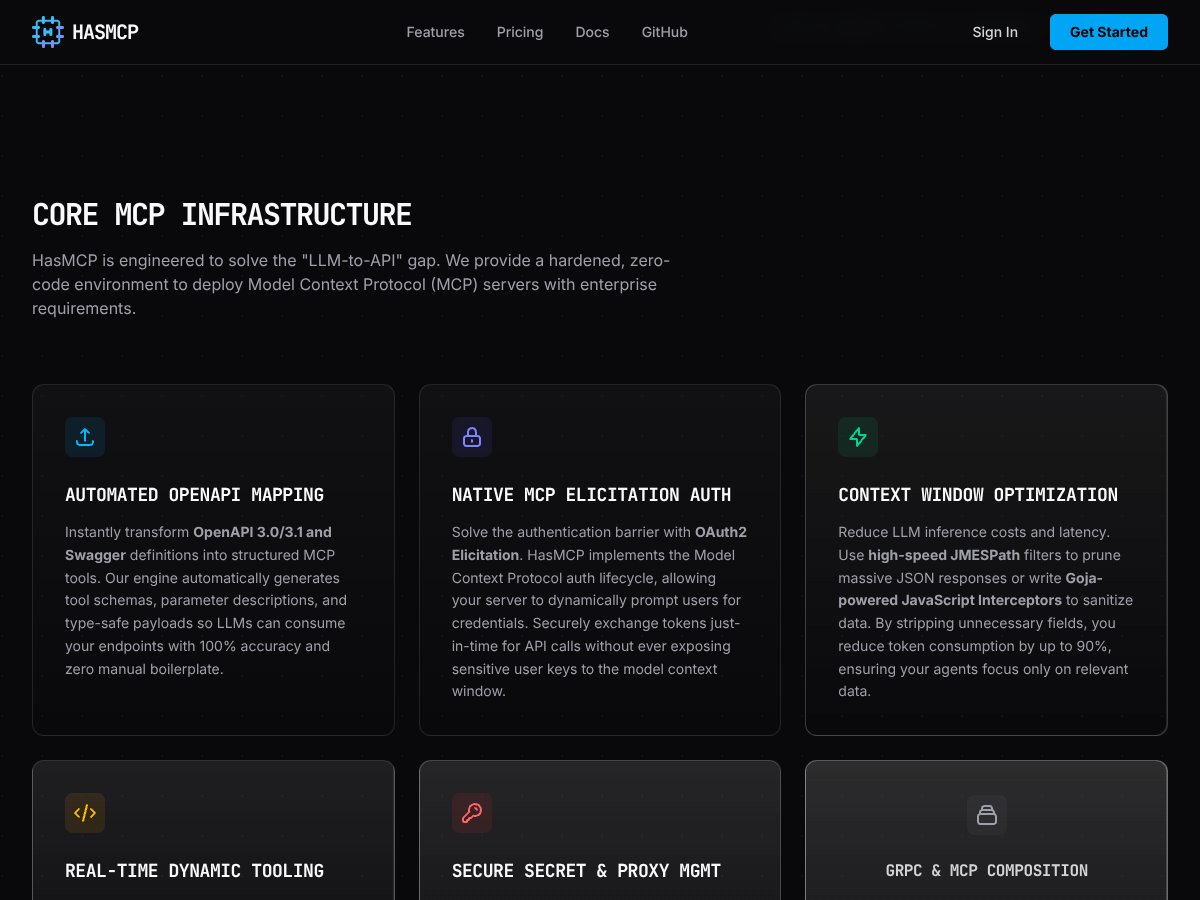
HasMCP interface
HasMCP in action
Plan Price What You Get My Take
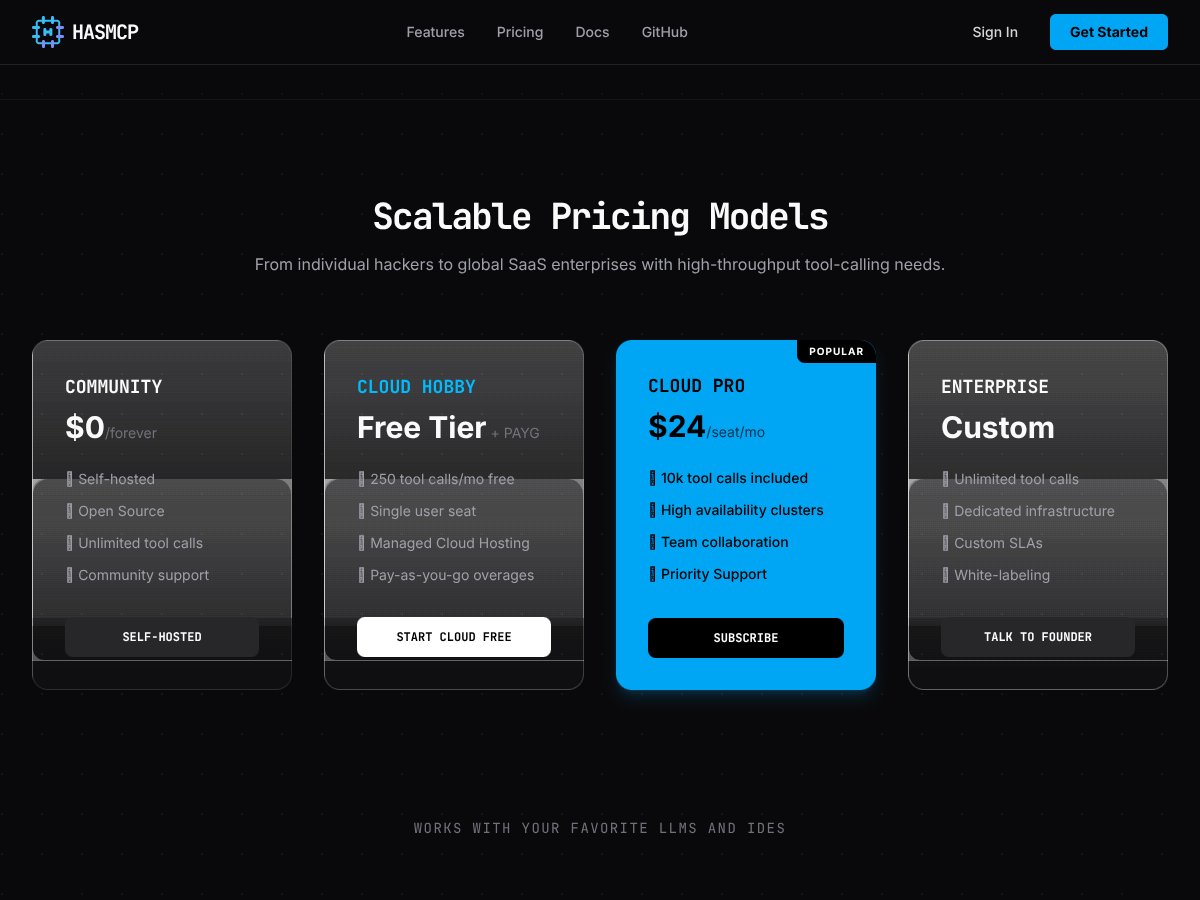
Community $0 / forever
  • Self-hosted, open source
  • Unlimited tool calls
  • Community support
This is a great entry point if you're comfortable with self-hosting and open source tools. It removes cost barriers but requires technical know-how to set up and maintain. Perfect for hobbyists or small teams that can handle infrastructure on their own.
Cloud Hobby Free Tier + Pay-as-you-go
  • 250 tool calls/month free
  • Single user
For small-scale projects or testing, this plan offers some free capacity. However, once you exceed 250 calls, costs can add up, and there's no clear cap or predictable pricing beyond that. It might be suitable for prototyping but not for heavy production workloads.
Scalable Plans Pricing varies (details on site)
  • Designed for individual hackers to enterprise SaaS
  • High throughput API calls
  • Dedicated support options (likely)
They don't publicly specify exact costs, which makes it a bit of a gamble. If you're a larger operation needing high throughput, you'll probably need to contact them directly. Be prepared for a potentially enterprise-level price tag, which might be prohibitive for smaller players.

Overall assessment: The pricing seems to be leaning towards enterprise customers, especially with no public pricing transparency. The free community tier is appealing for open source enthusiasts, but for commercial use, expect to need a paid plan. Be wary of hidden costs—usage limits and feature gates might kick in quickly if your needs grow. For solo developers or small teams, the community plan could suffice, but larger teams should prepare for custom quotes.

The Good and The Bad

What I Liked

  • Zero-code setup: Transforming OpenAPI specs into MCP servers with a click is a huge time-saver; I was honestly expecting a lot of manual configuration here.
  • Enterprise-grade security: The encrypted secrets management and OAuth2 support are critical for production environments—and they handle this well.
  • Real-time schema updates: Being notified of API changes instantly means your LLM integrations stay current without manual re-deployments.
  • Performance optimizations: The use of JMESPath pruning and JavaScript interceptors actually reduces token costs significantly, which can save both money and latency.
  • Open source and self-hosted options: If you prefer to keep everything in-house, the community version is a solid choice.

What Could Be Better

  • Limited feature set in current release: The upcoming gRPC support and MCP composition sound promising, but right now, you're mostly relying on HTTP APIs with no native multi-server mesh yet.
  • Lack of detailed documentation or tutorials: It’s not super beginner-friendly; you might need to dig through GitHub repos or ask in communities to get started.
  • Pricing transparency: No public plans or costs are posted, so you might face surprises when scaling up, especially in enterprise plans.
  • No dedicated integrations listed: While the core features are compelling, the absence of pre-built integrations with popular tools could be a hurdle for some users.
  • Limited use case guidance: The marketing doesn’t specify exactly who should be using this and for what; you’ll need to assess if your API setup fits their model.

Who Is HasMCP Actually For?

HasMCP interface
HasMCP in action

If you're a developer or startup working heavily with APIs and want to empower LLMs to interact seamlessly without writing boilerplate, this could be a potent tool. Think solo AI engineers, small teams, or even larger SaaS providers who need dynamic API integrations that are secure and cost-effective. For example, if you run a customer support chatbot that needs to call various APIs securely and efficiently, HasMCP’s ability to transform OpenAPI specs into MCP servers with real-time updates can streamline your workflow.

Similarly, if you're managing multiple internal APIs and want to expose them safely to an LLM-based system, this platform simplifies deployment, secret management, and payload optimization. But note—it's geared toward those with a decent understanding of API specs and some infrastructure knowledge, especially if you go with the self-hosted community version.

Who Should Look Elsewhere

If your primary need is a plug-and-play LLM tool with minimal setup, or if you don’t want to handle self-hosting or API specs, this isn’t the right fit. Also, if you’re dealing with APIs outside the OpenAPI standard, or need deep customizations beyond what's offered, you might be disappointed. For example, if you’re looking for a no-code chatbot builder that requires zero API configuration, there are simpler, more user-friendly options.

Additionally, those expecting comprehensive integrations with existing SaaS platforms or a transparent, predictable pricing model might find this frustrating. It’s more of a developer-centric platform, so if you’re a non-technical user or small business without API expertise, you should probably look elsewhere.

How HasMCP Stacks Up Against Alternatives

Amazon Bedrock with MCP Support

  • Amazon Bedrock offers a fully managed LLM service that supports MCP-like integrations, but it's tied to AWS infrastructure and ecosystem. Unlike HasMCP, which transforms OpenAPI specs into MCP servers instantly, Bedrock is more of a platform with a steeper setup curve and less control over custom MCP configurations.
  • Pricing is typically based on AWS usage, which can become costly at scale. HasMCP's pricing isn't transparent publicly, but it might be more predictable for enterprise deployments.
  • Choose this if you want a managed AWS experience and are already invested in their ecosystem. Stick with HasMCP if you prefer quick setup, flexible API integration, and local control over MCP servers.

Replit MCP Implementations

  • Replit offers open-source MCP server implementations that you can host yourself. This gives full control but requires technical setup, maintenance, and infrastructure management, unlike HasMCP's no-code approach.
  • Cost depends on your hosting provider—can be free if you run on free-tier cloud services, but you'll handle setup and scaling. HasMCP charges may include enterprise features and support, which are not available with free Replit setups.
  • Choose this if you want full customization and are comfortable managing infrastructure. Stick with HasMCP if you need quick deployment without the hassle of server management.

Open-Source MCP Projects (e.g., from GitHub)

  • Open-source MCP servers give maximum flexibility and no licensing fees but require deep technical expertise to implement, extend, and secure. They often lack enterprise features like OAuth2 or dynamic schema updates.
  • They're free, but the time investment can be significant. HasMCP offers a more streamlined experience with enterprise-grade security and real-time updates, which open-source projects typically lack.
  • Choose this if you have a strong development team and need total control. Stick with HasMCP if you prefer a ready-made, secure, and scalable solution without building from scratch.

Custom Built MCP Servers (manual implementation)

  • Building your own MCP server from scratch ensures maximum control but involves significant engineering effort, ongoing maintenance, and potential security risks. HasMCP automates this process, saving time and reducing errors.
  • Cost varies depending on development and hosting, but it’s generally higher than using a ready-made tool. HasMCP’s subscription or licensing might be more cost-effective in the long run.
  • Choose this if you need bespoke features not supported by HasMCP and have the resources to maintain custom infrastructure. Otherwise, HasMCP is the smarter choice for most.

Bottom Line: Should You Try HasMCP?

Overall, I’d rate HasMCP around 7/10. It’s a solid tool for quickly turning OpenAPI specs into secure, scalable MCP servers, especially if you’re looking to avoid coding and infrastructure headaches. The no-code setup, combined with enterprise features like OAuth2 and real-time updates, makes it a compelling choice for teams wanting fast deployment with security in mind.

If you’re a developer or product team that needs rapid MCP deployment, minimal maintenance, and enterprise-grade security, definitely give it a shot. On the other hand, if you require total customization, have a tight budget, or prefer open-source flexibility, you might want to explore alternatives.

The free tier (if available) is worth testing to see how well it fits your needs, but for sustained production, the paid plans could be a worthwhile investment, especially given the time saved and security benefits. Personally, I’d recommend it if you’re aiming for quick, reliable MCP deployment without the hassle of building everything from scratch.

If your priority is enterprise API security and instant MCP setup, give HasMCP a try. If you want full control or low-cost open-source options, look elsewhere.

Common Questions About HasMCP

Is HasMCP worth the money?
It can be, especially if you need fast, secure MCP deployment with minimal setup. However, the value depends on your specific needs and budget, as pricing isn’t publicly transparent.
Is there a free version?
Details about a free tier aren’t clear publicly. It’s likely there’s a trial or limited free tier, but enterprise features probably require payment.
How does it compare to Amazon Bedrock?
HasMCP offers more control and instant setup for MCP servers, while Bedrock is a managed platform tied to AWS. Bedrock might be better if you’re already in the AWS ecosystem, but HasMCP is more flexible for API integration.
Can I use it with non-HTTP APIs?
No, currently HasMCP is limited to HTTP APIs. Support for gRPC is upcoming but not yet available.
Is there support for dynamic schema updates?
Yes, HasMCP supports real-time tool updates without server restarts, making schema changes seamless.
Can I get a refund?
Refund policies aren’t publicly detailed. You’ll need to check directly with the provider, but enterprise SaaS typically offers some form of refund or credit for unsatisfactory service.

As featured on

Automateed

Add this badge to your site

Stefan

Stefan

Stefan is the founder of Automateed. A content creator at heart, swimming through SAAS waters, and trying to make new AI apps available to fellow entrepreneurs.

Related Posts

FaceSymmetryTest Review – Honest Look at Free AI Tool

FaceSymmetryTest Review – Honest Look at Free AI Tool

FaceSymmetryTest is a fun online tool

Stefan
Sweep Review – An AI Assistant for JetBrains IDEs

Sweep Review – An AI Assistant for JetBrains IDEs

Sweep enhances productivity in JetBrains IDEs

Stefan
AI Song Maker Review – Simple & Creative Music Generation

AI Song Maker Review – Simple & Creative Music Generation

easy way to create music with AI

Stefan

Create Your AI Book in 10 Minutes