
Table of Contents
A synopsis is a short summary of a book, film or other work. If an agent asks for a novel synopsis, they want the complete main story, including the ending. Explain who the story follows, what they want, what goes wrong and how it turns out. You can leave out minor scenes, but don't hide the resolution to create suspense. merriam-webster.com
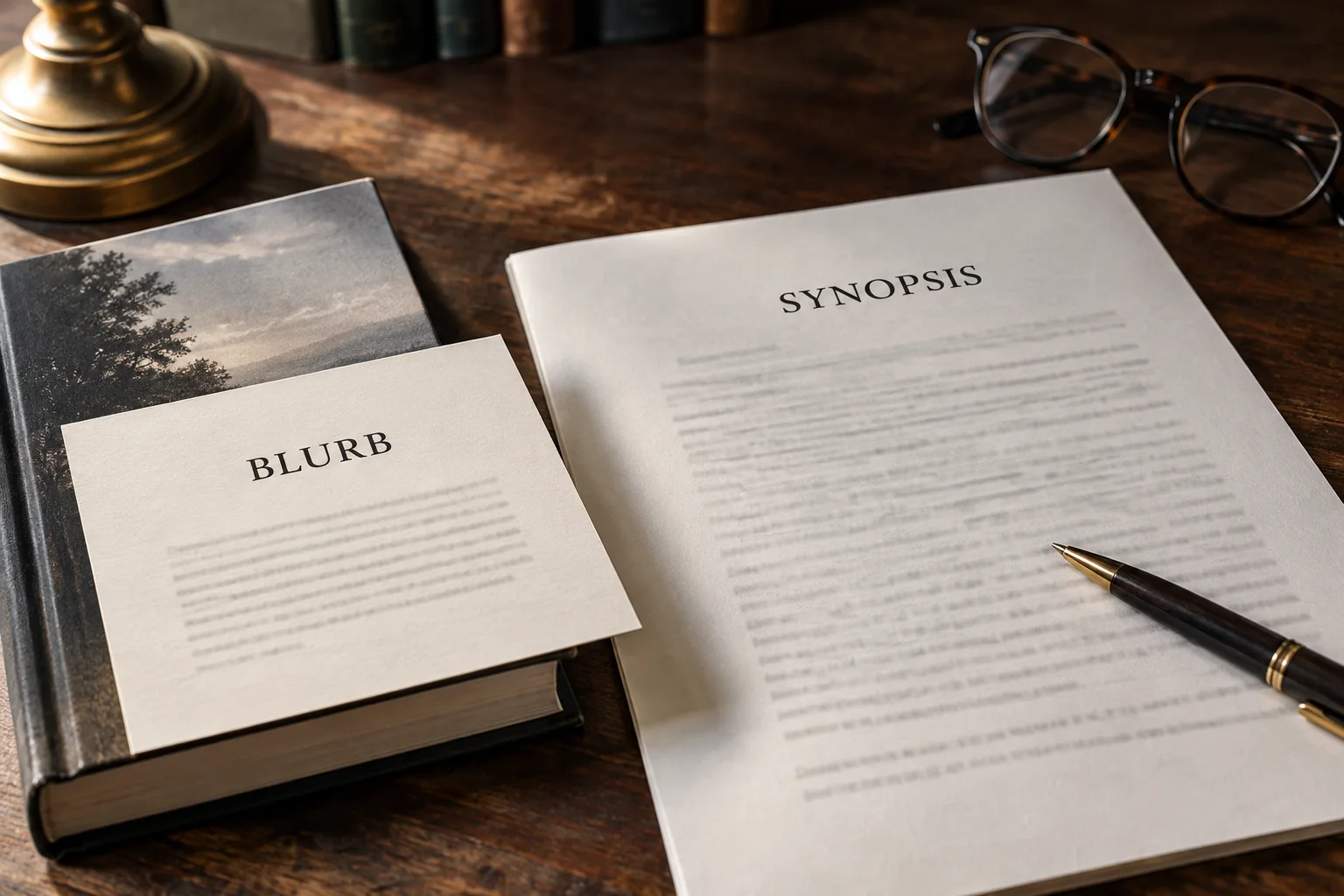
Think of the difference this way: a blurb makes someone want to read the book; a submission synopsis shows how the whole story works. That means spoilers belong in the synopsis. Below, we'll follow one complete example and show how to decide which events to include, how much detail they need and what you can cut. marloberliner.com
What does synopsis mean?
Synopsis means a condensed account, not a complete retelling. The word’s general meaning is broader than publishing: it can describe an overview of a work or subject. Here, the focus is the fiction submission document. (merriam-webster.com)
Start with six things: your protagonist, their goal, the main obstacle, the choices that change the story's direction, the climax and the outcome. Connect them into a clear account. You don't need to recreate every scene; you need someone who hasn't read the manuscript to understand why the important events happen.
Eve White Literary Agency asks fiction submissions for a brief synopsis of the whole plot, including spoilers, no more than one page. This is a useful example of how a recipient defines the document: a complete plot account within a stated limit, rather than a teaser. (evewhite.co.uk)
A useful check: the blurb raises the story's central question, while the synopsis shows how the manuscript answers it. If your final paragraph still ends with “Will she succeed?”, you probably haven't finished the synopsis.
Types of synopses
Check what the recipient asks for before deciding how much to write. The same novel can have a one-page synopsis and a longer version. The longer one has room to explain more of the connections between events. The table below helps you plan that detail, rather than laying down categories every agent uses.
| Type | Intended reader | What to prepare |
|---|---|---|
| Novel submission synopsis | Literary agent or publisher | The main plot from beginning to end, with the protagonist’s changing motives and decisive actions |
| Short one-page synopsis | Recipient specifying one page | The central conflict, essential turning points, and resolution; omit supporting threads unless the ending needs them |
| Longer synopsis | Recipient requesting additional detail | The same complete arc, expanded with evidence, motivations, and relevant subplot connections |
| Screen synopsis | Producer, development reader, or collaborator | A prose account of the principal characters and action; check whether the request covers a feature, pilot, or larger series |
| Academic synopsis | Instructor or researcher | Use the assignment brief: identify the question, approach, argument or findings, and scope rather than imposing a fictional plot structure |
For a concrete screen-submission example, Dark House requests the complete plot, major developments, and ending within two sides of A4. Its screenplay requirements also distinguish standalone television, episodic television, and feature-film material. Those are that agency’s requirements, not a universal screen format. (darkhouse.uk)
How to write a synopsis, with a complete example
Get the main story down first, then shorten it to the requested limit. Start with decisive actions, connect each to its cause or consequence and remove details that don't help explain the central plot. These seven steps will take you from a manuscript you know inside out to an account a new reader can follow.
- Introduce the protagonist in a disrupted situation. Give the reader a person and a problem, not a biography. In the example below, Lina’s profession matters because it equips her to recognize altered maps.
- Make the goal concrete. Write what the protagonist tries to achieve. “Stop construction of an unsafe sea wall” is more informative than “find the truth.”
- Connect events through consequences. After each major action, explain what becomes harder, possible, or unavoidable. If two sentences can swap places without changing anything, check whether their relationship is missing.
- Retain choices that redirect the story. A discovery earns space when it changes the investigation or forces a decision. Include the emotional reason for a choice when the action alone would seem arbitrary.
- Write through the climax to the aftermath. State what the protagonist does, whether it succeeds, and what remains damaged or unresolved. Do not finish with a question.
- Reduce the cast and scene detail. Name the people whose actions the reader must track. Describe everyone else by a clear role, and summarize conversations unless their precise wording is indispensable.
- Apply the recipient’s format. Check length, spacing, file type, and attachment instructions. For a novel synopsis without contrary instructions, third-person present tense is a useful default; Marlo Berliner recommends that approach in her synopsis guide. (marloberliner.com)
How long should it be? Use the requested limit: Dark House Literary & Screen Agency allows up to two sides of A4 and requires the major plot developments and ending. Together with Eve White’s one-page limit, this illustrates why a general page recommendation cannot replace the actual brief. Neither example establishes a universal word count. (darkhouse.uk)
Here's a complete three-paragraph synopsis for an invented novel. The setup, escalation and resolution labels show how it's built; you can leave those labels out when writing a continuous submission document.
Setup: Marine cartographer Lina Vale returns to the island she left ten years earlier after discovering alterations to her late father’s coastal maps. A sea wall is being built from the false measurements, leaving the harbor vulnerable when the first storm arrives. Lina sets out to stop construction before residents rely on protection the wall cannot provide.
Escalation: The contractor rejects her warning and produces her father’s signed survey. Investigating the discrepancy, Lina discovers that her brother Tomas forged the final measurements to secure the project that kept the island’s shipyard open. Exposing him would halt the wall but bankrupt hundreds of neighbors. Protecting him would leave those same people inside the flood zone.
Resolution: Lina makes the original survey public and demonstrates that the wall cannot protect the harbor. Tomas confesses, and the council suspends construction and funds reopening the old evacuation road before the storm. The harbor floods, but no residents are trapped. Rather than leave again, Lina stays to establish a public map archive that no single contractor can alter.
“Lina must choose between her brother and the island” tells us the dilemma, but stops before the choice. The final paragraph goes further: she releases the survey, the council acts and residents escape the flood. That's the information an agent needs to understand how the story resolves its central problem.
Why these events belong in the synopsis
Each event changes the problem or helps explain the ending. The altered maps bring Lina home and give her a job to do. Her father's signature makes that job harder because the contractor appears to have evidence on his side. Keeping that detail explains why Lina can't simply point out the danger and stop construction immediately.
Discovering Tomas's forgery makes the investigation personal. Lina must expose her brother, and his actions are tied to the island's jobs. That gives her a meaningful conflict without spending a paragraph on their childhood. We learn enough about the relationship to understand why the next decision is difficult.
The ending solves two problems separately. Publishing the survey exposes the unsafe construction plan. Reopening the evacuation road gives residents a way out when the storm arrives. Keep both actions: revealing a forgery doesn't stop the weather, and the synopsis needs to show how the characters address the danger that remains.
The archive also shows what changes for Lina. She returned to an island she'd left behind; now she chooses to stay and take responsibility for its maps. That action tells us more than a final claim that she “learns courage.” The emotional ending grows out of something she actually does.
A dinner or reunion might be a lovely chapter in the novel without needing a sentence in the synopsis. Keep it only if leaving it out removes vital evidence, makes a choice hard to understand or hides a relationship that determines the ending. The synopsis follows the main story, not every enjoyable scene.

What to add when you have more space
Use extra space to explain how the big turns happen. In our short version, Lina's discovery of the original survey is compressed. A longer synopsis can show how she finds it and why she trusts it. That adds useful explanation without becoming a list of everyone she meets during the investigation.
For example: “A retired harbor engineer gives Lina a dated survey copy preserved before the contractor’s revisions. Its measurements agree with old flood markers still visible on warehouse walls. Tomas initially dismisses the copy as obsolete, but Lina produces matching field notes. Unable to explain away both records, he admits replacing the final figures to secure the shipyard contract.”
The expansion gives us the source of the survey, a way to check it, Tomas's objection and the evidence that defeats it. Each detail helps explain the discovery. Naming every person Lina interviewed would make the synopsis longer, but might do less to help us understand why she reaches the right conclusion.
Next, identify who has authority to act: “At an emergency council meeting, Lina releases the original and altered surveys. Tomas confirms the substitution publicly, and the council suspends construction. It redirects the available emergency allocation to clearing the old evacuation road.” Now the funding decision belongs to the council, rather than seeming to fall within Lina’s personal control.
Keep the outcome faithful to the story. The harbor still floods; the evacuation road prevents people from being trapped. If the novel also resolves compensation, Tomas's legal position or the shipyard's future, include what matters most. If those questions remain open in the manuscript, don't invent neat answers just to tidy the synopsis.
Those added details are possible developments of our invented story. In your own synopsis, use what actually happens in the manuscript. If a crucial explanation exists only in your planning notes, consider whether the novel needs that explanation too. A clearer synopsis can reveal a story problem worth fixing before submission.
Synopsis vs. summary
A synopsis is a kind of summary; a submission synopsis has the specific job of presenting the full narrative. “Summary” alone does not tell you whether to reveal an ending or how much detail to include. Its purpose must come from the context. (merriam-webster.com)
| Document | Primary job | Ending treatment | Drafting emphasis |
|---|---|---|---|
| Submission synopsis | Present the complete story for evaluation | State the resolution | Motives, obstacles, turning points, decisions, and consequences |
| Back-cover blurb | Create interest in reading the book | Generally withhold the resolution | Premise, distinctive situation, and stakes |
| Query pitch | Introduce the project and encourage further reading | Generally withhold the resolution in the story pitch | Hook and central conflict; place project information elsewhere in the letter |
| General summary | Condense material for a particular use | Follow that use | The information the reader needs, whether narrative or non-narrative |
Berliner’s guide distinguishes the complete synopsis from shorter, ending-withholding pitches and separates it from author information and comparable titles. Treat those documents as related tools, not interchangeable versions of the same text. (marloberliner.com)
“A cartographer discovers that saving her island means exposing her brother” could work as a pitch. A synopsis has to go on: what evidence does Lina find, what does she release and how do residents escape the flood? Adding those answers changes the document's purpose, not just its length.
The role of a synopsis in publishing
A synopsis makes the whole plot available for evaluation when the recipient has only sample chapters. For example, Eve White requests opening chapters alongside the full-plot synopsis. The two documents therefore supply different information: the opening itself and an account of what follows. (evewhite.co.uk)
Check the synopsis as someone who hasn't read your chapters. Can they follow how a mystery reaches its solution? Do they know how the central romance ends? Have you included the earlier clue that makes a late twist plausible? Answer those questions without feeling obliged to account for every chapter in turn.
The rest of the package remains recipient-specific. Penguin’s interview with literary agent Cathryn Summerhayes describes a nonfiction proposal containing a project overview, planned chapter breakdown, and sample chapter; that is a different task from summarizing a novel’s plot. Do not substitute a synopsis for a requested proposal. (penguin.co.uk)
Let actions carry the emotion. “An unforgettable reckoning” doesn't tell an agent what Lina does. Releasing evidence against her brother does. You don't need to strip the prose of feeling, but give readers the event that creates that feeling instead of instructing them how impressive it should seem.
Common mistakes to avoid
First fix what's missing or hard to follow. Polish the sentences afterward. These common problems and repairs will help you find the places where the synopsis leaves a new reader guessing:
- Stopping at the dilemma: add the choice, its immediate result, and the final situation.
- Listing disconnected events: explain why the next event follows or remove an event that contributes nothing essential.
- Introducing too many names: retain names for recurring decision-makers and use roles for supporting figures.
- Replacing action with theme: turn “she learns about loyalty” into the decision that reveals what loyalty now means to her.
- Retelling scenes: replace dialogue, gestures, and setting description with what the encounter changes.
- Drifting between tense or viewpoint: choose a consistent narrative frame and make past events clearly subordinate to it.
- Compressing beyond intelligibility: restore the evidence or motivation that makes an apparently sudden turn understandable.
- Using praise as a conclusion: delete claims that the story is gripping, cinematic, or unique, and finish with its actual outcome.
Also check compliance separately from prose quality. A readable synopsis can still exceed the recipient’s limit or arrive in the wrong attachment arrangement. Eve White and Dark House both specify how fiction materials should be combined. (evewhite.co.uk)
Repair a weak synopsis paragraph
Replace broad promises with the actual obstacle, discovery and choice. Consider this weak middle paragraph: “Lina returns home, meets many interesting people and discovers shocking secrets. She must confront her past in a race against time.” It sounds busy, but we still don't know what happens.
“Interesting” and “shocking” tell us the reaction the writer hopes for. They don't explain the people or secrets. “Confront her past” leaves Lina's action unclear, and “race against time” doesn't name the deadline. Give the reader those missing facts and the paragraph will become more compelling without needing stronger adjectives.
A stronger replacement is: “The contractor dismisses Lina’s warning by producing her father’s signed survey. Comparing it with an earlier copy, Lina finds altered flood measurements and confronts Tomas, who admits changing them to secure the shipyard contract. Stopping the unsafe wall before the storm now requires her to expose his forgery publicly.”
Now we can follow the obstacle, the conflicting surveys, Tomas's responsibility and Lina's choice. The sequence also stays clear: he admits the forgery privately during the investigation, then confesses publicly near the ending. Keeping that order prevents the synopsis from making the same revelation appear to happen twice for no reason.
Keep names easy to follow. Introduce “her brother Tomas,” then use “Tomas” where it's clear. The contractor and retired harbor engineer can remain job descriptions unless their names matter later. For a subplot mentioned only once, explain how it changes Lina's decision or leave it out of the short version.
A submission-ready synopsis checklist
Check the synopsis against the manuscript and the submission instructions. It needs to tell the story accurately and arrive in the form the recipient requested. Use this list for the final pass:
- The opening identifies the protagonist, immediate problem, goal, and stakes.
- Each retained event advances the conflict, changes a decision, or explains an outcome.
- The main turning points and the protagonist’s motivations are understandable without the novel beside them.
- The climax states what happens, rather than promising a dramatic confrontation.
- The ending covers the central outcome and any remaining uncertainty honestly.
- Character names and roles remain consistent and easy to track.
- The document meets the requested length, spacing, file type, and attachment arrangement.
- Title and identifying details match the submission package where identification is requested.
- No review quote, sales claim, or cliffhanger substitutes for plot information.
Do not automatically add your name to every document. Anonymized opportunities can require the opposite: Penguin’s WriteNow application guide instructs applicants to omit their names from the synopsis and extract. Follow the particular brief, including its identification rules. (penguin.co.uk)
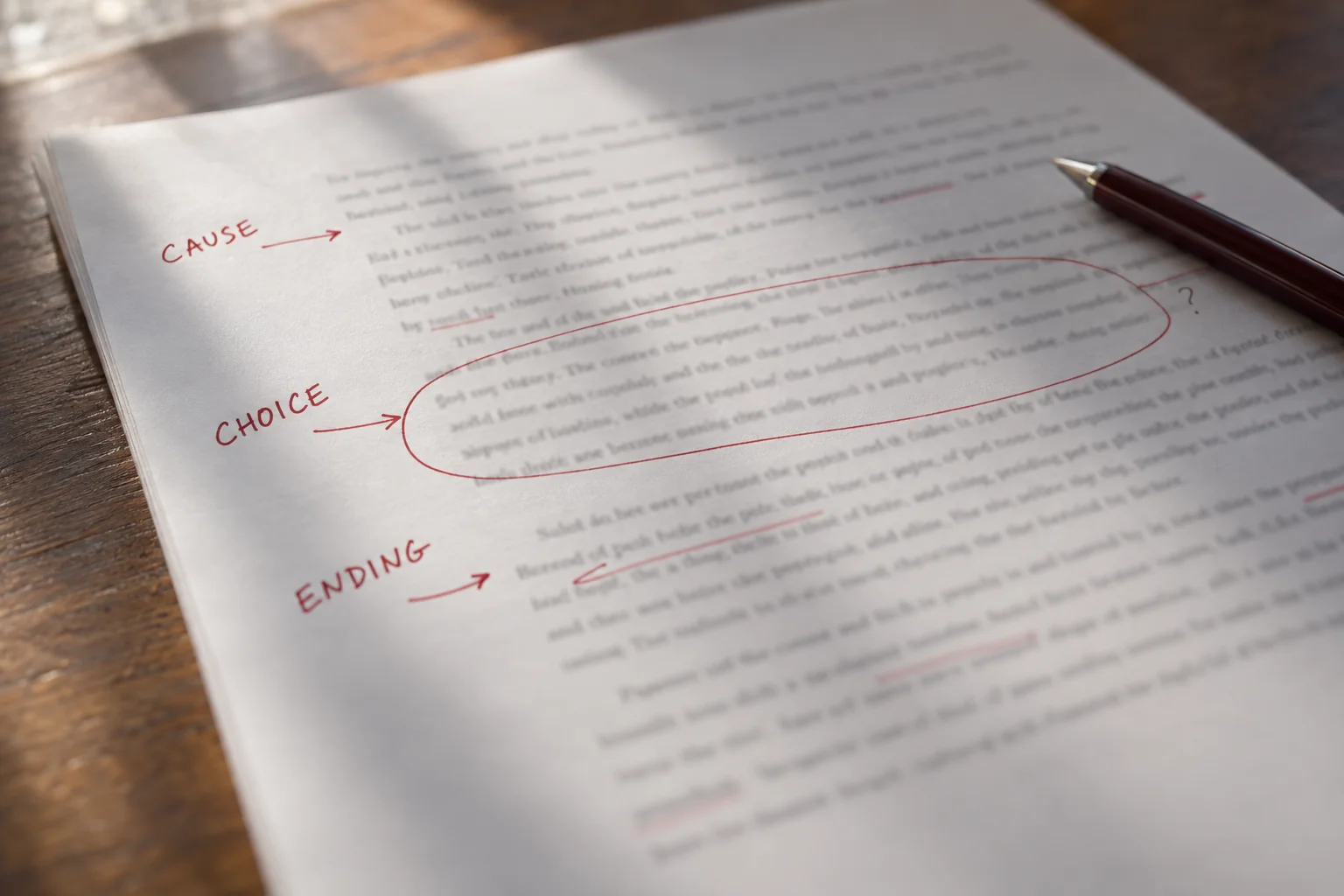
Read the synopsis on its own and mark every place you ask “Why?” If the event matters, restore the missing cause. If it doesn't, cut it. And if the manuscript itself never explains an important decision, return to the story. A shorter sentence can't fix a plot turn that has no convincing reason behind it.
Open the final attachment before sending it. Check the ending, page limit and arrangement of the requested materials. Read the recipient's current genre and authorship rules too. The agencies above show how requirements differ; their examples don't replace checking whether your particular submission fits the full brief.