Table of Contents
Feeling overwhelmed by the idea of writing for newspapers? Trust me, you’re not alone. It can feel like trying to juggle cats sometimes!
But here’s the good news: with a few handy tips, you’ll be crafting articles like a pro in no time.
From uncovering a newsworthy story to penning a headline that grabs attention, let’s dive into making your writing shine.
Key Takeaways
- Start with a newsworthy story relevant to your readers.
- Define your audience and set clear goals for your article.
- Research thoroughly using reliable sources and include accurate data.
- Organize information using the inverted pyramid structure.
- Craft a strong lead to grab the reader’s attention immediately.
- Write clearly and concisely, using simple language and short sentences.
- Incorporate quotes and diverse perspectives to add depth.
- Maintain objectivity and fact-check all information.
- Engage readers with storytelling techniques while sticking to the facts.
- Edit and proofread your work carefully to eliminate errors.
- Create a compelling, accurate headline that grabs attention.
- Submit your article on time and continually work on improving your writing skills.

Start with a Newsworthy Story
Writing for newspapers starts with finding a story that matters. Look around your community for events or issues that people care about. Is there a local hero making a difference? Has a new policy impacted your town? Choosing a timely and relevant topic will capture your readers’ attention.
For example, covering the opening of a new community center provides an opportunity to highlight its benefits and share residents’ reactions. Remember, the most impactful stories often come from everyday happenings that resonate with your audience.
Define Your Goals and Audience
Before you start writing, think about who your readers are. Are you addressing young adults, parents, or business leaders? Understanding your audience helps you craft your message in a way that speaks directly to them.
Set clear goals for your article. Do you aim to inform, persuade, or entertain? Knowing your purpose guides your writing and ensures your article has the desired impact. For more on identifying your target audience, check out What Does Target Audience Mean?
Research Your Topic Thoroughly
Solid research is the backbone of good journalism. Gather information from reliable sources to provide accurate and informative content. Dive into statistics, expert opinions, and recent studies to enrich your article.
For instance, if you’re reporting on technology trends, including data like “over 8.5 billion searches are performed daily on Google” can emphasize the topic’s significance. Did you know that the #1 result in Google gets approximately 27.6% of all clicks? Using up-to-date statistics makes your article more compelling and trustworthy.
Don’t hesitate to use AI tools to enhance your research process. Tools like those discussed in AI Tools for Research can help you gather information efficiently.
Always verify your sources to maintain credibility. Quoting reputable organizations and double-checking facts builds trust with your readers.
Use the Inverted Pyramid Structure
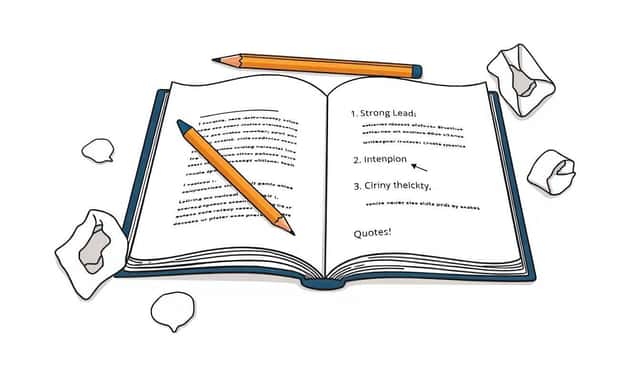
When writing for newspapers, organizing your information effectively is key.
The inverted pyramid structure places the most important information at the beginning.
Start with the essential details, then move on to the supporting information.
This approach ensures that readers get the crucial points even if they don’t finish the article.
For example, begin by answering the who, what, when, where, why, and how of the story.
By prioritizing key information, you capture and retain your audience’s attention.
Craft a Strong Lead for Your Article
Your lead is the first sentence or paragraph of your article, and it’s crucial.
A compelling lead grabs the reader’s attention and encourages them to keep reading.
Try starting with an interesting fact, a provocative question, or a powerful quote.
For instance, “Over 8.5 billion searches are performed daily on Google—how does your story stand out?”
An effective lead sets the tone and gives a glimpse of what’s to come.
Remember, you have just a few seconds to hook your reader, so make it count.
Write Clearly and Concisely
Clarity is essential in journalism.
Use simple language and avoid jargon to make your article accessible to everyone.
Short sentences and paragraphs improve readability, especially on mobile devices.
Did you know that 80% of emails not optimized for mobile are deleted immediately?
Similarly, readers appreciate articles that are easy to read on any device.
Get straight to the point, and eliminate unnecessary words.
If you can say something in fewer words, do it.
Incorporate Quotes and Diverse Perspectives
Including quotes from people involved brings your story to life.
Talk to different sources to provide various viewpoints on the topic.
This adds depth and credibility to your article.
For example, if you’re reporting on local education, interview students, teachers, and parents.
Their insights can highlight different aspects of the issue.
Remember, diverse perspectives make your story more engaging and informative.
Maintain Objectivity and Fact-Check Information
As a journalist, it’s important to stay unbiased.
Present the facts without letting personal opinions color your writing.
Always fact-check your information from multiple reliable sources.
With so much information available, accuracy builds trust with your readers.
Did you know that about 49% of the time, the top-ranking page on Google gets the most search traffic?
Ensuring your article is accurate and reliable can help it reach more people.
Double-check names, dates, and statistics before publishing.
Engage Readers with Storytelling Techniques
While sticking to the facts, you can still make your article interesting.
Use storytelling techniques to draw readers in.
Set the scene with vivid descriptions and engage the senses.
For instance, describe how the aroma of freshly baked bread fills a new bakery that’s opening in town.
These details help readers visualize the story and feel connected.
For more ideas on crafting engaging narratives, check out Creating the Myth.
But keep it balanced—don’t let creativity overshadow the facts.
Edit and Proofread Your Work
Before submitting your article, take the time to edit and proofread.
Look for grammar mistakes, typos, and awkward phrasing.
Reading your article out loud can help you catch errors you might miss otherwise.
You might also consider using tools that can assist you, as discussed in Best Proofreading Software.
However, remember that over 65% of people believe that AI content is the same or better than human writing.
Still, adding your personal touch ensures your article stands out.
If possible, ask a colleague to review your work for a fresh perspective.
Create a Compelling Headline
Your headline is often the first thing readers see, so make it count.
Craft a headline that is clear, concise, and grabs attention.
Include keywords that make the topic obvious.
Did you know that organic search results that rank on page 1 of Google contain an average of 1,447 words?
While your headline doesn’t need to be long, it should accurately reflect the content of your article.
Avoid clickbait—misleading headlines can disappoint readers and damage your credibility.
Submit on Time and Keep Improving
Meeting deadlines is crucial in the fast-paced world of journalism.
Plan your time wisely to ensure you can research, write, and edit your article before the deadline.
Submitting on time shows professionalism and reliability.
Also, always look for ways to improve your writing skills.
Consider seeking feedback from editors or peers.
You might even explore resources on how to write in present tense or other writing techniques.
FAQs
Begin by identifying a current event or topic that is timely, relevant, and interesting to your audience. Gather facts, conduct interviews, and ensure the story has a clear angle or hook that will engage readers from the start.
The inverted pyramid is a writing style where the most important information is presented at the beginning of the article. It allows readers to quickly grasp the key points before delving into supporting details and background information.
Write a compelling first sentence or paragraph that summarizes the most critical aspects of the story. It should grab the reader’s attention, provide essential information, and entice them to read further into the article.
Fact-checking ensures the accuracy and credibility of your article. It helps maintain journalistic integrity, builds trust with your audience, and prevents the spread of misinformation or errors that could damage your reputation.