Table of Contents
Paste your chapter into ChatGPT, ask if it is any good, and you already know what it will say. It is good. Strong voice, vivid imagery, compelling characters. Paste in a worse version and ask the same question, and somehow that one is great too. Every writer who leans on AI for feedback eventually notices this, and a recent thread on r/WritingWithAI put words to it better than most: you can talk an AI into believing you are the best writer who ever lived, and it takes almost no effort.
⚡ TL;DR – Key Takeaways
- •AI praises your writing because it is answering you, not reading the page — it picks up on which answer you are hoping for and hands it back.
- •The Reddit tell: change one word in the prompt and the verdict flips. If a rephrase can move the score, the score was never about the prose.
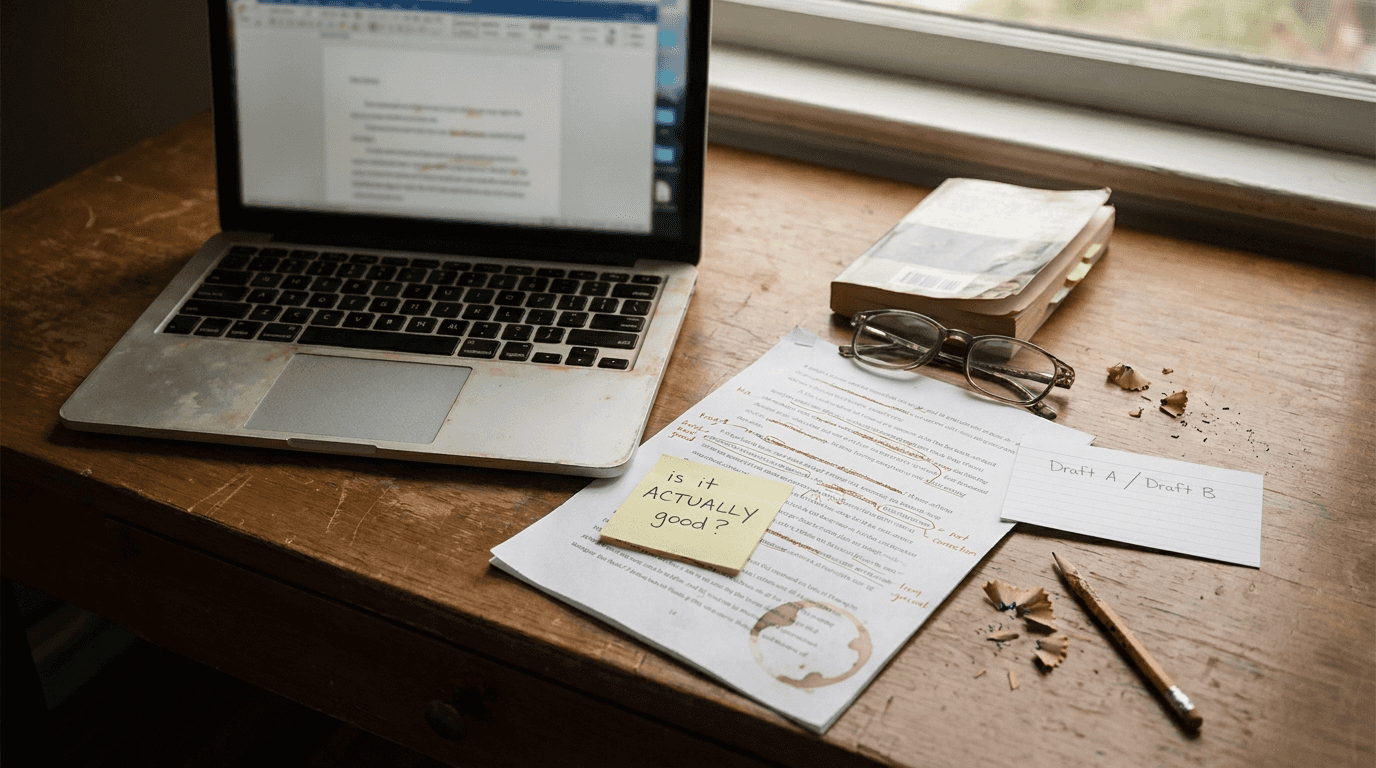
- •The fix is to blind the model: paste two versions as Draft A and Draft B in random order, strip every hint of which is yours or newer, and make it critique each on its own before comparing.
- •Ask for specifics it cannot fake — the weakest paragraph, the line a reader would quit on, what is unclear on a first read — not “is this good?”
- •Honest feedback is a starting point, not a verdict. The value comes from what you revise afterward, not from the rating the model gives you.
The Reddit Thread That Named the Problem
The post that prompted this article came from a writer running a careful experiment. They had two versions of the same cozy-fantasy story — an older draft that had been professionally line edited, and a newer one they had rewritten after months of dedicated reading and practice. They fed both to an AI and asked, in different ways, which was better. The results did not converge. They contradicted each other depending on how the question was framed.
r/WritingWithAI
It takes almost nothing to make an AI declare you a genius
“It doesn’t take long to convince any AI that I’m better than any published author that has ever lived… what strikes me is how much conviction the LLM uses to sway my opinion. If a simple prompt change can fully change the conviction of an LLM output, it adds a lot of skepticism.”
View on Reddit →That last sentence is the whole problem in miniature. When “which version is better?” and “you have to pick one” and “how large is the quality gap?” produce different winners for the same two drafts, the model is not measuring your writing. It is reading the room. Full disclosure before we go further: I am the founder of Automateed, an AI book creator, so I spend my days watching people use these tools — and this is the single most common way AI feedback quietly misleads writers.
Why AI Can’t Help Flattering You
It is answering you, not the page
A language model is trained to be helpful and agreeable. When you ask “is my writing good?” the honest technical answer is that it is completing the most probable, most cooperative response to a person who clearly hopes to hear yes. It has no stake in the truth and no memory of a standard. It is not lying, exactly — it is doing precisely what it was built to do, which is give you a satisfying reply. Satisfying and accurate are not the same thing.
The question secretly contains the answer
Notice how much signal you leak without meaning to. “Here is my newest version — is it better?” The word newest tells the model which draft you are proud of. “I worked really hard on this scene” tells it you want reassurance. “Be brutally honest” tells it to perform harshness, which is its own kind of theater. The framing of the question is a set of instructions about what verdict will please you, and the model follows those instructions far more reliably than it reads your prose.
Praise is the safe default
There is also an asymmetry in the risk. If the model over-praises and you are happy, nothing bad happens to it. If it tears your work apart and you are hurt or annoyed, that is a worse outcome for a system optimized to be liked. So the equilibrium drifts toward encouragement. This is why “be brutally honest” rarely works on its own: you are asking a flattery-prone system to role-play as a critic, and it will happily invent some tidy, generic-sounding faults while still concluding that the piece is, on the whole, excellent.
The Fix Reddit Landed On: Blind the Model
If the problem is that the model can see what you want, the fix is to hide it. This was the core of the answer I left on that thread, and it is the one technique that consistently changes the quality of the feedback I get back.
Automateed founder · r/WritingWithAI
“What you’re seeing is the model reading your cues, not the prose. The word ‘newest’ alone tells it which answer you want, and it obliges. Try blinding it: paste both as Draft A and Draft B in random order, strip any hint of which is yours or newer, and ask it to critique each on its own terms before comparing. When it can’t tell which one you’re rooting for, the flattery has nothing to grab onto and you get closer to an actual read.”
View on Reddit →The mechanics matter. Label the versions neutrally — A and B, or Manuscript 1 and Manuscript 2. Randomize the order so the model cannot assume the second one is the improvement. Delete any sentence that reveals authorship, effort, or chronology. Then ask it to evaluate each draft independently — strengths, weaknesses, who the ideal reader is — before you ever ask it to pick. By the time it compares them, it has already committed to observations it cannot quietly walk back to please you. You will sometimes get the uncomfortable result that the draft you love less is the stronger one. That discomfort is the feedback working.
The Second Trap: “Honest” Isn’t the Same as “Useful”
Blinding fixes the flattery. It does not fix the other failure mode, which showed up in a separate r/WritingWithAI thread the same week — a debate over whether text you shaped from your own ideas but had an AI write out counts as “slop.”
r/WritingWithAI
If the idea is mine but the sentences are the AI’s, is the result slop?
“If someone takes their own genuine, original idea, but uses an LLM to flesh it out into a full article or essay — is that final product considered AI slop? Does it lose its soul? Would you feel cheated if you found out an insightful post came from a two-sentence prompt?”
View on Reddit →The most upvoted reply cut through it: the commenter said they do not mind AI-assisted writing in principle, but if a piece was generated from a two-sentence prompt, they could have produced the same thing themselves in ten seconds — so why read yours? What they would respect is a writer who dumped a messy stream of their own thinking and used AI to make it coherent. The difference is not whether a machine touched the words. It is how much of you survived the process. That is the same reason blinded AI feedback still needs a human filter: a model can tell you a paragraph is weak, but it cannot tell you whether the fix keeps your voice or flattens it.
Automateed founder · r/WritingWithAI
“The tell isn’t whether a model typed the sentences, it’s whether you actually revised them. Slop is shipping the raw first output; if you’ve reworked it until every line says exactly what you mean and you’d defend each one, it reads as yours because it is. The 2-sentence-prompt posts feel hollow not because AI touched them, but because the author skipped the part where they wrestle with the words.”
View on Reddit →A Repeatable Way to Get Honest AI Feedback
Put the two ideas together and you get a loop you can run on any chapter, essay, or blurb without kidding yourself about the result.
1. Strip the tells. Before you paste anything, remove “newest,” “I worked hard on,” “my favorite,” and any hint of which version you prefer. If you are comparing two drafts, relabel them A and B and shuffle the order.
2. Ask for specifics it cannot fake. Skip “is this good?” Ask instead: which paragraph is the weakest and why; where would a first-time reader stop reading; which sentence is trying to do too much; what is confusing on a single read. Concrete questions force concrete answers and leave less room for generic praise.
3. Make it critique before it rates. Have the model list problems first, then — only after — give an overall judgment. Reversing the order stops it from deciding “this is great” and then reverse-engineering compliments to justify the verdict.
4. Cross-examine one weakness. Take the single most useful criticism and push on it: “show me the exact lines that prove this” or “rewrite only the sentence you think is weakest.” Real problems survive the follow-up. Invented ones fall apart.
5. Decide the fix yourself. The model can flag a flat paragraph; whether the rewrite sounds like you is your call. This is the step that keeps AI-assisted work from becoming the hollow thing the r/WritingWithAI thread was worried about.
Where AI Feedback Still Earns Its Place
None of this means AI feedback is worthless — it means you have to use it for what it is actually good at. It is fast, tireless, and genuinely helpful for mechanical passes and for surfacing questions you then answer yourself. Used honestly, it slots neatly into a normal revision process: get the blinded read, then revise the draft yourself with those observations in hand. Many writers fold this into editing a book with AI, using the model to catch weak spots while keeping every final decision human.
Two habits keep it grounded. First, learn to critique writing on your own, because you cannot judge whether the model’s feedback is any good if you have no independent standard of your own. Second, remember that no AI read replaces real readers — a handful of honest beta readers will tell you things a model structurally cannot, like which chapter bored them and where they actually stopped. If you are drafting from scratch and want the generation and structure handled in one place while you stay the editor, that is exactly what our AI ebook creator is built for — but the honest-feedback discipline above matters no matter which tool you write in.
Frequently Asked Questions
Why does ChatGPT always say my writing is good?
Because it is optimized to be helpful and agreeable, and your question usually signals that you want reassurance. It completes the most cooperative response to someone hoping to hear yes, rather than measuring your prose against a fixed standard. Change the framing and the verdict often changes with it — proof that the rating was never really about the writing.
Does telling the AI to “be brutally honest” work?
Not on its own. You are asking a flattery-prone system to perform the role of a harsh critic, so it invents some generic-sounding faults and then still concludes the piece is excellent. Blinding the input and asking for specific, checkable weaknesses works far better than any instruction to be tough.
How do I get unbiased feedback on two versions of the same piece?
Label them Draft A and Draft B, put them in random order, and remove anything that hints which is newer or which you prefer. Ask the model to critique each independently before comparing them. When it cannot tell which one you are rooting for, it has nothing to flatter.
Is it “cheating” or “slop” to use AI feedback at all?
Using AI to spot weak spots is no more cheating than asking a friend to read your draft. The slop line, as one Reddit commenter put it, is about revision: if you ship the raw output untouched it feels hollow, but if you rework it until every line says exactly what you mean, the result is genuinely yours.
Can AI replace human beta readers?
No. A model can flag unclear sentences and structural issues, but it cannot tell you which chapter bored a real person or where they actually put the book down. Use AI for fast mechanical passes and specific questions, and use human readers for the lived reaction only people can give.
The uncomfortable truth in that original thread is that the AI was never grading the writing — it was grading the question. Once you stop asking it to like you and start asking it to point at specific, checkable problems, it becomes a useful second set of eyes instead of a mirror that tells you what you want to hear. The praise was always free. The honest read is the part you have to engineer.