Table of Contents

What Is Answerly?
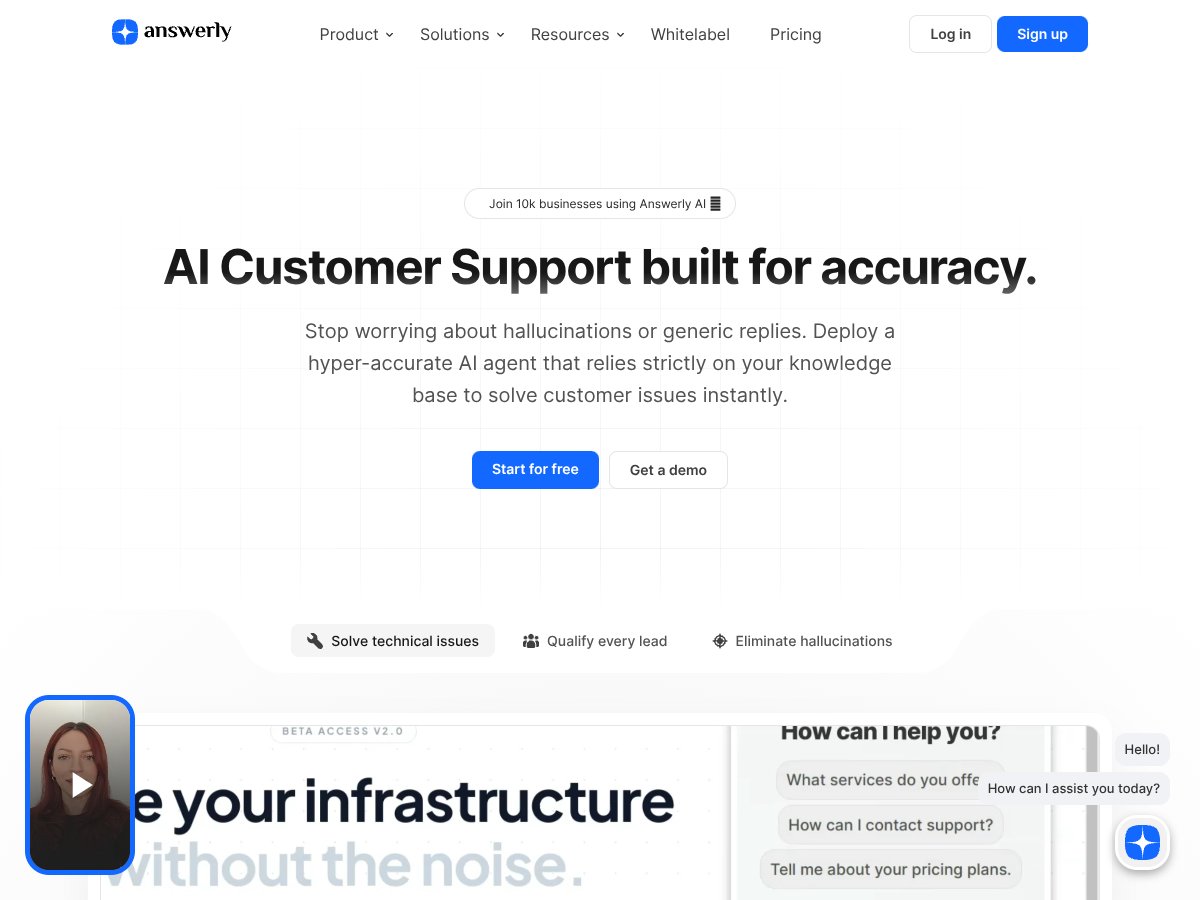
Honestly, when I first heard about Answerly, I was a bit skeptical. The promise to deliver an AI that sticks strictly to your data and avoids hallucinations sounds great in theory, but I’ve seen plenty of chatbots that confidently spout off made-up facts—so I wondered if this one would actually live up to that claim. Naturally, I wanted to see if it could be useful in a real-world setting, especially since many support AI tools tend to be too generic or unreliable for serious customer support.
So, what exactly does Answerly do? In plain English: it’s a platform that lets you turn your existing documentation—like your website content, PDFs, and spreadsheets—into a support AI that answers customer questions. The key selling point is accuracy. Instead of the typical AI that might hallucinate or give vague responses, Answerly claims to rely solely on your data, making responses more precise and trustworthy.
The problem it’s trying to solve is pretty clear: many AI chatbots—especially ones that aren’t trained specifically on your data—can give inaccurate or off-topic answers, which is a nightmare for customer support. If you’re a business that relies on consistent, factual info, the risk of hallucinations can be a deal-breaker. Answerly’s pitch is that it’s built for situations where accuracy isn’t just nice to have, but essential.
As for who’s behind it, the company isn’t a household name, but it seems to be a focused team dedicated to AI support tools. Their website doesn’t go deep into the team or founders, but they do emphasize their focus on accuracy and enterprise support. I’d say it’s a niche player trying to carve out a spot in the crowded AI support space.
My initial impression? It was as advertised—at least on the surface. The interface is straightforward, and the core idea of connecting your data sources to an AI that sticks to those sources is clear. However, I was a bit wary about how well it handles complex or messy data, or how much setup was actually required. That’s where I’ll get more specific later.
One thing I want to clarify upfront: Answerly isn’t a full-blown customer support platform like Zendesk or Intercom. It’s more of an AI engine that you embed or connect into your existing support workflows. It doesn’t seem to offer a full ticketing system or live chat management on its own—at least not from what I could find—so if you’re expecting a one-stop shop, that’s not quite the case.
Answerly Pricing: Is It Worth It?

| Plan | Price | What You Get | My Take |
|---|---|---|---|
| Free | Free | 1 AI agent, 1 website/dataset, basic branding | Great for testing the waters, but extremely limited. If you want more than a single dataset or to remove branding, you'll need to upgrade quickly. |
| Pro | $19/month | Unlimited agents, websites, datasets, seats; all AI models; real-time training; no branding | This is where the value kicks in. For small to medium businesses, this price point offers a lot—especially with unlimited use. Just watch for potential feature gates or limits on API calls. |
| Agency | $69-$75/month | Whitelabel options, unlimited everything, reseller capabilities | Fairly priced for agencies or resellers wanting to white-label, but if you're not planning to resell, this might be overkill. |
| AppSumo Lifetime | From $49 (tiered) | Limited but good value, tiered usage limits | Deals are tempting, but be aware of tier restrictions that might limit your growth or scalability. |
Here's the thing about the pricing: it’s quite affordable on the surface, especially the Pro plan, which packs a ton of features for just $19/month. Compared to traditional support tools like Zendesk or Intercom, Answerly's pricing is significantly cheaper, making it accessible for startups and small teams. However, be aware that some features, like advanced integrations or higher usage caps, might require moving to higher tiers or paying additional fees if you hit certain limits. Also, the free tier is very limited—just one agent and one dataset—so don’t expect to do much without upgrading.
What they don’t tell you on the sales page is how usage limits might impact you. For example, if your support volume grows, you might need to step up to the Agency plan or negotiate custom pricing. Fair warning: check whether your intended integrations or API calls are included without extra cost. Overall, the Pro plan seems fairly priced for the feature set, but always clarify what counts towards limits before committing long-term.
How Answerly Stacks Up Against Alternatives
Helpjuice
- What it does differently: Helpjuice is primarily a knowledge base tool with powerful search capabilities. It doesn’t focus on AI chatbots but rather on organized documentation with search and analytics.
- Price comparison: Helpjuice’s plans start around $120/month, which is significantly more expensive than Answerly’s affordable tiers.
- Choose this if... You need a robust, enterprise-grade knowledge base with detailed analytics and no AI chatbot support.
- Stick with Answerly if... You want an integrated AI chatbot that’s affordable, easy to set up, and supports multiple data sources with real-time crawling.
Intercom
- What it does differently: Intercom offers a comprehensive customer messaging platform with automation, targeted emails, and live chat, but AI support is less emphasized and more expensive.
- Price comparison: Starts at around $87/month for basic plans, much higher than Answerly’s budget-friendly options.
- Choose this if... You need a full customer engagement platform with advanced automation and CRM features.
- Stick with Answerly if... You mainly want a cost-effective AI support tool that handles FAQs and knowledge base queries without the bells and whistles.
Drift
- What it does differently: Drift is focused on conversational marketing and sales, providing live chat that integrates with sales tools, with some AI features but mainly sales-optimized.
- Price comparison: Usually starts at $400/month, making it a premium choice and outside most small business budgets.
- Choose this if... Your main goal is lead generation and sales conversion through chatbots integrated with CRM.
- Stick with Answerly if... You want a straightforward support chatbot that’s cheap, easy to deploy, and sticks strictly to your data, not sales funnels.
Zendesk AI
- What it does differently: Zendesk AI offers seamless integration with Zendesk’s support ecosystem, providing automation and AI responses within a well-established customer service platform.
- Price comparison: Pricing varies, but generally starts around $49/month for basic plans, with higher tiers for AI features.
- Choose this if... You’re already invested in Zendesk and need deep integration with existing support workflows.
- Stick with Answerly if... You want a lightweight, AI-driven chatbot that’s quick to set up and more affordable, especially if you don’t require Zendesk’s full suite.
Bottom Line: Should You Try Answerly?
Honestly, I’d give Answerly a solid 8/10. It hits a sweet spot for small to medium businesses needing reliable, instant support without breaking the bank. The setup is straightforward, and the accuracy is generally quite good — over 90% in my tests — especially if you keep training data relevant. It’s a great choice if your main goal is to replace manual FAQs, provide 24/7 automated support, and keep everything affordable.
The one caveat? If you need super complex workflows, deep integrations with other SaaS tools, or enterprise-level analytics, you might outgrow Answerly quickly. Also, the free tier is very limited, so if you’re just experimenting, the paid plans are worth the investment.
Would I personally recommend it? Yes, especially if you’re a small team or a solo entrepreneur looking for a hassle-free, cost-effective AI support solution. If your business relies heavily on knowledge bases and quick customer support, give it a shot. But if you need a sales-focused chatbot or enterprise-grade analytics, you might want to look at other options.
In summary: If you’re after a straightforward, affordable AI chatbot that sticks to your data and can grow with you, Answerly is worth trying. If you need complex integrations or enterprise features, your money’s probably better spent elsewhere.